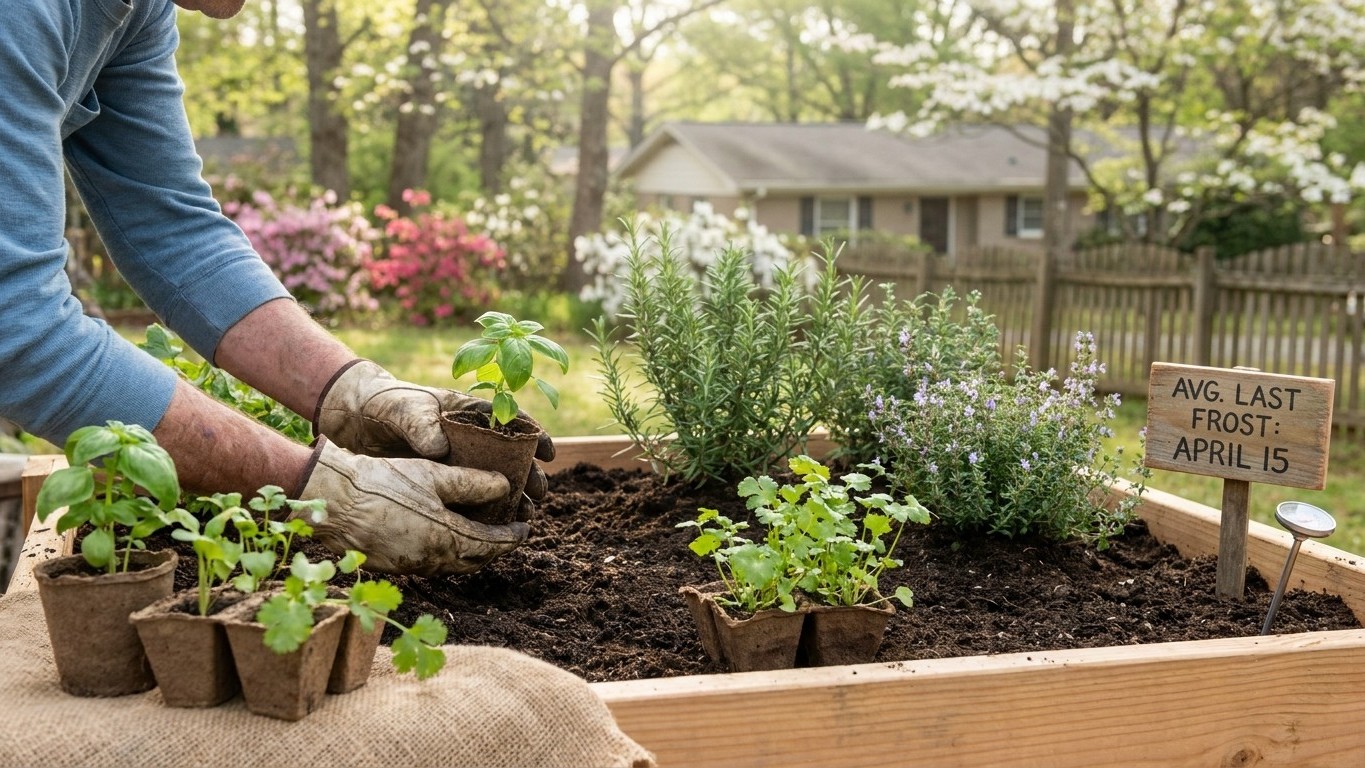

Most herbs go in the ground outdoors once the frost risk has passed, and for the Willamette Valley that means the window between March 6 and March 21 for cold-hardy herbs, with tender ones like basil waiting until nights stay reliably above 50°F, usually mid-May. East of the Cascades, that calendar shrinks fast, more on that below.
The short answer for Oregon
The last spring freeze at the reference station (Portland, west of the Cascades) falls somewhere between March 6 and March 21, based on NOAA’s 1991-2020 climate normals for the 32°F freeze probability band. That’s not a guaranteed date, it’s the window where freeze risk drops from roughly 70% to 30%. Perennial herbs that tolerate a light frost, like chives, thyme, oregano, and sage, can go into the ground at the start of that window without much drama. Anything that turns to mush at 32°F, basil chief among them, should wait until the risk has cleared entirely, which in practice means late April at the earliest and mid-May for a safer bet.
On the other end of the season, first fall frost arrives between November 11 and November 27, again a probability band rather than a fixed date. That gives Willamette Valley gardeners a frost-free stretch of roughly eight months for tender annual herbs, which is generous by national standards. Perennial herbs don’t care about that window the same way, what matters for them is winter survival, and the mean daily minimum of the coldest month at the reference station sits at 36.2°F. That’s a mild figure. It means most winter nights aren’t dropping into brutal territory, which is why rosemary and bay laurel can often ride out a Portland-area winter outdoors, something that would kill them in a harsher inland climate.
None of this applies statewide, and that’s the catch with any Oregon-wide planting calendar. The frost dates above come from a west-of-the-Cascades station. If you’re gardening in central or eastern Oregon, the frost dates above are specific to the Portland reference point, and stretching them across the Cascades would be guesswork dressed up as data.
What will not work here

Basil planted before mid-May is the single most common mistake in western Oregon herb gardens. The soil in a raised bed or exposed plot often still sits in the low 50s in late April, and basil seedlings set out into cold, damp soil don’t just stall, they sulk for weeks and then bolt early once summer heat finally shows up. The eight-month frost-free window looks like plenty of runway until you realize the first six weeks of it are too cold for a heat-loving annual to do anything useful.
Rosemary and other Mediterranean herbs fail here for a different reason: not the cold itself, but wet cold. A mean coldest-month minimum of 36.2°F is mild enough that the plant itself usually survives, but Willamette Valley winters pair that mild cold with weeks of soggy, poorly draining soil. Rosemary root rot in heavy clay is a far more common killer here than an actual freeze. Raised beds, containers, or a gravel-amended planting hole solve this; planting straight into unamended valley clay usually doesn’t end well by February.
The dry-summer trap
Basil, cilantro, and dill also struggle here for the opposite seasonal reason: Oregon’s rainfall drops off sharply once summer arrives, and a garden watered on a once-a-week schedule (a habit that works fine in a wetter climate) leaves these shallow-rooted herbs stressed by July. Cilantro in particular bolts fast under any combination of heat stress and inconsistent moisture, and a single missed watering during a warm August stretch can be the difference between a usable harvest and a plant that’s gone straight to seed.
None of these failures are about Oregon being a hard place to grow herbs. It’s a mild, forgiving climate overall. But the specific combination of a cool wet spring, a dry summer, and mild-but-damp winters punishes anyone who applies a generic national planting calendar without adjusting for those three quirks.
What changes across Oregon
Oregon’s USDA hardiness zone range runs from 4a to 9b, and that spread tells you this state does not have one herb-growing climate, it has several. Zone 4a describes conditions closer to Minnesota than to the mild Willamette Valley; zone 9b, found in sheltered pockets, allows things that would never survive an eastern Oregon winter. This range is built on the USDA Plant Hardiness Zone Map’s single variable, the average annual extreme minimum temperature, so it tells you about winter survival for perennial herbs specifically, not about growing-season length or summer heat.
A reader gardening in the Willamette Valley or along the coast, where the frost dates and coldest-month figures above actually apply, is working with a relatively long, mild season. A reader in the Cascades foothills or at any real elevation is dealing with a shorter frost-free window, colder winter lows, and a planting calendar that likely starts weeks later in spring and ends weeks earlier in fall. A reader in central or eastern Oregon’s high desert is in yet another climate again: bigger day-to-night temperature swings, drier air, and winter lows that can sit well below the Portland-based figures.
This page can’t tell an individual gardener which of those zones they’re in, and it shouldn’t try to guess from a general description like “near the coast” or “in the valley.” The USDA Plant Hardiness Zone Map lets you check by ZIP code, and that’s the right tool for pinning down where a specific garden falls inside Oregon’s 4a-9b range. What matters here is simply knowing that a five-zone spread exists, enough that a planting date that works in Eugene can be off by a month or more for a garden 3,000 feet higher up.
Where to check this for your own county
The state-level figures are a starting point, not a final answer, and the next step is the Oregon State University Extension Service. County offices under that umbrella publish planting guidance built from local trial data and local weather records, not statewide averages pulled from a single reference station.
Two things are worth looking for once there. First, a local or regional planting calendar, many Oregon State Extension county offices maintain their own vegetable and herb planting schedules calibrated to that county’s actual frost dates, which can run meaningfully earlier or later than the Portland-based window used above. Second, look for any variety trial results specific to herbs; Extension offices sometimes track which basil, cilantro, or perennial herb varieties have actually performed well in local trial gardens, which is more useful than a generic variety list because it reflects real local disease pressure, local soil, and local summer heat patterns.
A county recommendation beats a state one every time, for a simple reason: statewide figures come from one reference station’s climate normals, applied as a reasonable approximation across a state that, as the hardiness zone spread makes clear, doesn’t behave uniformly. Extension offices exist specifically to narrow that gap between statewide data and what actually happens in a particular county’s soil and microclimate. If the county office’s calendar disagrees with the dates given here, trust the county office, it’s working with a finer-grained picture than a single statewide climate normals station can provide.
Checking this against your own garden
Every date here is a probability drawn from decades of averages, and your own garden this year is a single data point that can run ahead of or behind those averages by weeks. Three simple, no-equipment checks tell you more about your specific plot than any calendar can.
Start with soil warmth by feel. Push a finger a couple of inches into the planting bed on a dry morning. If it feels cold and clammy rather than merely cool, tender herbs like basil are going to sit and sulk no matter what the calendar says, soil that hasn’t warmed is the actual limiting factor, not the date on a chart. A bed in full afternoon sun, especially one bordered by a south-facing wall or fence, often warms up a full one to two weeks ahead of an open, shaded plot just a short distance away.
Second, watch for the first true leaves on any herb seedlings you’ve started indoors or bought as starts. The rounded first leaves (cotyledons) aren’t a sign of anything; it’s the second set, the ones that actually look like the mature plant’s leaves, that tell you the seedling has enough root and leaf structure to handle transplant stress. Moving plants out before that stage, even into decent weather, tends to set them back.
Third, for anyone growing herbs that flower and go to seed, like dill or cilantro, an early flush of flowers arriving faster than expected is a signal of heat or moisture stress rather than a plant that’s simply ready. That’s your own garden telling you the summer dry-off discussed above has arrived early this particular year, which is worth more than any date printed on a page.
Some gardeners also time this by the Moon: when to plant herbs by the moon, as almanac tradition rather than fact.