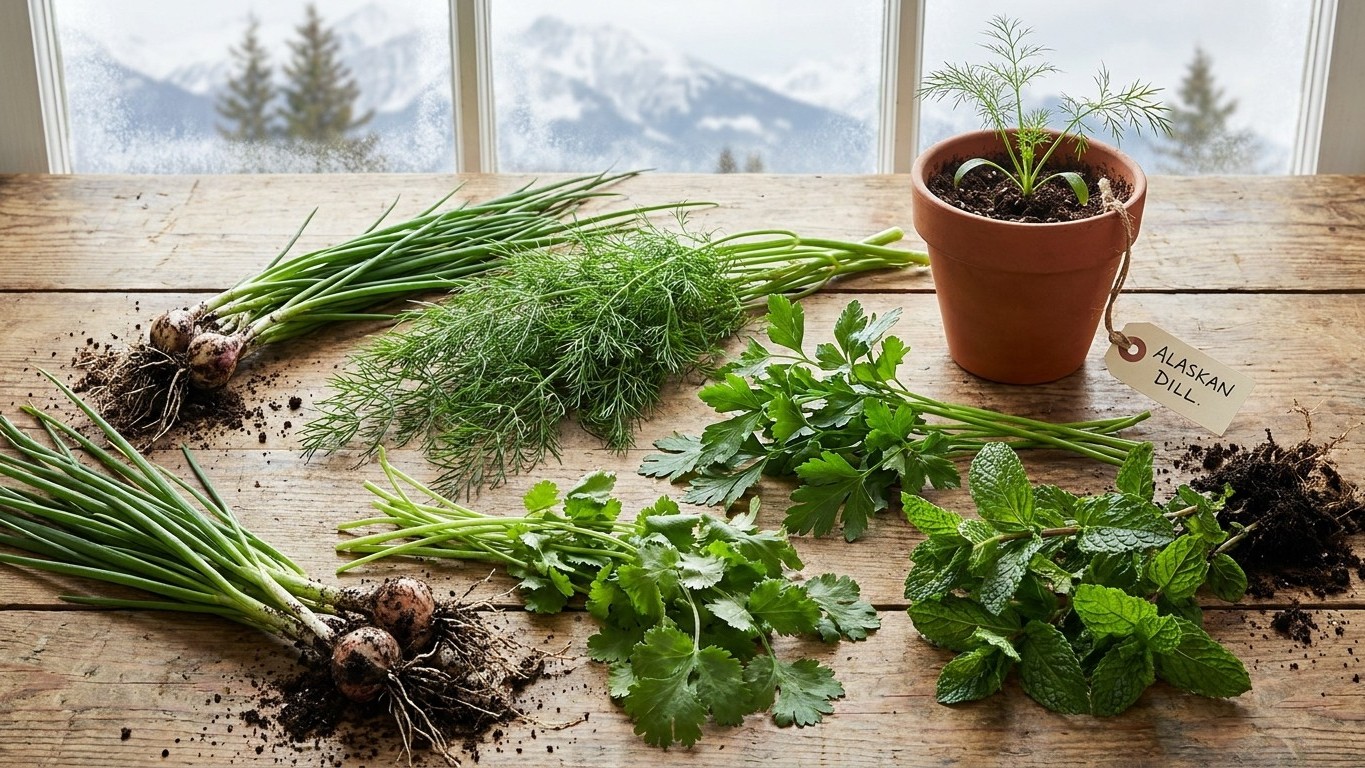

West Virginia’s mountain climate means no single answer fits the whole state: gardeners in the Eastern Panhandle valleys can grow heat-loving basil and rosemary through a full season, while those at higher elevations need to lean on cold-hardy perennials like chives, thyme, and oregano that shrug off a short, cool summer.
The short answer for West Virginia
Basil is the herb most people ask about first, and it works fine in the lower valleys, but the decision that actually matters here is season length, not any single crop. Charleston’s frost data (station USW00013866, NOAA NCEI 1991-2020 Climate Normals) puts the last spring freeze between April 9 and April 23, and the first fall freeze between October 18 and November 1. That gives the river-valley gardener roughly six months of frost-free growing, which is enough for nearly anything sold as an annual culinary herb.
The catch is that Charleston sits in a river valley, and the state’s hardiness zone range of 5a-7a (USDA Plant Hardiness Zone Map 2023) tells you that number does not travel uphill. Higher elevations freeze earlier in fall and later in spring, sometimes by weeks, which shortens that same growing window considerably. So the honest framing is by type, not by variety name.
Annual, heat-loving herbs (basil, cilantro that’s grown for leaf rather than seed, dill) do best where the frost-free stretch runs closer to the full six months implied by the Charleston data. Plant them after the last frost date has passed for your specific spot, not the state average.
Cold-hardy perennials (chives, thyme, sage, oregano, mint) are the safer bet almost everywhere in the state, because they tolerate the mean daily minimum of the coldest month, 26.1°F at the Charleston reference station, and they don’t need the full growing season to produce a usable harvest. These are the herbs worth planting once and letting come back, especially at elevation where the annual list gets riskier every year.
Biennials and slow perennials like parsley and lovage sit in between. Parsley germinates slowly and prefers cool soil, so it actually handles a shorter, cooler West Virginia season better than a long hot one.
Rosemary is the one plant that deserves a flag of its own: it is only marginally hardy at the cold end of this state’s range and often needs container culture or a sheltered wall in zone 5a conditions, while it can overwinter outdoors in the milder valley pockets closer to 7a.
What will not work here
The mean daily minimum of the coldest month sitting at 26.1°F is the number that eliminates candidates before you even plant them. That’s not a record cold snap; it’s the average low across the coldest month, which means any herb rated hardy only to zone 8 or warmer is functionally an annual here, full stop, unless it spends winter indoors. This rules out true bay laurel, lemongrass, and most Mediterranean shrub herbs sold as perennials in warmer catalogs.
A short growing season at elevation defeats the slowest herbs before they ever produce a usable harvest. Anything that needs 90-plus days from seed to first real leaf, planted from seed rather than transplant, is gambling against a fall frost that can arrive as early as October 18 even in the Charleston valley, and earlier still up in the mountains. Slow-to-establish herbs like French tarragon from seed, or lovage grown from a spring sowing, do much better started as transplants or divisions instead of direct-sown seed in a marginal zone.
Watering habits built for a drier climate also fail here. West Virginia’s mountain summers bring humid, muggy stretches, and herbs planted at the tight spacing recommended in drier-climate garden guides tend to develop fungal problems, Powdery Mildew on bee balm and mint relatives especially, when air can’t move between plants. The fix isn’t more water, it’s more room: wider spacing than the seed packet suggests, particularly for anything in the mint family.
The reverse mistake shows up too. Someone treating this state like a uniformly cool, wet region and skipping drainage prep will lose rosemary, lavender, and thyme to root rot over winter, not to cold. These three want soil that drains fast, and West Virginia’s clay-heavy valley soils don’t do that on their own. Raised beds or heavy grit amendment solve this more reliably than picking a “hardier” variety.
Finally, treating the April 9 to April 23 frost window as a green light everywhere in the state is the single most common error. That’s a Charleston-area probability band. A gardener at higher elevation who plants basil the second week of April, matching the valley date, is very likely planting into a frost that valley gardeners already escaped weeks earlier.
What changes across West Virginia
West Virginia’s hardiness zone range runs from 5a up to 7a, per the USDA Plant Hardiness Zone Map (2023 edition, built on 1991-2020 normals). That’s a two-zone spread inside one state, which in practical terms means a swing in average annual extreme minimum temperature of roughly 20 degrees between the coldest mountain pockets and the mildest river valleys. There is no single “West Virginia zone,” and any planting date or variety pick that ignores that spread is only right for part of the state.
The mechanism behind that spread is elevation and topography, not latitude. The state’s Allegheny Mountains and eastern highlands sit at elevations far above the Charleston river valley used for the frost data in this article, and cold air drains into the lower valleys at night, which sometimes makes low-lying valley floors surprisingly frost-prone even at modest elevation. This is why two gardens twenty miles apart can have meaningfully different frost dates.
What should a reader in the higher, colder parts of the state actually change? Push transplant dates for annual herbs later than the Charleston-based window implied here, favor perennial and cold-hardy herbs over heat-loving annuals in the overall garden mix, and treat marginally hardy perennials like rosemary and lavender as needing extra winter protection, mulch, a sheltered spot against a south-facing wall, or containers brought indoors, rather than assuming in-ground survival.
A reader in the milder valley pockets closer to zone 7a can generally follow the Charleston-based frost dates fairly closely, push their luck with a longer basil and cilantro succession, and expect better odds of rosemary and thyme overwintering outdoors without extra protection.
Neither of those readers should guess which zone applies to their own yard from this article. That’s a job for a map, not a paragraph.
Where to check this for your own county
The West Virginia University Extension Service is the state’s land-grant extension office, and it’s the source that actually knows your county’s frost dates, soil, and which herb varieties have been trialled locally rather than nationally.
Once there, two things are worth hunting down specifically. First, a county-level or regional planting calendar, if one is published, will give you frost dates tied to your actual elevation instead of the Charleston river-valley numbers used throughout this article. Second, look for any variety trial results or recommended-variety lists for herbs and vegetables; land-grant extensions frequently test cultivars in their own research plots and publish which basil, thyme, or parsley varieties actually performed well under local conditions, information no general state-level article can responsibly guess at.
It’s also worth calling or emailing your county extension office directly if the website doesn’t have a specific herb-growing bulletin. County agents deal with local soil and microclimate questions daily, and a five-minute conversation about your zip code will beat any average pulled from a single reference station miles away.
This article draws on statewide data, one river-valley weather station, and a hardiness zone range that spans two-thirds of the USDA scale. That’s useful for understanding the big picture and ruling out obviously wrong choices, like planting bay laurel outdoors year-round. It is not a substitute for a county-specific recommendation. A county extension answer, based on trials and frost records from your actual area, outranks a state-level answer every time they disagree, and this page is, deliberately, the state-level answer.
Checking this against your own garden
Every date in this article is a probability built from decades of weather records at one station in one river valley. Your own garden will tell you something more precise, if you know what to watch.
Soil warmth, checked by feel rather than a thermometer, is the first signal. Herb seeds like basil and cilantro germinate poorly in cold soil no matter what the calendar says. Dig down two or three inches with your hand in spring; if the soil feels only cool and slightly damp rather than cold, that’s a better cue for direct-sowing warm-season herbs than any date range, especially at elevation where spring can lag the valley by weeks.
Watch your perennial herbs for their first flush of new growth at the base, not just the calendar. Chives, thyme, oregano, and mint typically push new green shoots from the crown once the soil has genuinely warmed, and that flush is a more honest signal of your specific microclimate waking up than a printed frost date, because it accounts for your soil type, drainage, and exposure all at once.
Watch the first true leaves on any seedlings you started indoors or bought as transplants, distinct from the rounded seed leaves that appear first. Herbs that sit at the seed-leaf stage for an unusually long time in your garden, compared to how they behaved for a neighbor or in a catalog description, are telling you your spot runs cooler or shadier than average, information worth remembering the next time you’re tempted to trust a statewide date over what’s actually happening six inches from the ground.