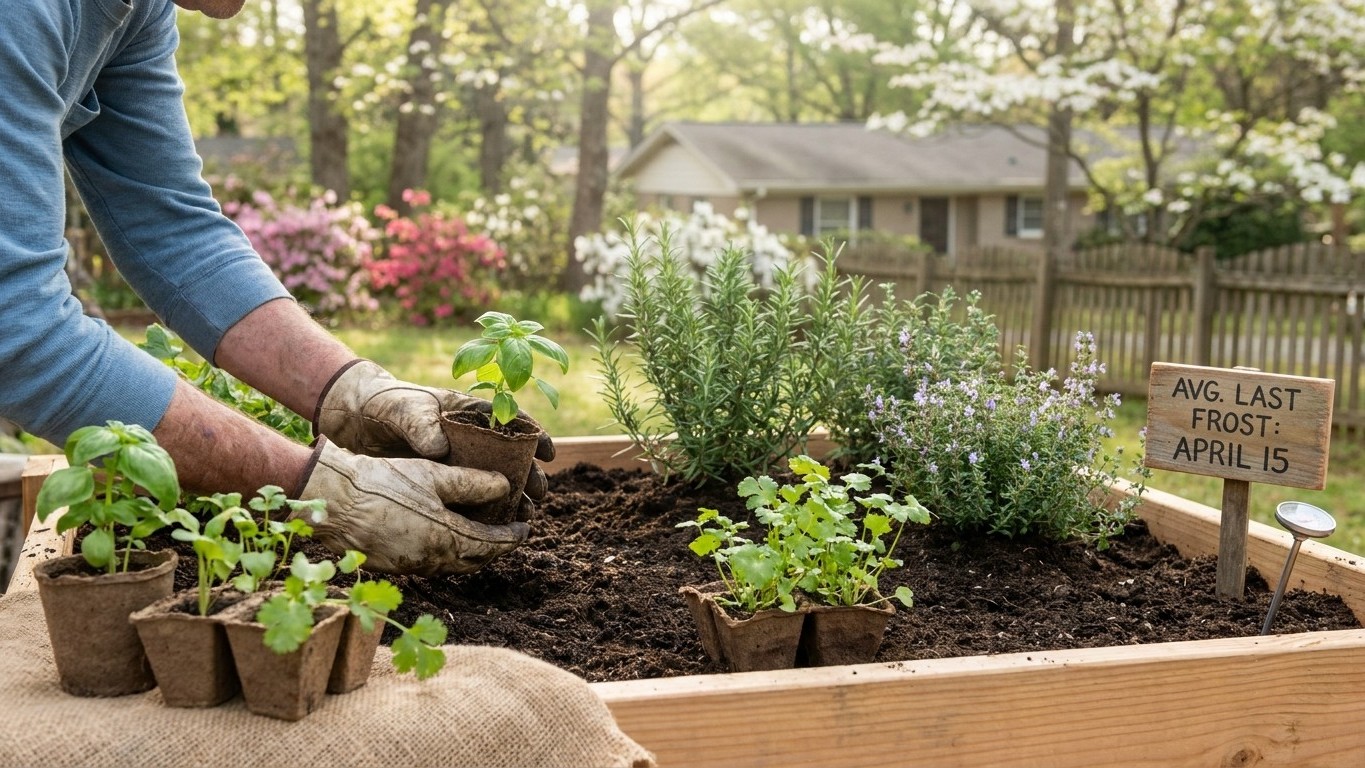

Plant herbs outdoors in West Virginia once the danger of frost has passed in your area, generally between April 9 and April 23 at lower elevations. That window comes from a 30-year weather record for the Charleston region, and it shifts earlier or later depending on where you sit in the state.
The short answer for West Virginia
Using the Charleston reference station (USW00013866), the National Weather Service’s 1991-2020 Climate Normals put the last spring freeze between April 9 and April 23. That’s a 30-70% probability band, not a hard cutoff. It means that even inside that window, there’s still a meaningful chance of a freeze on any given date, especially toward the earlier end. Gardeners who sow tender herbs like basil right on April 9 are gambling with roughly a coin-flip’s worth of risk. Waiting until closer to April 23 shrinks that risk considerably.
On the other end of the season, the first fall frost arrives between October 18 and November 1, using the same probability method. That gives Charleston-area growers a frost-free stretch of somewhere around six months, which is enough time to grow nearly every annual culinary herb from seed to harvest, including slower ones like parsley and cilantro that need a longer runway.
Perennial herbs are a separate question, and the number that matters most is the coldest month’s average daily minimum: 26.1°F. That’s not the record low for the winter, it’s the typical overnight low during the coldest stretch of an average year. Herbs rated hardy to USDA zone 6 or colder, think chives, thyme, oregano, sage, and most mints, should survive a Charleston-area winter outdoors without special protection. Anything rated only to zone 7 or 8 is working against that 26.1°F number every year, not just in an unusually cold one.
The USDA hardiness zone for the Charleston area sits at the warmer end of the state’s 5a-7a range. That range itself tells you something important before you even open a seed catalog: West Virginia is not one climate, it’s several stacked on top of each other by elevation. A recommendation dated to Charleston’s frost window will run early for a garden a few thousand feet higher up.
What will not work here
Tender perennial herbs marketed as easy, rosemary, bay laurel, lemongrass, and most lavender cultivars, are the first casualties of a West Virginia winter left unaddressed. Rosemary is typically rated hardy only to about 10°F in ideal conditions, and even the hardier cultivars struggle when the coldest month’s average low sits at 26.1°F for weeks at a stretch rather than dipping briefly. These plants either need to come indoors for winter or be treated as annuals, replaced every spring. Gardeners who plant them in the ground expecting a permanent herb bed are usually disappointed by the following March.
French tarragon is another one that struggles here, though for a different reason. It wants a long, cool establishment period and resents the humid, sometimes erratic summer weather that settles over the lower valleys. In a state where the frost-free season already runs a modest six months at lower elevations, and considerably less at altitude, tarragon’s slow start eats into time it doesn’t have to spare.
Close spacing is a quieter failure point. West Virginia’s river valleys and hollows trap humidity, and herbs like basil and bee balm planted shoulder to shoulder in that kind of air are set up for powdery mildew and fungal leaf spot by midsummer. The fix isn’t a different herb, it’s more air movement between plants than a seed packet’s spacing chart usually recommends for drier climates.
Sowing too early is the most common mistake tied directly to the frost data above. Basil in particular is damaged by temperatures well above actual freezing, sometimes showing blackened leaves after nights in the upper 30s. Planting it out on April 9, the early edge of the last-frost window, means betting against roughly a 30% chance of a freeze and an even higher chance of chilly nights that stunt the plant even without killing it outright. Cilantro sown too late into a hot early summer is the opposite problem: it bolts to seed within weeks once daytime temperatures climb, especially at the lower, warmer elevations near Charleston.
What changes across West Virginia
A hardiness range of 5a to 7a is not a rounding error, it’s a real split in what survives the winter outdoors. The difference between the coldest parts of zone 5a and the mildest parts of zone 7a is roughly 20°F in average annual extreme minimum temperature. That’s the gap between a mint bed that shrugs off winter and one that needs mulch just to come back reliably.
| Zone (USDA) | General elevation pattern | What it means for herbs |
|---|---|---|
| 7a (warmer end) | Lower river valleys, southern and western lowlands | Closer to Charleston’s frost dates; borderline perennials like some lavenders have a better shot outdoors |
| 6a-6b (middle) | Mid-elevation valleys and plateaus | Frost windows shift earlier in fall and later in spring than Charleston; standard zone 6 herbs (thyme, sage, chives) are the safe bet |
| 5a (coldest end) | Highest elevations, Allegheny Highlands | Shorter frost-free season overall; treat marginal perennials as annuals and start slow herbs indoors |
Charleston sits in a river valley, and that matters beyond the numbers already cited. Valley locations often see a milder microclimate than the surrounding hills because cold air can drain away and urban or riverine warmth lingers. A garden a thousand feet higher, even a short drive away, can see its first fall frost weeks earlier than the October 18 to November 1 window recorded at the reference station.
The practical shift for a reader in the northern counties or up in elevation: push the spring planting date later than Charleston’s April window suggests, and pull the fall cleanup earlier. For an exact zone assignment, use the interactive USDA Plant Hardiness Zone Map rather than guessing from a county name, since zone boundaries follow elevation contours more than political ones.
Where to check this for your own county
This page gives the state-level picture, built from one reference station and one hardiness zone range. Your county’s actual planting calendar, worked out from local weather stations and years of trial plots, will be more accurate than anything a statewide article can offer. West Virginia University Extension is the land-grant service responsible for that local data, and it’s worth going straight to the source at extension.wvu.edu.
Once there, look specifically for two things. First, a county-level planting calendar or frost date table, since WVU Extension offices maintain data broken down well below the statewide average cited here. Second, look for any list of herb or vegetable varieties that have been trialled at a county extension office or a nearby research farm. A variety that performs well in a university test plot two counties over tells you more about what will thrive in your soil and elevation than a generic seed catalog description ever will.
Extension offices also run local Master Gardener programs, and those volunteers often have hands-on notes about which herbs sail through a given county’s winters and which ones need coddling, information that rarely makes it into any published calendar at all. A phone call or a visit during office hours can surface details, like a particularly late microclimate frost pocket, that no map will show.
The rule of thumb worth remembering: a county recommendation always beats a state one. This page exists to give you the statewide baseline and explain why it varies. Your county extension office exists to narrow that baseline down to your actual backyard.
Checking this against your own garden
No calendar, state or county, replaces what your own garden is telling you in a given year, since frost dates are 30-year averages and any single spring can run early or late by weeks. Three simple checks, none requiring equipment, will tell you more than a printed date ever could.
Feel the soil itself, a few inches down, with a bare hand in the morning. Cold, damp soil that feels like it’s still holding winter means seeds will sit and rot rather than germinate, regardless of what the calendar says. Warm, crumbly soil that’s dried out slightly on the surface is the real signal that herb seeds like basil, dill, or cilantro will sprout within days rather than weeks.
Watch the first true leaves on anything you’ve already started indoors or direct-sown. The first set of leaves after the initial seed leaves (cotyledons) tells you the plant has moved past its most fragile stage and can handle a bit more cold or dry stress than a seedling still running on stored seed energy. That’s the point where hardening off outdoors becomes reasonable, even a week or two ahead of the average frost date.
For herbs that bolt in heat, cilantro especially, the first flush of tiny white flowers is an early warning rather than a happy milestone. Once you see that flush starting, the leaf harvest window is closing fast, and it’s a sign that this particular spot in your garden, whether from afternoon sun exposure or valley heat pooling, runs hotter than the county average. That’s information no calendar can give you, and it’s worth writing down for next year’s planting date.