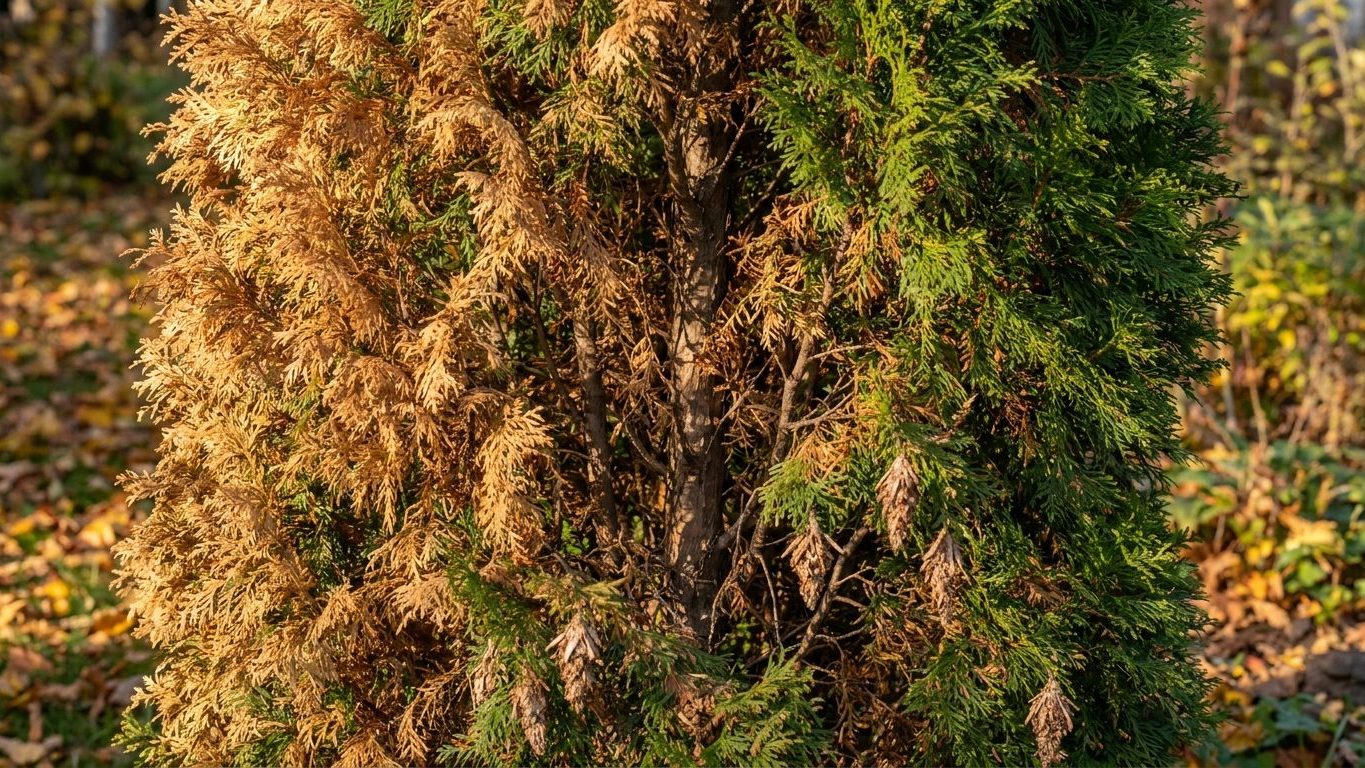

An arborvitae turning brown almost always fits one of four patterns, and the pattern tells you which one you’re facing: needles fading near the trunk in fall, a scorched side after winter, bags climbing the branches in summer, or the whole plant bronzing at once. The harder part of the answer is this: arborvitae doesn’t regrow from bare brown wood. What’s dead stays dead. What follows explains how to read the symptom before deciding what, if anything, can be saved.
Telling apart what makes arborvitae turning brown
Start with location, not with a guess at the cause. Where the brown sits on the plant, and when it showed up, narrows the list to one answer almost every time.
Reading the pattern
Inner needle drop shows up close to the trunk, in the oldest growth hidden under the outer canopy, and it spreads outward like a cascade rather than in a solid block. It arrives in September and October as the plant sheds needles that are two or three years old. This is normal. Winter burn looks different: it sits on the side of the plant facing the prevailing wind or the afternoon sun, and it appears after a hard winter, typically showing as uniform tan or rust-brown foliage on one exposed face while the sheltered side stays green. Bagworm damage starts low and works upward, or starts at one branch and spreads, and it comes with small cone-shaped bags, camouflaged with bits of foliage, hanging from twigs in midsummer. Whole-plant bronzing is the one that alarms people most: the entire shrub turns dull brown or bronze at once, usually during summer heat, and it points to root stress from drought, from overwatering, or from a root ball planted too deep at installation.
Running the scratch test
Before assuming the worst, scratch a small patch of bark on a brown twig with a fingernail. Bright green tissue underneath means that wood is still alive and the browning may be limited to needles. Dry, brown tissue underneath means that section is dead and won’t return, no matter what happens next.
| Cause | Where it shows | When it appears | Tell-tale sign |
|---|---|---|---|
| Normal needle drop | Inner canopy, near trunk | Fall | Gradual, cascading pattern |
| Winter burn | Windward or sun-facing side | Late winter into spring | Uniform scorch on one face |
| Bagworm | Bottom or one branch, spreading | Midsummer | Silk-and-foliage bags hanging |
| Root stress | Whole plant at once | Summer heat | Bronzing across entire shrub |
Will it come back?
No, not for tissue that’s already brown and dead. Arborvitae, Thuja occidentalis, doesn’t carry dormant buds under its bark the way many broadleaf shrubs do, so once a section loses its needles and the wood underneath dies back, there’s nothing left to push new growth from that spot. That’s the mechanism behind nearly every disappointing pruning job on this species: a hole cut into old wood stays a hole for the life of the plant.
Why arborvitae can’t resprout from old wood
Conifers vary a lot on this point. Some species hold latent buds along older stems and can be cut back hard, then fill back in over a few seasons. Arborvitae isn’t one of them. Its growth happens only at the tips of green shoots, so any cut made past the last bit of green foliage removes the plant’s only mechanism for refilling that space. Cutting into bare wood instead of stopping at the green leaves a gap that never closes, which is why the pruning window matters: late winter before new growth starts, or midsummer, timed by the reader’s own frost dates rather than a fixed date on a calendar. Check a local frost-date guide from the state extension service before cutting.
When browning isn’t permanent
The exception is browning limited to needles on an otherwise live twig. Normal fall needle drop reverses itself by nature, since it’s the plant discarding old foliage while new growth continues at the tips. Mild winter burn, where the scratch test shows green wood under scorched needles, often pushes new growth from the same branch the following spring, and the old brown needles eventually drop and get hidden by fresh foliage. Once the twig itself has died back and gone brittle and gray, though, that section is finished, and the surrounding green growth is the only part that will ever expand again.
Stopping the cause
Not every fix changes the outcome. Some causes respond to a change in care, others don’t respond to anything short of removal, and knowing which is which saves a season of wasted effort.
What responds to a fix
Root stress from drought or from a plant set too deep responds well to correction. Deep, infrequent watering during dry stretches, and checking that the root flare sits at or slightly above grade rather than buried, lets the plant rebuild over the following growing season since the species adds 6 to 9 inches of new growth a year once conditions stabilize. Bagworm is also manageable through sanitation: hand-picking and destroying the bags before the eggs hatch in spring is the step that actually breaks the cycle, since each overwintering bag holds hundreds of eggs. A county or state extension service can confirm the pest and time the removal window.
What doesn’t respond
Winter burn can be reduced going forward with windbreak placement or by planting away from a hedge’s most exposed line, but there’s no in-season treatment for burn that’s already happened. Normal needle drop needs no intervention at all. Spacing and airflow help general plant vigor and reduce fungal pressure over time, but they won’t undo damage that’s already brown. The one rule that applies across every cause: any pruning cut must stop inside the green growth and never pass into bare wood, because that cut can’t be undone, and it’s the single most common way a fixable problem becomes a permanent one.
What to do with what is left
The honest choice depends on how much of the plant is affected, not on wishful thinking about regrowth.
When replacement is the honest answer
- Live with it: if browning is limited to interior needle drop or a small side section, leave it. New growth at the tips, 6 to 9 inches a year, gradually hides it over a season or two.
- Renovate: not a real option for this species, since a hard cutback into old wood leaves a permanent gap rather than triggering fresh growth the way it might on a different hedge shrub.
- Interplant: where one plant in a hedge row is dead, removing just that one and setting a new plant of similar size in the gap works, though the newcomer lags behind its neighbors for a few years before the line looks even.
- Replace: where the majority of the plant, or most of a hedge, shows dead brown wood without live green tissue, full replacement is the realistic call. In a hedge meant to run 4 to 15 feet tall, waiting to replace only widens the height gap, since the rest of the row keeps adding 6 to 9 inches every year while a dead section adds nothing.
Common questions
Can I cut brown arborvitae branches back to encourage new growth?
No. Cutting past the green into bare wood removes the only tissue capable of producing new growth, and that section will not fill back in.
Is brown arborvitae dead or just dormant?
It depends on where the brown sits. Scratch the bark: green underneath means the wood is alive and may recover, brown and dry underneath means that section is gone for good.
How do I tell winter burn from bagworm damage?
Winter burn appears on one exposed side of the plant after a hard winter and looks like uniform scorch. Bagworm damage starts low or on one branch in midsummer and comes with small hanging bags made of silk and foliage.
Will fertilizer fix a browning arborvitae?
Rarely on its own. Bronzing usually traces back to watering or planting depth rather than a nutrient gap, so a soil test through the local extension service is a more useful first step than adding fertilizer.