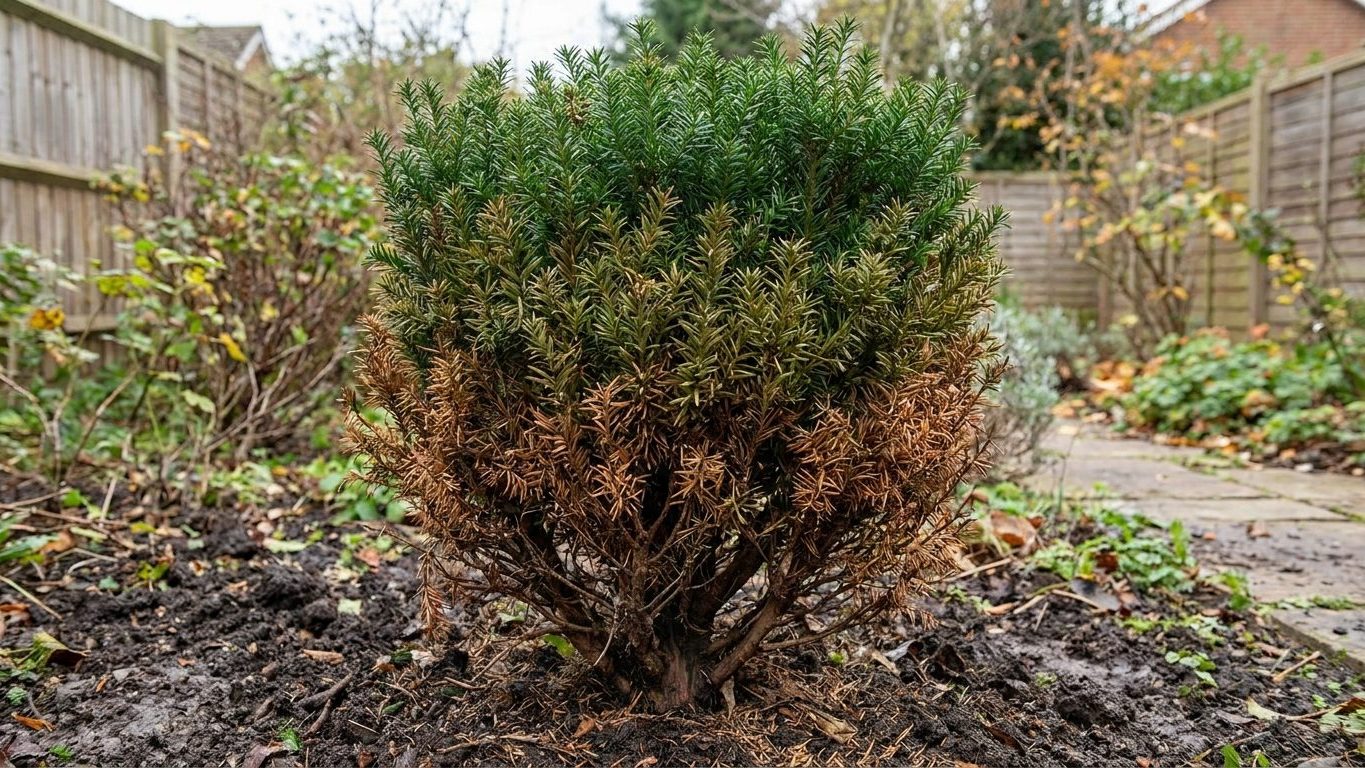

Yew turning brown almost always traces back to the roots, not the foliage. Root rot in soil that stays wet is the single most common cause of death in this plant, and it explains the majority of browning cases that don’t clear up on their own. The good news: yew regrows from old wood, so a browned section can often be cut back and refilled, provided the wet-soil problem gets fixed first.
Telling apart what makes yew turning brown
Where the brown starts and when it shows up tells you more than the color itself. Root rot begins low, near the base of the plant, and works upward through whole branches rather than scattered tips. It shows up in heavy, compacted, or poorly drained soil, often following a wet spring or a fall with heavy rain. The needles go dull olive before fading to a uniform brown, and entire limbs can go at once rather than just the outer growth.
Winter burn looks different. It hits the side of the plant facing prevailing wind or winter sun, and it shows up on exposed tips of the newest growth rather than spreading from the base. The color reads as bleached tan, not the olive-to-brown progression of root disease, and it doesn’t creep inward from the trunk. Mechanical damage, from a string trimmer nick or mulch piled against the stem, produces brown above a specific wound point with green tissue still healthy below it. Salt spray from a nearby road or walkway browns the side facing the pavement, usually worst in late winter. Spider mites, active in hot dry summers, leave a stippled bronze look across the whole plant along with fine webbing on close inspection.
| Cause | Where it starts | When it shows | What the tissue looks like |
|---|---|---|---|
| Root rot | Low, at the base, spreading up | After a wet spring or fall, in heavy soil | Dull olive fading to uniform brown, whole branches |
| Winter burn | Side facing wind or sun | Late winter to early spring | Bleached tan, worst on new growth tips |
| Mechanical damage | Above a wound or mulch line | Any season, tied to the injury | Brown above the wound, green below |
| Salt spray | Side facing road or walkway | Late winter | Brown with scorched-looking margins |
| Spider mites | Scattered, whole plant | Hot, dry summer | Stippled bronze, fine webbing |
If the pattern points to the base and the soil, run a simple check before doing anything else: dig a shovel’s depth, 6 to 8 inches, at the root flare and feel the soil and the roots. Soggy, dark, sour-smelling soil with mushy roots confirms rot. Firm soil with white, intact roots rules it out and sends you looking at wind exposure, a mower scar, or a salt source instead.
Will it come back?
Yes, in most cases. Yew carries dormant buds under the bark along the length of its stems, not just at the branch tips, so wood that has gone entirely brown can still push new growth once the cause is corrected. That’s a trait most conifers don’t share. Spruce, fir, and most arborvitae have no buds waiting in bare interior wood, so cutting into their dead zones leaves a permanent hole. Yew is the exception, which is exactly why it’s the standard answer for renovating an overgrown or storm-damaged hedge that a spruce hedge could never survive.
The mechanism matters because it tells you how to test a branch before committing to a cut. Scratch a small patch of bark with a thumbnail. Green, moist cambium underneath means the tissue is alive and will likely sprout once cut back into it. Dry, brittle, brown tissue all the way through means that section is dead and won’t respond to any pruning, however carefully timed.
There’s one case where this doesn’t apply, and it’s the same case that causes most of the browning in the first place. If root rot has advanced into the main roots, no amount of pruning on the top growth will fix a plant whose root system has already failed. Cutting back a browned branch on a plant with rotted roots is treating the wrong end of the problem, and it buys time at best.
The renovation cut itself has a window, and it’s a season, not a date. Extension horticulturists across the yew’s USDA zones 4 to 7 range point to late spring, after the new growth has hardened off, as the point when the plant has stored enough energy to push new buds without frost setting them back. Test each brown branch with a thumbnail scratch before you cut, and don’t assume a section is dead just because it looks that way from a distance.
Stopping the cause
Correcting the site responds to a short list of changes, and yew responds to some of these far more than others. Drainage tops the list: redirecting a downspout, regrading a low spot, or shutting off an irrigation zone that keeps the root area wet addresses the actual mechanism behind most browning. Spacing plants for air movement helps the soil surface and foliage dry faster after rain, which slows the fungal activity that thrives in still, damp conditions. Mulch piled against the trunk, sometimes called volcano mulching, holds moisture against the bark and invites both rot and the kind of girdling damage that shows up as brown above a single point. Pulling mulch back a few inches from the stem removes that risk without costing anything.
- Redirect water away from the root zone: downspouts, grading, irrigation timing
- Space plants and prune for airflow so foliage and soil surface dry between rains
- Keep mulch off the trunk itself, a few inches of bare space at the stem
- Guard against mower and trimmer contact at the base
- Block or redirect runoff carrying de-icing salt away from the root area
What doesn’t respond: soil corrections after root rot has already progressed into the main structural roots. At that stage, adjusting watering or improving drainage doesn’t reverse damage already done to tissue that’s dead. The most it can do is stop the rot from spreading further into roots that are still alive, which is worth doing but isn’t a fix. Leaving standing water at the root zone uncorrected is what turns a recoverable plant into a dead one, so this is the one change worth making even when the rest of the diagnosis is uncertain.
For identification beyond what’s visible by eye, particularly when a fungal or insect cause is suspected rather than a straightforward drainage problem, the state’s Cooperative Extension Service is the resource built for this. They can confirm a diagnosis from a sample and advise on any treatment decision specific to the local soil and climate, which a general guide can’t do.
What to do with what is left
Living with minor, one-sided browning is often the right call. A patch of winter burn on the windward side of a healthy plant will typically fill in on its own, since yew adds 6 to 12 inches of new growth a year once conditions are corrected. No cutting required, just patience through a growing season or two.
Where the damage is heavier but the roots check out sound, hard renovation is the realistic option, and it’s the one place yew has an advantage over most other hedge conifers. Cutting back into bare, old wood works because of those dormant buds under the bark. A hedge that runs 3 to 8 feet tall can be cut back hard in late spring after new growth hardens and expect to rebuild over several growing seasons at that same 6 to 12 inch annual pace. It’s slow, but it works, which isn’t true for most conifer hedges.
Interplanting suits a hedge run where one or two plants died out from root rot but the rest held. Removing the dead plant, correcting the wet spot that killed it, and setting in new stock lets the hedge line stay mostly intact while that one gap catches up over a few seasons.
Replacement is the honest answer once root rot has taken the majority of a plant, which happens often enough in ground that stays wet that it shouldn’t be treated as a rare outcome. Digging out a plant lost to root rot and fixing the drainage before replanting anything, yew or otherwise, is the step that actually prevents a repeat. Skipping that step and replanting into the same wet spot just restarts the same failure. Because all parts of yew are toxic to livestock and horses, dispose of removed material away from pastures and grazing areas rather than piling it at a fence line.
Common questions
Can I just cut the brown branches off the top and leave the rest?
Only if the branch tests alive underneath. Scratch the bark with a thumbnail first. Green cambium means it can be cut back to live wood and will likely sprout. Dry brown tissue all the way through won’t regrow no matter where you cut it.
How fast will a cut-back yew fill back in?
At the species’ typical 6 to 12 inches of growth a year, rebuilding a hedge cut back hard from a 3 to 8 foot height takes several growing seasons, not one. Correcting the original cause first is what makes that regrowth possible at all.
Is brown yew foliage dangerous to pets or livestock?
All parts of the yew plant are toxic to livestock and horses, and this doesn’t change based on whether the foliage is green or brown. Keep clippings and removed material away from grazing animals.
Should I water more if my yew is browning?
Not by default. Since root rot in wet ground is the leading cause of yew browning, adding water without confirming the soil is actually dry first tends to make the underlying problem worse rather than better. Check the root zone before deciding either way.