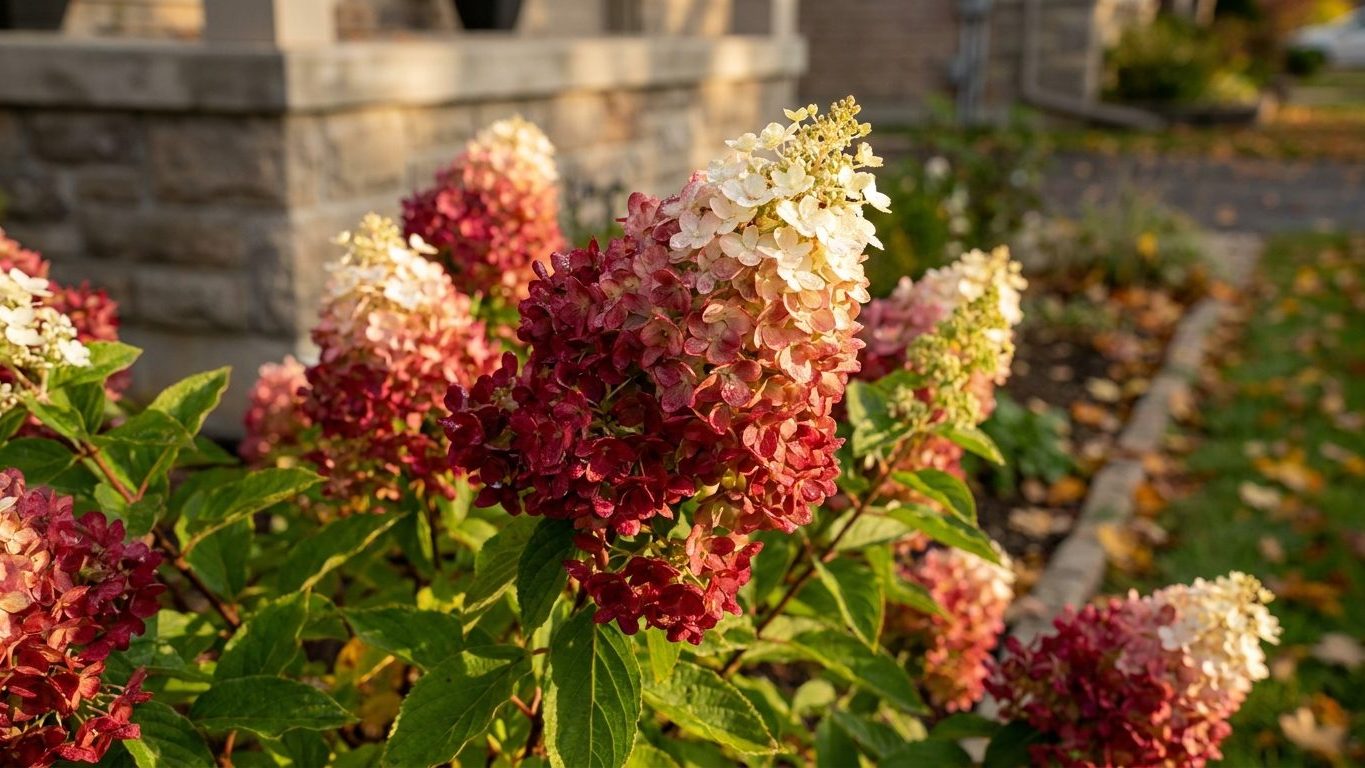

Fire Light is a panicle hydrangea (Hydrangea paniculata), hardy from USDA zone 3a to 8b, that opens white to cream on the current season’s growth and ages to a deep garnet red by late summer. Because it flowers on new wood rather than last year’s stems, a late spring frost never costs it a season’s blooms. The real question for most gardens is whether the zone and growing season match what this cultivar is built for.
What Fire Light actually is
Three facts decide whether Fire Light fits a given yard. First, the hardiness: USDA 3a-8b, according to the North Carolina Extension Gardener Plant Toolbox, wider cold tolerance than any bigleaf hydrangea offers. Second, the bloom mechanism: this cultivar flowers on the current season’s growth, not on wood that formed the previous year. That single fact changes how the plant is handled, because the flower buds aren’t sitting exposed on old stems all winter, waiting for a hard freeze or an ill-timed prune to wipe them out.
Third, the stems are rigid, distinct from panicle cultivars that arch and flop once the flower heads fill with rain. Rigid stems mean less staking and a cleaner look in a foundation planting.
What the record doesn’t give is a fixed height or width for this specific cultivar. The genus entry lists panicle hydrangeas generally at 8 to 25 feet, too wide a range to plan a border around, so treat any exact size claim for Fire Light with suspicion unless it comes from a nursery tag in hand.
What Fire Light is good for
Bigleaf and mountain hydrangeas shift between blue and pink depending on soil pH, but panicle types don’t play that game. Fire Light’s blooms don’t change color with pH at all. They open white to cream and age on their own clock, through pink, and finally to a deep red-garnet color as the season winds down. Anyone hoping to turn this variety blue with soil amendments is working against a trait that has nothing to do with aluminum availability.
That aging sequence is the plant’s main landscape value. A single shrub carries three or four color phases across one growing season, which is why panicle hydrangeas show up so often as a foundation planting or hedge line rather than a single specimen. The North Carolina source makes a useful point here: panicle hydrangeas are “a good substitute for the mop-head hydrangea in areas where that species is not winter hardy.” That’s a real answer for a gardener who has watched a bigleaf hydrangea die back every winter and never bloom, since the buds it needs never survive the cold. Fire Light doesn’t have that problem, because its buds form fresh each spring on new wood.
Cut flowers are the other common use for this type, though the source doesn’t document vase life or drying performance for this specific cultivar, so that’s left to the grower’s own experience.
Where it ripens in time, and where it is a gamble
Panicle hydrangeas flower on the current season’s growth, meaning the plant must push new stems, set buds, and open flowers all within one growing season, starting from whatever it was cut back to over winter. That’s a different clock from a bigleaf hydrangea, which is really just finishing a job started the previous summer. For Fire Light, the growing season itself is the constraint, not the survival of last year’s buds.
USDA zone 3a is about as cold as ornamental shrubs get, and it typically comes with a short frost-free window. That doesn’t stop Fire Light from surviving winter there, the hardiness rating covers that, but it does compress the stretch of warm weather the plant has to work with each year. In a zone 3a garden, that often means later blooms and a shorter display window compared with the same shrub two zones warmer.
At the other end, zone 8b is the warm edge of where the NC State source places this cultivar. That’s not a hard wall, hardiness zones are drawn from average winter minimum temperatures, not cutoffs, but it does mean anyone gardening warmer than 8b, in the Gulf Coast lowlands or peninsular Florida, is planting outside the documented comfort zone. The source doesn’t say Fire Light fails there; it simply doesn’t extend the rating that far, and that absence is worth taking seriously rather than assuming the plant will be fine everywhere.
Inside 3a to 8b, the arithmetic is simple: a longer, warmer growing season gives the plant more time to push wood, set buds, and finish its color progression before frost. A shorter season at the cold edge compresses that same sequence into fewer weeks.
The two ways a season goes wrong
A hardiness zone tells a gardener whether the plant survives winter. It says nothing about whether the growing season in between gives the plant enough to work with, and that’s where two different problems show up depending on which end of the range someone gardens in.
In the coldest zones Fire Light is rated for, the risk isn’t frost killing flower buds, since those form fresh each year on new growth rather than surviving winter on old wood the way a bigleaf hydrangea’s do. The risk instead is a short accumulated growing season: not enough warm weeks between the last spring frost and the first fall frost for the plant to grow, set buds, and open flowers before the display gets cut short. That’s a season-length problem, not a frost-survival problem, and the two get confused constantly.
At the warm edge, past zone 8b, the documented range simply stops, and the source doesn’t specify what limits the plant beyond that point, whether it’s heat stress, humidity-driven disease pressure, or something else. Given that the genus source names rust and bud blight as diseases specific to paniculata, and both favor warm, humid weather, it’s a reasonable inference that heat and moisture together matter more for Fire Light than cold ever does. The season-length problem in the north is the better-documented risk; the warm-zone limit is real but less specified in the source.
What it resists, and what it does not
The North Carolina Extension source names three diseases across the hydrangea genus broadly: leaf spot, bacterial wilt, and powdery mildew. For panicle hydrangeas specifically, it adds rust and bud blight. Fire Light isn’t singled out with its own resistance rating in the source, so none of these five should be assumed to be a non-issue just because the cultivar has other strengths. The source doesn’t grade any of them as “resistant” or “intermediate” for this variety, so the honest answer is that no documented resistance exists here, not that the plant is vulnerable to everything either.
On pests, the genus source lists aphids, scales, nematodes, and mites as “rarely a problem,” a reassuring line but a general one, not specific to Fire Light. Deer are the one pest named with a caution attached: the same source lists deer both as a documented damage agent and, elsewhere on the genus page, under a general resistance-to-challenges heading. Those two entries contradict each other, and the honest way to report it is to say what’s actually observed: hydrangeas get browsed by deer. Calling any hydrangea deer-resistant on the strength of that source would overstate the record.
Exact disease and pest management steps depend on climate and season, and belong on a state-specific page rather than a national one. What matters here is knowing which five diseases and which pests are on the list before planting.
Growing it without the usual mistakes
Fire Light flowers on the current season’s growth, which should shape every other decision made about this plant. Because next year’s flowers don’t exist yet on any part of the shrub in late winter, it can be cut back hard while dormant without losing a single bloom, a real advantage over old-wood bloomers like bigleaf hydrangea, where a mistimed cut removes flowers for the entire year. The exact month for that cut depends on climate zone and belongs on a state-level page, but the underlying rule holds nationally: prune while dormant, before new growth starts, and the plant rewards it with vigorous new stems and a full flush of flowers.
Root systems on paniculata are shallow, the same trait bigleaf hydrangea shares, so a two- to three-inch mulch ring does more for this plant than almost any other single input. Mulch buffers soil temperature swings and holds moisture without the plant needing deep roots to find it. Soil itself is forgiving: clay, loam, or sand all work, and pH runs from acidic to alkaline without changing bloom color the way it would on a bigleaf hydrangea. Occasional wet spots are tolerated too, though good drainage overall is still the safer default.
Feeding should taper off by late summer regardless of zone, since pushing tender new growth right before the season ends leaves that growth unripened and vulnerable to early cold. And when the stems finally get cut back for winter, leaving cut sections 12 to 24 inches tall rather than clearing everything to the ground gives native bees a place to nest through the cold months, a detail the extension source flags specifically for hollow-stemmed shrubs like this one.
Common questions
Does Fire Light hydrangea change color based on soil pH?
No. That trait belongs to bigleaf and mountain hydrangeas only. Fire Light ages from white to cream to pink to garnet red on its own schedule, regardless of soil acidity or alkalinity.
Can a late spring frost kill this year’s flowers?
No, because Fire Light blooms on the current season’s growth rather than on stems that overwintered. The flower buds haven’t formed yet when a late frost would typically hit, unlike bigleaf hydrangea, which stores its buds on old wood all winter.
Is Fire Light hydrangea deer resistant?
The source that documents this cultivar lists deer as a pest that damages hydrangeas, while separately mentioning general resistance to challenges for the genus. Those two statements conflict, so the safer assumption is that deer will browse it given the chance, not that it’s protected.
What’s the biggest mistake people make growing this variety?
Treating it like a bigleaf hydrangea and either being afraid to prune it hard in winter, or pruning it at the wrong time for their zone. Because Fire Light blooms on new wood, a dormant hard cutback doesn’t cost flowers the way it would on an old-wood bloomer, but the exact timing still depends on local climate.