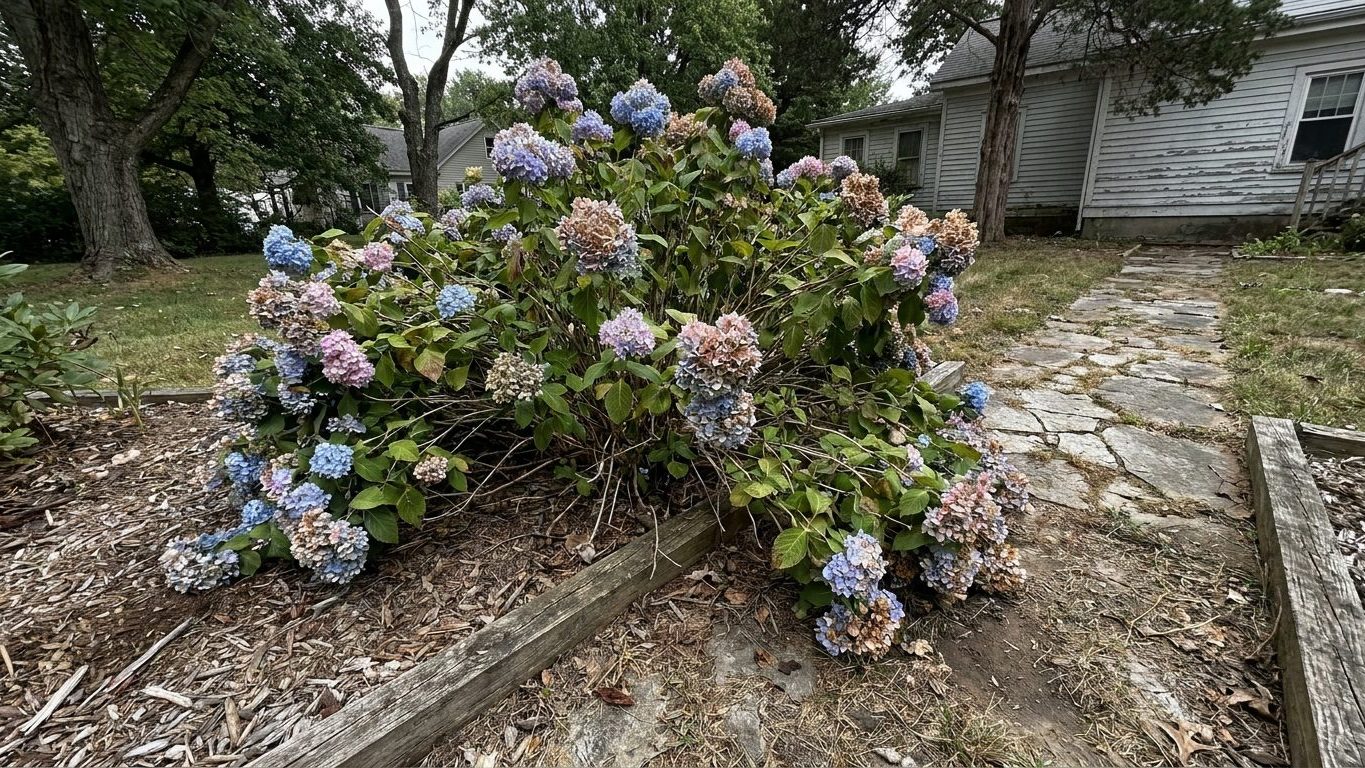

Endless Summer is a bigleaf hydrangea that flowers on last year’s wood and on the current season’s growth, which is why a late frost rarely wipes out the whole bloom the way it does on older bigleaf cultivars. It’s rated for USDA zones 6a through 11b, reaches 3 to 6 feet tall and wide, and turns blue or pink depending on soil pH. Whether it blooms reliably where you garden depends less on the calendar than on how cold your winter actually gets.
What Endless Summer actually is
According to the North Carolina Extension Gardener Plant Toolbox, Endless Summer belongs to the bigleaf group of hydrangeas (Hydrangea macrophylla), rated for USDA zones 6a through 11b. That figure matters more than any other on this page, because it sets the floor below which the plant isn’t expected to survive a normal winter outdoors.
What sets this cultivar apart from a standard bigleaf hydrangea is where it puts its flower buds. Most bigleaf types bloom only on wood grown the previous summer, so buds already exist by fall and sit exposed all winter. Endless Summer adds a second source: it also flowers on the current season’s new growth. In practice that means two waves of bloom instead of one, and a plant not entirely dependent on old wood making it through winter unscathed.
Its growth rate is medium-to-rapid, typical of bigleaf and panicle hydrangeas, and its maintenance need is rated low. The roots are shallow, which is why mulch is standard care rather than an optional extra. Site it in dappled sun or partial to deep shade, and keep it out of direct afternoon sun. Propagation is by stem cutting or layering.
What Endless Summer is good for
The main garden problem it solves is insurance against a single bad frost. On a bigleaf hydrangea that blooms only on old wood, one late cold snap after buds have formed can erase the entire season’s flowers. Because Endless Summer also sets buds on new growth made after winter, a damaging frost still leaves a second chance: the plant can push new stems and bloom on those later in the season.
It’s also a working example of pH-driven color. Below about pH 5.5 the flowers run blue; above about pH 6.5 they run pink; in between, expect purple. Aluminum sulfate acidifies soil and pushes color toward blue, while lime raises pH and pushes toward pink. This color response is specific to bigleaf and mountain hydrangeas, panicle, smooth, oakleaf and climbing types don’t respond to soil pH at all.
There’s a safety side that cuts the other way. Bigleaf hydrangea is documented as toxic if eaten in quantity: nausea, stomach pain, vomiting and sweating, caused by cyanogenic compounds called hydracyanosides present in the bark, flowers, leaves and stems. The same risk applies to cats, dogs and horses. That doesn’t make normal garden use dangerous, but it’s not the shrub to plant right at the edge of a dog run or a spot where kids graze on anything green.
It earns its keep in partial-shade borders and foundation plantings under morning sun, exactly the conditions the source lists as ideal, and as a low-maintenance color feature for gardeners willing to manage soil pH.
Where it ripens in time, and where it is a gamble
The honest way to read “hardy in zones 6a through 11b” is as a range with a soft edge on each end, not a hard guarantee across the whole span. What changes is how much old-wood bloom survives winter intact, and how much of the season’s color depends on the new-wood safety net instead.
| Zone band | What typically happens to old-wood buds | What the remontant habit adds |
|---|---|---|
| 6a-6b (cold edge) | Winter dieback is common; buds and sometimes stems can be lost to hard freezes | New growth after winter still carries buds, so bloom is reduced but usually not eliminated |
| 7a-8b | Old wood generally survives; buds exposed to occasional late frost | Full two-wave bloom is most likely here |
| 9a-9b | Winter cold rarely the limiting factor | Heat and sun exposure become the bigger variable |
| 10a-11b (warm edge) | Frost risk minimal to none | Afternoon sun protection matters more than bloom timing |
In the middle band, 7a through 8b, the plant does what it was bred to do with the least drama: old wood carries through winter, buds open on schedule, and the new-wood flush simply extends the display. That’s the sweet spot for this cultivar.
At the cold edge, 6a and 6b, a genuinely cold winter can knock out a lot of old-wood buds even though the plant survives. The remontant trait doesn’t undo that damage, it just means the shrub isn’t blank for the year, it leafs out, grows new stems, and those stems carry whatever bloom the season delivers. Expect a lighter, later display in a hard winter and a fuller one in a mild one.
Below zone 6a, bigleaf hydrangea isn’t rated as reliably hardy at all. For colder gardens the same source points to panicle hydrangea, rated down to zone 3a, describing it as “a good substitute for the mop-head hydrangea in areas where that species is not winter hardy.” That’s a different plant with a different bloom mechanism (flowers only on current-season growth, so it can be cut back hard every winter with no bud loss), not a substitute cultivar of Endless Summer itself. The exact zone verdict for your county depends on your state’s climate data.
The two ways a season goes wrong
The cold failure is the one this cultivar was specifically bred against: buds form the previous summer, so a late frost after they’ve set, or a spring prune that removes them, takes the flowers with it. That’s the dominant risk for bigleaf hydrangea generally, and it’s why Endless Summer’s second bloom source exists at all.
The heat failure is real but less severe here. The source’s concrete instruction is to protect the plant from afternoon sun and keep it in dappled or partial shade. No specific temperature threshold for halted flower development is documented; the practical, source-backed response is simply shade in the hottest part of the day.
For Endless Summer specifically, frost timing is the bigger lever to manage. The heat side is mostly solved by where you plant it in the first place.
What it resists, and what it does not
The source names three diseases at the genus level: leaf spot, bacterial wilt and powdery mildew. It assigns no resistance grade to Endless Summer against any of them, so the safe assumption is that this cultivar carries no built-in protection, and normal disease-watching (spacing for airflow, avoiding wet foliage at night) is the only defense on record.
On pests, the picture is milder: aphids, scales, nematodes and mites are listed as “rarely a problem” for the genus. Deer are a different story, the genus page names deer as a damage agent in one place and lists the plant under general “resistance to challenges” in another, a contradiction the source doesn’t resolve. The safer statement is that hydrangeas including this cultivar do get browsed by deer in practice.
- Diseases named for this type: leaf spot, bacterial wilt, powdery mildew (no resistance grade given)
- Pests named for the genus: aphids, scales, nematodes, mites, rarely a problem
- Deer: documented as browsing the plant despite a conflicting genus-level resistance note
One more risk belongs here: bigleaf hydrangea is documented as toxic if eaten in quantity, with symptoms including nausea, vomiting and sweating in people, and the same danger for cats, dogs and horses. It’s low-probability in ordinary garden use, but worth knowing before siting the plant near pets or unsupervised kids.
Growing it without the usual mistakes
Because Endless Summer flowers on both old wood and new growth, it needs a different care rhythm than hydrangeas that bloom only on new wood, like panicle or smooth types, which can be cut back hard every winter with no bud loss. Endless Summer can’t be treated that way: a heavy winter or spring cutback removes buds already set on old wood. The rule for this type is to prune right after flowering and before August 1, giving the plant the rest of the season to set next year’s old-wood buds before frost.
Spacing follows from its size: 3 to 6 feet tall and wide means no staking needed, but it does need room, planted 3 to 6 feet from its neighbors for light and airflow.
Feeding is where a color goal can quietly get undone. High-phosphorus fertilizer locks up aluminum in the soil, and available aluminum is what actually produces blue flowers, not soil pH alone. A gardener chasing blue blooms who feeds with a high-phosphorus product will watch the color drift toward pink regardless of soil acidity.
Because the roots are shallow, mulch isn’t cosmetic, it protects roots close to the surface from both summer heat and winter cold. And when cutting the plant back at all, leave some stems standing at 12 to 24 inches rather than clearing everything to the ground; native bees use dead hollow hydrangea stems to nest and need them to stay put until they naturally break down.
Common questions
Does Endless Summer hydrangea bloom the first year after planting?
It can produce some flowers on new growth the first season, since it blooms on current-season wood as well as old wood, but a young plant without an established framework of old wood typically shows a lighter display than it will once established.
Will Endless Summer hydrangea flowers turn blue automatically?
No. Color follows soil pH: blue below about pH 5.5, pink above about pH 6.5, purple in between. Aluminum sulfate pushes toward blue; lime pushes toward pink. This response is specific to bigleaf and mountain hydrangeas, and Endless Summer follows it.
Is Endless Summer hydrangea toxic to pets?
Yes, if eaten in quantity. Bigleaf hydrangea contains hydracyanosides in its bark, flowers, leaves and stems, and can cause nausea, stomach pain, vomiting and sweating in people, cats, dogs and horses.
Can Endless Summer hydrangea survive colder than zone 6a?
Not reliably, based on the documented hardiness range of 6a through 11b for its type. Gardeners in colder zones are better served by panicle hydrangea, described as a substitute for mop-head types where they aren’t winter hardy, hardy down to zone 3a. Check your state’s zone data for a firm local answer.