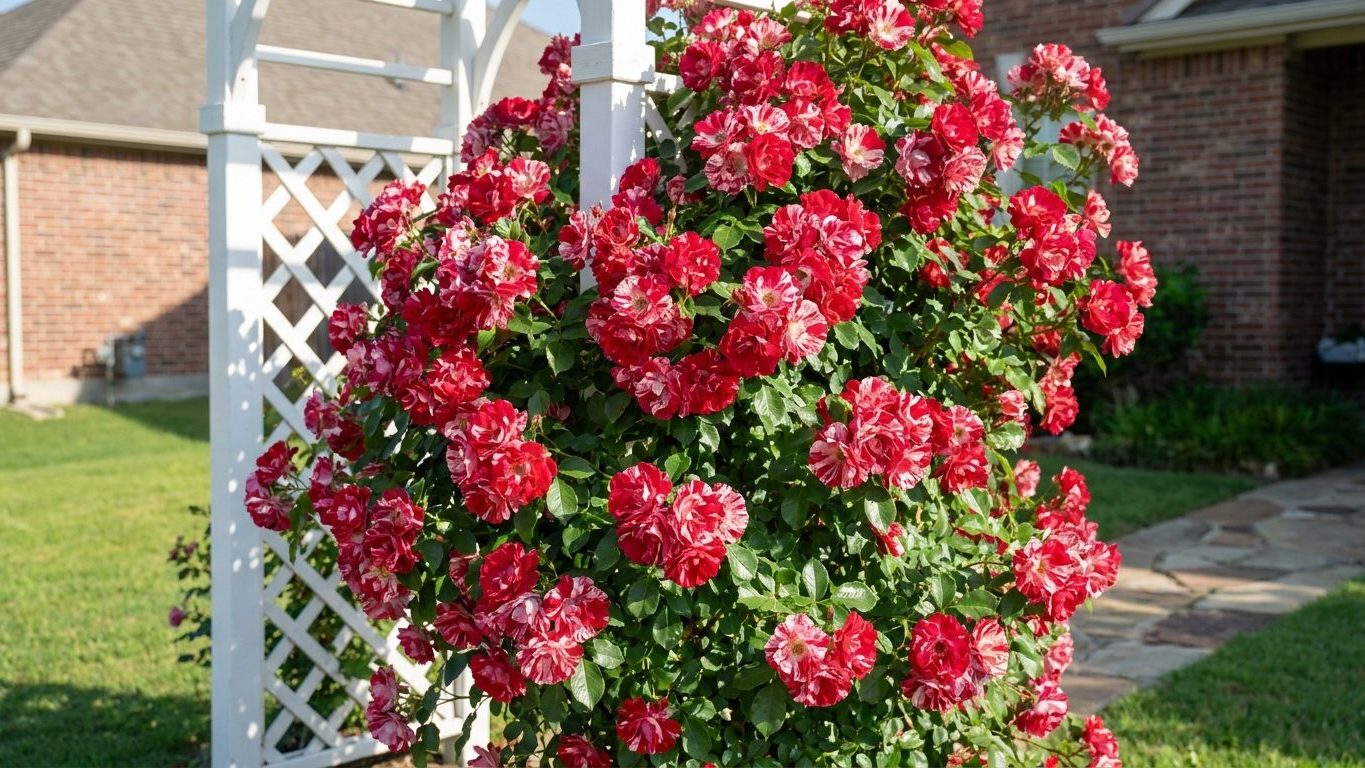

Fourth of July is a climbing rose bred by Weeks Roses (code name ‘WEKroalt’) that covers a trellis, arbor, or fence with red-and-white blooms carrying an apple scent. It’s hardy across USDA zones 5a through 11b, but that wide range hides real differences in how much winter care the plant needs depending on where it’s planted.
What Fourth of July actually is
Fourth of July belongs to the climbing group, one of at least eleven main groups the North Carolina Extension Gardener Plant Toolbox catalogues for the genus Rosa, alongside hybrid tea, floribunda, grandiflora, shrub, rambling, miniature, ground cover, old garden, rugosa, hybrid musk, and polyantha. Its blooms mix red and white, and the fragrance falls into the fruity family, one of five scent groups the source recognizes for roses.
The fact that actually decides how this rose gets pruned: it flowers on new wood, produced on lateral shoots that break from a permanent framework of canes trained along whatever it’s climbing. That puts it in a different camp from a rambler, which flowers on old wood and gets cut back right after its one spring flush. On Fourth of July, the framework stays, and the laterals coming off it get shortened each year. Timing depends on hardiness zone, not on a fixed date, so it belongs on the page for the reader’s own state rather than here.
Across the genus, the toolbox lists a size range of 1 to 8 feet tall and 1 to 6 feet wide depending on cultivar, growth rate medium, and maintenance load rated high. Flower parts on any rose come in multiples of five, with petal counts running from 5 (single) past 20 (double), though the exact count for this cultivar isn’t broken out on the source page cited here.
What Fourth of July is good for
Because it flowers on new wood off a standing framework rather than on wood grown the year before, Fourth of July produces repeat flushes through the growing season instead of one big spring show and then nothing. That’s why gardeners plant a climber like this on a fence or arbor they want in color for months: new laterals keep breaking and blooming as long as the plant stays fed and pruned correctly.
The apple fragrance puts it in the fruity scent group, a reason to train it near a porch, gate, or bench rather than a back property line. Cut for a vase, timing matters: a bud should be cut once the sepals have folded back and the first one or two petals are starting to unfurl. Cut tighter than that and the bud often never opens indoors.
Full sun (6 or more hours of direct light a day) isn’t a suggestion so much as a mechanism. The new laterals that carry this season’s blooms are built on the sugar the leaves produce, and a climber trained on the shaded side of a fence won’t push enough new growth to flower well, regardless of how established its framework is.
Soil-wise, clay or loam both work, and the documented pH range runs from acid (below 6.0) through neutral (6.0 to 8.0), wide enough that most garden soil qualifies without amendment. The one condition worth watching is strongly alkaline ground, above roughly 7.5, where iron chlorosis has been documented in roses generally.
Letting some spent blooms stay on the plant instead of deadheading produces hips, an edible accessory fruit that turns from green to red in fall, adding a second season of color and a food source unrelated to the flowers.
Where it ripens in time, and where it is a gamble
A hardiness range of zones 5a through 11b covers most of the continental country, but the number that actually separates an easy planting from a demanding one is what happens to the permanent framework over winter, not whether the rose survives at all. Because Fourth of July flowers on new laterals growing off that framework, losing the framework to cold doesn’t just damage the plant, it delays the whole season’s bloom while the rose regrows canes that won’t carry flowers until they mature.
| Zone band | Winter risk to the framework | What that means for bloom |
|---|---|---|
| 5a to 5b | Real risk of cane dieback in a hard winter | Spring flowering delayed while lost framework regrows |
| 6a to 7b | Framework generally hardy, protection worthwhile in a severe winter | Reliable, close to on-schedule flowering most years |
| 8a to 9b | Cold rarely damages the framework | Bloom timing steady; disease pressure becomes the bigger issue |
| 10a to 11b | No frost risk to the framework | Full sun and airflow, not cold, drive bloom quality |
At the cold edge, the practical question isn’t just the zone number, it’s whether the plant is budded onto a rootstock or grown own-root. A budded rose has a graft union that needs protection through winter; an own-root rose has no union at all, and it’s the crown that needs the same care. Most hybrid teas, grandifloras, and many climbers, Fourth of July’s own group, are still commonly sold budded, while many landscape shrub roses on the market today are own-root. Checking the tag before deciding how to protect the plant matters more than the zone map alone.
Toward the warm end of the range, zone 11b, cold stops being a factor entirely, but the toolbox doesn’t document a chill-hour requirement or a heat ceiling for this cultivar, so anything claimed about performance in the deep tropics beyond “no frost risk” isn’t published here.
The two ways a season goes wrong
A wide hardiness range doesn’t mean every zone inside it delivers a trouble-free season, and the failure modes at the two ends look nothing alike. At the cold edge, the risk is straightforward: a hard freeze that reaches the framework kills the very canes the new flowering laterals need to break from, and the plant spends the following season rebuilding structure instead of blooming on schedule.
At the warm, humid end, the risk shifts from cold to disease pressure. Warm, damp conditions favor the diseases the toolbox lists for the genus: botrytis, blights, powdery mildew, leaf spots, and anthracnose. None of these kill the framework the way a hard freeze can, but they strip foliage and spoil bloom quality in the same stretch of the calendar when a northern grower is just worried about the plant surviving at all.
For Fourth of July specifically, the cold-damage risk matters more, because losing the framework costs an entire season of new-wood flowering, while disease pressure, managed with airflow and sanitation, costs bloom quality in a given year but doesn’t touch next year’s framework. That’s the practical reason a grower in a borderline northern zone should prioritize winter protection of the union or crown over anything else on this list.
What it resists, and what it does not
The North Carolina Extension source doesn’t publish a cultivar-specific disease resistance grade for Fourth of July, so nothing here should be read as a guarantee of resistance. What it does list, for the genus, are the pests and diseases that show up on roses generally: Fuller rose beetle, Japanese beetle, rose chafer, rose thrips, southern red mite, and two-spotted mite among the pests, and botrytis, blights, powdery mildew, leaf spots, and anthracnose among the diseases.
Two of those pests, southern red mite and two-spotted mite, are arachnids, not insects, which matters for anyone reaching for an insecticide, since a product built to kill insects won’t necessarily touch a mite.
On the disease side, black spot overwinters both in fallen leaves and in lesions on the canes themselves, so raking up litter in fall addresses only half the problem. Powdery mildew overwinters in dormant buds and on stems, not in leaf litter, so sanitation around the base of the plant does nothing to stop it. Because no cultivar-level resistance grade is documented here, the safest assumption is that Fourth of July needs the same airflow, spacing, and watering discipline any climbing rose needs to keep these diseases in check, rather than counting on inherited resistance it isn’t credited with.
Growing it without the usual mistakes
Because Fourth of July flowers on new wood off a permanent framework, the pruning job is narrower than people expect from a climber: keep the framework, and shorten the laterals coming off it. The exact month depends on hardiness zone, so it belongs on the page for the reader’s own state rather than a single date given here.
A sturdy, permanent support matters more for this rose than for a rambler that gets untied and reworked yearly, since the framework is meant to stay in place for years. Canes should be tied in as they extend, with enough spacing off the structure for air to move through the foliage, the single biggest lever against the fungal diseases listed above.
Feeding should taper off later in the season rather than continue right up to first frost. Growth pushed too late doesn’t have time to ripen; soft new wood that hasn’t hardened is what gets killed back in the first real cold snap, taking part of next year’s flowering framework with it. Deadheading works the same way in reverse: every cut pushes a new shoot, wanted in June and not in October, so stopping late in the season is what keeps the plant from pushing soft growth it can’t ripen before frost.
When dead stems do need removing, cut them back to 12 to 24 inches rather than to the ground and leave that stub standing, since native bees that nest in stems use exactly that kind of leftover cane. And whatever the tag says about union or own-root, that detail decides what actually gets mounded or wrapped for winter, a decision better made on the state-specific page than guessed at here.
Common questions
Is Fourth of July rose thorny?
The sharp structures on rose stems, including this cultivar, are prickles rather than true thorns. They grow from the outer skin of the stem, which is why they snap off sideways instead of splintering the way a woody thorn would.
Does Fourth of July rose need a trellis?
It’s a climbing rose, and it flowers on laterals off a permanent framework, so it needs a fixed structure, a trellis, arbor, fence, or pergola, that the canes can be tied to and left on for years rather than reworked each season.
When should Fourth of July rose be pruned?
The rule is fixed (keep the framework, shorten the laterals), but the calendar date depends on hardiness zone. Check the state-specific page for a planting-zone timeline rather than applying one national date.
Are the hips on Fourth of July rose edible?
Yes. Rose hips are an edible accessory fruit that turns from green to red in fall, and letting some blooms go unpicked late in the season is what produces them, since hips form only after a flower isn’t deadheaded.