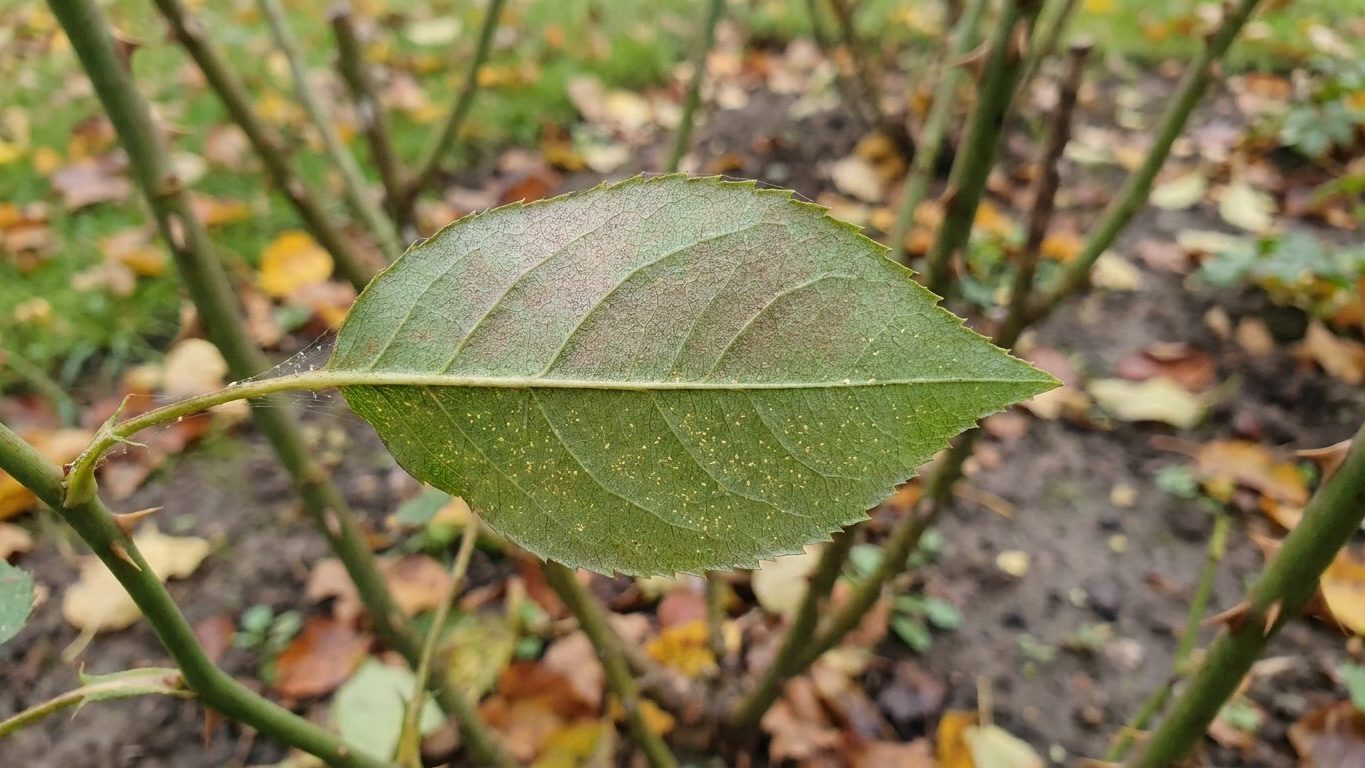

A dusty, bronze-gray speckling across rose leaves that shows up when the weather turns cool, not hot, is the calling card of the Southern Red Mite. On a mature, well-established rose bush this is almost always cosmetic and not a reason to panic. The exception is a young plant, a container rose, or one already stressed by drought, where a heavy population can thin out foliage and slow the next flush of growth.
What the damage looks like
The detail that separates this pest from almost everything else on a rose bush is timing paired with color. Southern Red Mite adults are tiny, dark reddish-brown to nearly black, barely visible without a hand lens, and they cluster along the midrib and main veins on the underside of leaves rather than scattering randomly across the leaf surface. The damage they leave behind is a fine, dusty stippling, tiny pale or yellowish flecks on the upper leaf that, from a few feet away, can look like a dull bronze or gray cast settling over the whole plant.
Unlike the heavy silk webbing that some other mites spin across leaf undersides and between stems, Southern Red Mite webbing is sparse, almost invisible unless you know to look for a faint sheen near the leaf veins. Leaves that have carried a population for a few weeks often look tired and dusty rather than shredded or torn. New growth emerging during a cool stretch is usually where the stippling first appears, since the tender tissue shows the feeding punctures more clearly than tougher, older leaves.
Growth doesn’t usually stop outright on an established rose. Flowering may slow slightly and leaf color can dull, but the plant typically leafs out fine once conditions change. On a rooted cutting, a first-year bush, or anything already struggling with poor drainage or root stress, the same feeding pressure can cause visible leaf drop and a real setback in vigor. That distinction, mature plant versus young or stressed one, matters more than the raw mite count when deciding how urgently to act.
One more clue worth checking: run a finger gently along the underside of a stippled leaf near the midrib. If it comes away with a faint reddish smear, rather than green or clear, that smear is crushed mite bodies, and it’s a strong confirming sign before moving to a closer look with magnification.
Making sure it is this and not something else
Stippling on a rose leaf gets blamed on several culprits, and the fastest way to sort them out is a simple tap test. Hold a sheet of white paper or a paper plate under a suspect leaf and tap the stem sharply. Whatever falls onto the paper, examine with a hand lens or a phone camera zoomed in tight.
Two-spotted spider mite
This is the mite most gardeners already know, and it’s the opposite personality: it thrives in hot, dry summer weather and builds heavy, visible webbing across leaves and stems. Its body is pale greenish-yellow with two dark spots on the back, not the dark reddish-black of Southern Red Mite. If the population is exploding during a heat wave with webbing thick enough to trap dust, that’s the two-spotted mite, not this one.
Thrips
Thrips cause a silvery, papery scarring, often concentrated on flower buds and petal edges rather than a uniform stippling across the leaf. Tapping a bud over white paper usually reveals thin, fast-moving yellow-brown slivers rather than the slow, dot-sized mites. Thrips damage also tends to distort or streak flower petals, something Southern Red Mite doesn’t do.
Nutrient stress or herbicide drift
A dusty bronze cast can occasionally be mistaken for magnesium deficiency or minor herbicide exposure. The difference: nutrient and chemical stress usually shows a consistent pattern across the whole plant or in a specific vein pattern, and the tap test onto white paper turns up nothing moving at all. If nothing falls out and no reddish smear appears on the leaf underside, look at soil and spray history before blaming a mite.
When it shows up
This pest is defined by cool weather, not a date on the calendar. Southern Red Mite populations build during periods when daytime temperatures stay mild and nights are still cool, particularly during the flush of tender new growth that follows a rose’s first big push after dormancy. That same pattern repeats as summer heat breaks and the plant sends out a second round of fall growth.
What shuts the population down isn’t a season ending, it’s heat. Once daytime highs settle into a sustained stretch above roughly the upper 80s to low 90s Fahrenheit, Southern Red Mite numbers typically crash on their own, which is the opposite of how the more familiar two-spotted spider mite behaves. That single fact, cool and active versus hot and active, is the most reliable way to know which mite pressure a rose is under at any given point in its growth cycle.
Humidity plays a supporting role. Mild, slightly humid stretches with overcast days tend to favor buildup more than dry, blazing heat or cold, wet conditions. Eggs laid on stems and leaf undersides can overwinter through cold weather and hatch once temperatures moderate again, meaning a rose that showed no symptoms through winter can suddenly show stippling as soon as the first sustained mild spell arrives. Watching new growth closely during any cool, mild stretch, rather than marking a spot on the calendar, is the more useful habit here.
What to do now
- Confirm with the tap test first. Before treating anything, tap a few suspect leaves over white paper and check color and speed of movement. Treating the wrong pest wastes time and can knock out predators that would otherwise help.
- Hose the foliage down. A firm spray of water aimed at the undersides of leaves physically knocks mites off the plant and disrupts feeding without any product cost. Repeating this every few days during an active cool spell is often enough on an established, otherwise healthy bush.
- Prune out the worst leaves. Heavily stippled or dust-coated leaves that are already declining can simply be removed and discarded, which reduces the population feeding the next generation without touching the rest of the plant.
- Protect the predators already on site. Predatory mites, lacewings, and small lady beetles all feed on Southern Red Mite and usually keep populations in check on their own in an established garden. Holding off on any broad-spectrum insecticide gives these predators a chance to do the work for free.
- Use insecticidal soap or horticultural oil as a spot treatment. Both are available at any garden center, work by contact rather than leaving a lingering residue, and are labeled for mite control on roses. Apply to the leaf undersides, avoid spraying during the hottest part of the day, and skip open blooms to protect visiting pollinators.
- Reach for a labeled miticide only if damage keeps spreading on a young or already-stressed plant. Products containing ingredients such as hexythiazox or bifenthrin are sold to home gardeners specifically for mite control, but always read the label for state restrictions and rose-specific instructions, since some formulations are limited or banned outright in certain states. This step should be the last one taken, not the first.
Stopping it coming back
- Rinse foliage with a hose spray every week or two during mild, dry stretches, since dusty leaves are more attractive to mites than clean ones.
- Keep roses on a consistent watering schedule; drought-stressed plants show worse mite damage than well-hydrated ones going into a cool spell.
- Space and prune roses for good airflow, which discourages the still, humid microclimate mites favor along dense inner growth.
- Avoid routine use of broad-spectrum insecticides for unrelated pests, since these wipe out the predatory mites and beneficial insects that normally keep populations low without any intervention.
- Inspect new growth closely during the first mild stretch after a cold snap or after a stretch of summer heat breaks, since that’s when a new generation is most likely to appear.
- Quarantine and inspect any new rose or nursery stock before planting it near established beds, since eggs can travel on leaves and stems unnoticed.
Common questions
Does Southern Red Mite kill roses? Rarely on an established, healthy bush. Damage is mostly cosmetic stippling and dulled foliage. Young plants, cuttings, or roses already stressed by drought or poor drainage are the ones at real risk of setback.
Are Southern Red Mites the same as spider mites? They belong to the same broad mite family but behave almost oppositely. Southern Red Mite favors cool weather and sparse webbing, while the common two-spotted spider mite favors hot, dry conditions and heavy webbing.
Can I see Southern Red Mites without a magnifier? Barely. They’re small enough that most gardeners notice the stippling and dusty leaf color long before they spot an individual mite. A hand lens or a zoomed phone camera makes identification much easier.
Do predatory insects control Southern Red Mite? Yes, predatory mites, lacewings, and lady beetles all feed on them and often keep populations low without any spraying, which is the main reason broad-spectrum insecticides should be a last resort rather than a first response.