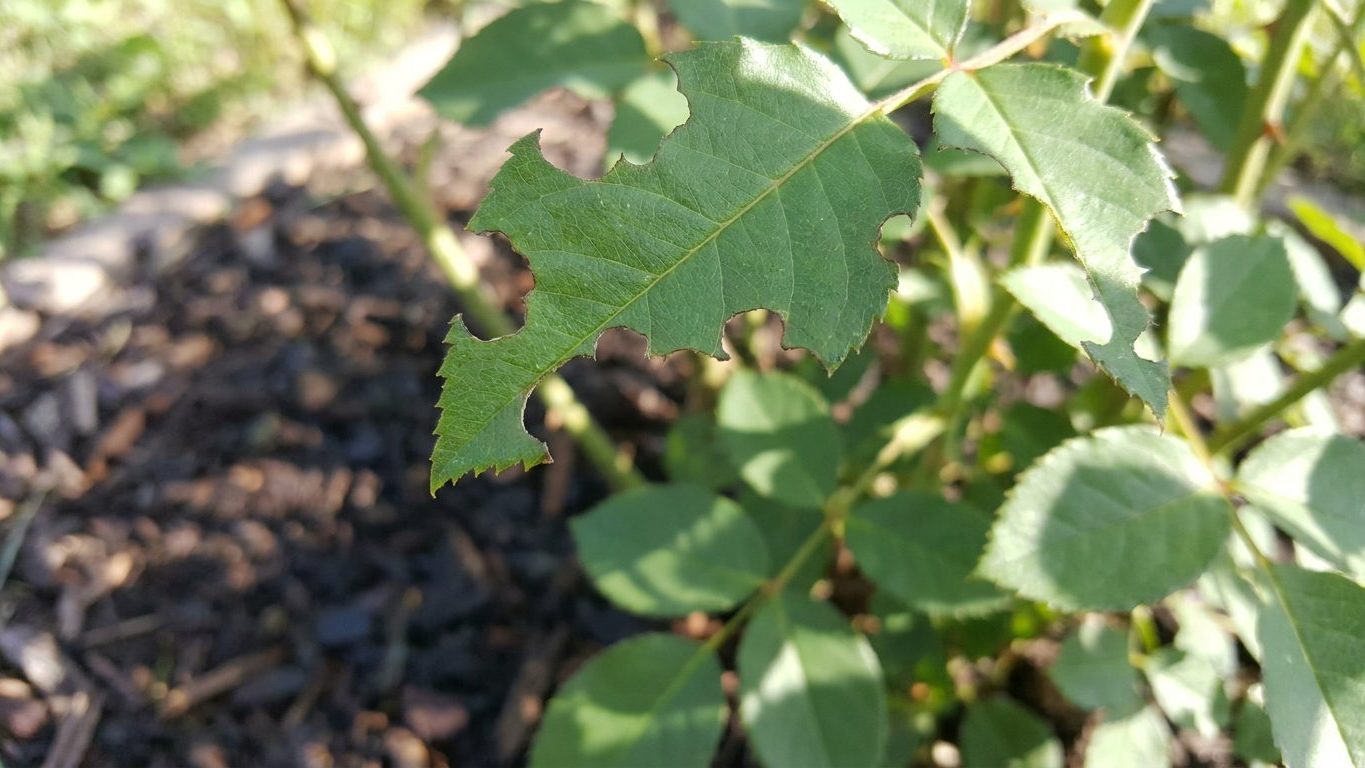

Notched, ragged bites along the edges of rose leaves, with no insect in sight during the day, point to the Fuller rose beetle. This flightless weevil feeds only after dark and hides in soil or mulch by morning. On an established rose the damage is almost always cosmetic. On a young transplant or seedling, root-feeding by the larvae can be a real problem worth addressing.
What the damage looks like
Start with the leaf margin, not the whole leaf. The Fuller rose beetle chews irregular, ragged notches into the outer edge of rose leaves, working inward in uneven scallops rather than clean semicircles. No two notches look quite the same size or shape, which is the first clue this isn’t a tidier feeder. The center of the leaf and the veins stay untouched. That’s the pattern this species leaves behind: edge damage, irregular in shape, with the leaf blade itself intact.
The adult responsible is a grayish-brown to dull brown snout weevil, roughly 1/4 to 3/8 inch long, with a short, blunt snout and no wings capable of flight. That last detail matters more than it sounds like it should. Because this beetle cannot fly, it has to climb up from the soil every night to reach the foliage, then descend and hide again before daylight. Shine a flashlight on an affected rose an hour or two after dark and you’ll likely find several beetles clinging to leaves or stems, feeding slowly. Check the same plant at noon and you’ll see nothing but the damage, because the beetles have already dropped to the ground and buried into mulch, loose soil, or leaf litter at the base of the plant.
Below ground, a second and less visible stage of damage happens. Fuller rose beetle larvae are small, legless, C-shaped grubs that live in the soil and feed on fine root hairs. On a mature rose with an established root system, this root feeding rarely shows up as a visible symptom. On a rooted cutting, a bare-root transplant still settling in, or any seedling with a limited root mass, the same feeding can stunt growth or cause wilting that looks like drought stress even when the soil is moist.
One more identifying habit: adult females often lay egg masses on the underside of leaves, on stems, or tucked near the calyx of a bud, and each mass is sealed under a hardened, glue-like coating that looks like a small dab of dried white cement. Finding that coating near fresh notching is a strong confirmation that this is the insect responsible, since few other rose pests leave anything resembling it.
Making sure it is this and not something else
The irregular notch pattern combined with a complete absence of beetles in daylight is the single most reliable field test. Still, a few other pests leave marks that get mistaken for Fuller rose beetle damage, and each has one detail that settles the question.
Leafcutter bees
Leafcutter bee damage looks deceptively similar at a glance, but the cuts are smooth, rounded, and almost perfectly circular or oval, as if someone used a paper punch. Fuller rose beetle notches are jagged and uneven by comparison. Leafcutter bees also work during the day, and you’ll rarely see any other damage on the plant besides those clean, geometric holes.
Black vine weevil and other root weevils
Black vine weevil adults also feed at night and leave notched leaf margins, and they too are flightless, which makes them the closest look-alike. The reliable separator is the beetle itself under a hand lens: black vine weevil is nearly black with small patches of gold or yellow flecking on the wing covers, while Fuller rose beetle is a more uniform dull gray-brown with no flecking. If you can’t catch one at night, the egg-mass coating described above is specific enough to Fuller rose beetle that its presence is a strong tiebreaker.
Rose sawfly (rose slug) larvae
Rose slug damage is skeletonizing, not notching. The larvae scrape away the leaf surface between veins, leaving thin, papery, translucent patches or windows rather than removing chunks from the edge. If the damage is confined strictly to the margin and the rest of the leaf is untouched, that rules out sawfly larvae.
When it shows up
Timing here tracks the plant’s growth stage more reliably than the calendar. Adult activity picks up once new spring growth flushes out and leaves are still soft and expanding, since tender new foliage is easier for the beetles to chew than mature, hardened leaves. As the season’s growth toughens up, feeding pressure on established plants tends to taper off even though the beetles are still present in the soil.
Larval activity in the soil follows a separate rhythm tied to root development rather than foliage. Because larvae feed on fine root hairs, the window of real concern for them lines up with any stage when a plant’s root system is still small and can’t easily compensate for lost hair roots, such as the first season after transplanting a bare-root rose, a newly potted own-root cutting, or true seedlings grown from rose hips. Once a rose has settled in and built out a mature root mass over a full growing season, the same larval feeding becomes a minor background presence rather than a threat.
Mulch and groundcover also shift the picture, independent of season. Beetles need loose cover, whether that’s bark mulch, dense low groundcover, or a thick layer of fallen leaves, to hide in during daylight hours. A rose bed with bare, cultivated soil right around the crown gives adults far fewer places to shelter than one with mulch piled against the stems, and that difference in habitat matters more than what week it is.
What to do now
- Hand pick at night. Go out with a flashlight an hour or two after dark, shake affected canes gently over a tray or bucket of soapy water, and collect the beetles that drop. Fuller rose beetle plays dead when disturbed, so a firm shake works better than trying to grab individual insects.
- Clear hiding spots near the base. Pull mulch and leaf litter back a few inches from the crown of the plant during the day and rake through it. This exposes adults that would otherwise sit undisturbed until nightfall, and it makes the next step more effective.
- Install a sticky barrier band. Because adults are flightless and must climb the plant from the soil, a band of sticky barrier material (sold as tree tanglefoot or similar trunk-banding products at most garden centers) wrapped around the base of a cane, low and snug, stops them from reaching the foliage at all. This is one of the more effective and lowest-effort options specifically because this insect can’t simply fly over the obstacle.
- Apply beneficial nematodes to the soil for larvae. Products containing Heterorhabditis bacteriophora nematodes, watered into moist soil around the root zone, target the root-feeding grub stage directly. This step matters most for young transplants and seedlings where root damage actually threatens the plant’s health, and it’s largely unnecessary on a mature, well-rooted rose.
- Reach for a labeled insecticide only as a last resort. If damage is severe on a young or high-value plant and the steps above haven’t controlled it, a pyrethrin-based spray labeled for weevils and applied at night when adults are actively feeding can help. Read the label for state-specific restrictions before buying, since some broad-spectrum products carry limits in certain states, and avoid routine or broad-spectrum spraying, which also kills ground beetles and other soil predators that naturally prey on Fuller rose beetle larvae.
Stopping it coming back
- Keep mulch pulled a few inches back from rose crowns and canes rather than piled against the stems, since loose cover right at the base is exactly what adults use to hide during the day.
- Re-apply sticky barrier bands each time new growth flushes out and canes are still soft, since that’s when adult feeding pressure is highest and the bands do the most good.
- Check new transplants and seedlings more closely than established plants, since a small root system has less capacity to shrug off larval feeding underground.
- Leave some bare, cultivated soil around the base of roses rather than dense groundcover, which removes daytime shelter without any spraying involved.
- Avoid routine broad-spectrum insecticide use in the bed, since ground beetles and soil-dwelling predators that feed on Fuller rose beetle larvae are killed by the same products, often making future outbreaks worse rather than better.
- Do a nighttime flashlight check once or twice during the peak of spring growth as a simple early-warning habit, catching a small population before it produces the next generation of egg masses.
Common questions
Can Fuller rose beetle fly to a new plant?
No. The adults are flightless, with wing covers fused shut, so they move entirely by crawling. This is exactly why sticky barrier bands around the base of a cane work so well against this particular pest.
Will it kill an established rose bush?
Rarely. On a mature rose with a developed root system, the leaf notching is cosmetic and the plant typically outgrows it without lasting harm. The bigger risk is to young transplants, cuttings, or seedlings, where larval root feeding can slow establishment.
Do I need to find a male beetle for egg-laying to happen?
No. Fuller rose beetle females reproduce without mating in most populations, meaning a single female can start an infestation on her own. That’s part of why isolated potted roses or greenhouse-grown plants can still end up with a population even without an obvious source nearby.
Is this beetle regulated or a concern for shipping plants?
It has been treated as a quarantine-significant pest in some fruit and nursery export contexts, particularly around citrus, because of its presence on foliage and fruit. For a home rose garden, that regulatory status doesn’t change how you manage it, but it explains why some commercial growers monitor for it more formally than backyard gardeners need to.