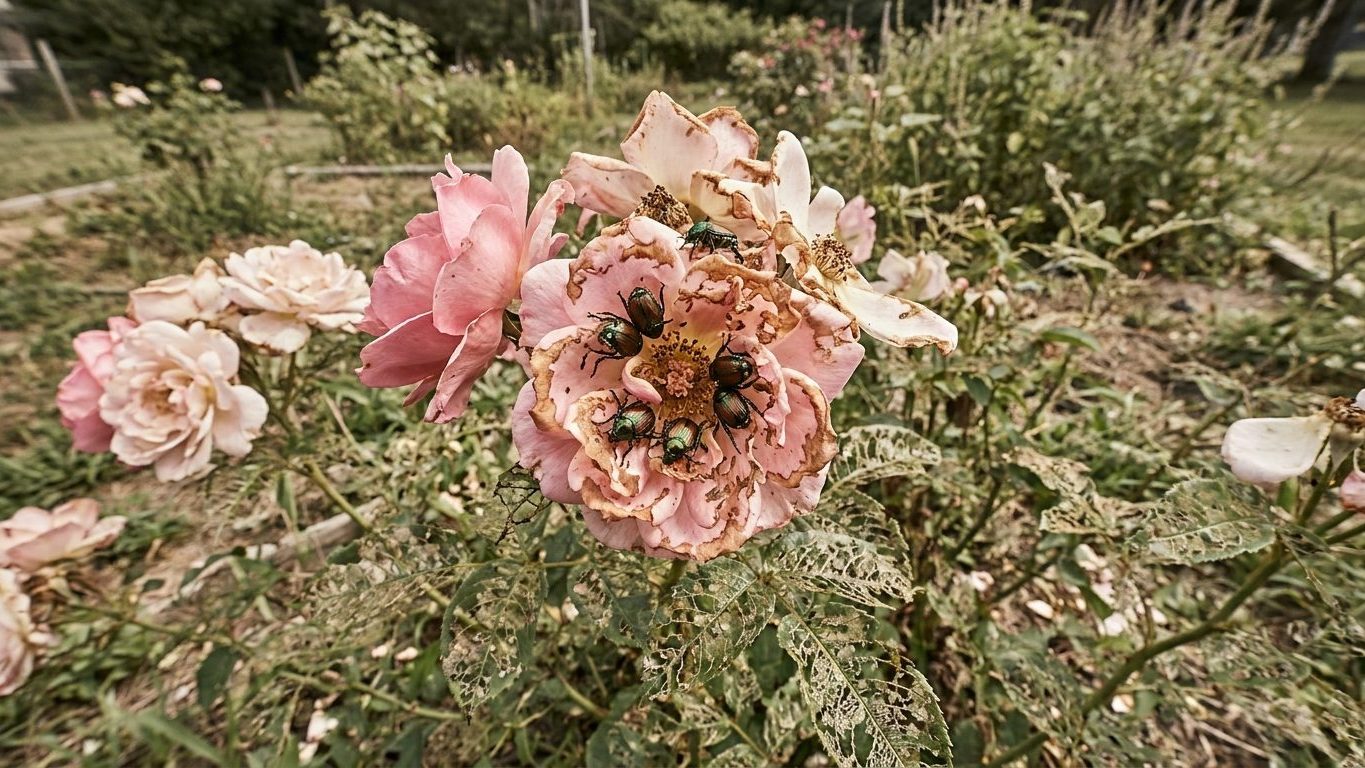

Skeletonized leaves and chewed-up rose blooms in the heat of summer point to one insect: the Japanese beetle. On an established rose bush, the damage is mostly cosmetic, ugly but rarely fatal. The bigger mistake most gardeners make isn’t the beetle itself. It’s the pheromone trap they hang nearby, which pulls in beetles from well beyond the yard and dumps most of that traffic on the roses instead of in the bag.
What the damage looks like
Look at the leaf before you look for the bug. Japanese beetles feed on the upper surface, chewing out the soft tissue between the veins and leaving the ribs and larger veins untouched. The result is a lacy, skeletal leaf that still holds its shape but has almost nothing left to photosynthesize with. Weevils and other chewing pests leave notched edges or ragged holes; this one leaves a see-through pattern that looks almost intentional.
Flowers take the worst of it. Buds get chewed before they open, and open blooms end up with shredded, brown-edged petals. Lighter-colored and more fragrant roses tend to draw heavier feeding than darker, less scented varieties, though every rose in a bed can get hit once beetles are established nearby.
The feeding pattern itself is a clue. These beetles don’t feed alone. They cluster, sometimes a dozen or more crowded onto a single bloom or leaf cluster, because feeding damage releases plant compounds that draw in more beetles. That’s why a rose bed can go from lightly nibbled to stripped bare in a matter of days once the first wave arrives. The upper canopy and the sun-facing side of the plant, usually south or west, take the heaviest damage, since these beetles feed during the day and prefer warm, well-lit foliage over shaded interior growth.
Before any formal identification, the insect itself gives away a strong hint while it’s sitting on the damage: a metallic green head and thorax, copper-brown wing covers, and a row of small white hair tufts along each side of the abdomen, visible peeking out from under the wing edges. No frass, no tunneling, no chewed canes. Just clean, external, daytime chewing and beetles that fly off readily the moment the plant is disturbed.
Making sure it is this and not something else
The white abdominal tufts are the single fastest confirmation, but a few other beetles show up on roses around the same general condition and get mistaken for this one.
Rose chafer
Rose chafers are tan to fawn-colored with noticeably long, spindly legs, and they show up most often in gardens with sandy soil. They have no metallic green sheen anywhere on the body and no white tufts along the abdomen. The single test: hold one up to the light. If it’s dull tan all over with long legs, it’s a rose chafer, not a Japanese beetle.
June beetles and May beetles
These are larger, often three-quarters of an inch or more, and solid reddish-brown with no green coloring at all. The giveaway isn’t appearance so much as behavior: June and May beetles are night fliers, drawn to porch lights after dark, and they don’t cluster on rose blooms during the day the way Japanese beetles do. If the damage is happening in daylight and the beetles are visible feeding in groups, it isn’t this insect.
False Japanese beetle
This one is the closest lookalike in size and general shape, but it’s a dull olive-tan color rather than metallic green, and it lacks the white hair tufts entirely. Check the sides of the abdomen under good light; if those tufts aren’t there, it’s the false version, which causes far less damage and rarely appears in the same numbers.
When it shows up
There’s no calendar date that works here, because emergence depends on soil temperature and how quickly the grub stage finishes pupating in the turf, not a fixed week. What matters is the plant stage: adult beetles start showing up as roses move into their first big bloom flush of the season, and feeding activity peaks while that flush is at its fullest. Adults live roughly four to six weeks, so the pressure is intense but temporary, tapering off as that generation ages out even before a second bloom flush opens.
Sun exposure is a bigger driver of severity than any date. Roses planted in full sun, especially ones near irrigated turf, tend to draw heavier feeding than roses in partial shade or surrounded by dry, unwatered lawn. That’s because the adult females return to moist, well-watered grass to lay eggs, so a lush, frequently irrigated lawn near the rose bed effectively breeds the next wave of beetles close to the very plants they’ll feed on.
A rose bed near a golf course, a heavily watered lawn, or a park with irrigated turf will generally see beetles arrive earlier in the bloom cycle and in higher numbers than one surrounded by drought-tolerant landscaping. Established, mature rose bushes tolerate this pressure far better than young, recently planted ones, since a first-year rose has less leaf area to spare and can be set back by heavy defoliation in a way a five-year-old bush simply won’t be.
What to do now
- Hand-pick every morning while beetles are sluggish. Cool, still air makes them slow to fly off. Knock or flick them into a jar of soapy water; they can’t climb out and drown quickly. This is free, has zero effect on bees or other pollinators, and works best done daily during peak feeding rather than occasionally.
- Skip the pheromone trap entirely, or move an existing one far away. These traps combine a floral lure with a sex pheromone that can draw beetles in from well beyond the property line. Multiple university extension entomologists have documented that traps often catch a fraction of what they attract, meaning most of the beetles pulled in end up feeding on nearby plants rather than in the bag. If a trap is already up, put it at the far edge of the yard, away from the rose bed, not next to it.
- Cover high-value plants with lightweight netting or row cover during the peak bloom flush. This physically blocks access without any spray, though it also blocks pollinators, so it’s best used only while the worst feeding pressure is on.
- Apply kaolin clay as a particle film on foliage and buds. It coats the leaf surface so the beetle can’t get purchase or recognize the plant as food. It washes off in rain and needs reapplying, but it’s low-cost and doesn’t harm beneficial insects.
- Use a contact spray like neem oil or pyrethrin only on beetles directly, and only in the evening after blooms close. Both break down fast and have less residual effect on bees than systemic products, but they can still harm pollinators if applied to open flowers during the day.
- Reserve systemic insecticides such as imidacloprid for the worst cases, and only on non-blooming growth or after petals have dropped. Several states restrict consumer use of neonicotinoid products on flowering plants specifically to protect pollinators, so check state extension guidance before buying one. These products move through the whole plant, including nectar and pollen, which is exactly why broad, routine use is discouraged.
Natural predators matter more here than most gardeners realize. Parasitic wasps in the genus Tiphia and a parasitic fly known as the winsome fly both attack Japanese beetle grubs or adults, and a broad-spectrum insecticide applied across the whole bed will knock those predators back along with the pest, often making next year’s population worse, not better.
Stopping it coming back
- Treat the lawn, not just the roses, since grubs feeding on turfgrass roots are the source of next year’s adults. Beneficial nematodes applied while grubs are actively feeding in the soil, or milky spore disease worked into the lawn over a couple of seasons, both target the larval stage directly.
- Ease off on lawn irrigation near the rose bed during the egg-laying window. Adult females strongly prefer moist turf for laying eggs, so a drier lawn nearby is a real deterrent, not just an inconvenience.
- Never set out a pheromone trap in or near the rose bed. If a neighbor runs one, it’s worth asking them to relocate it to the far side of their own property rather than a shared fence line.
- Scout the first bloom flush closely and start hand-picking at the very first beetle sighting. Because feeding damage draws in more beetles through plant-released compounds, catching the first few before they establish a feeding site keeps the whole aggregation from building.
- Protect the predators already working for free. Keep broad-spectrum spraying to genuine emergencies, and let ground-nesting wasps and other natural enemies stick around in untreated corners of the yard.
Common questions
Do Japanese beetle traps really make the problem worse?
Often, yes. The floral lure and sex pheromone combination draws beetles in from a wide radius, and studies from university extension entomologists have found these traps frequently attract more beetles than they actually catch, leaving the surplus to feed on nearby plants instead.
Will Japanese beetles kill my rose bush?
On an established, healthy rose, no. The damage is unsightly and can stress the plant during a heavy feeding period, but a mature bush recovers once the adult population dies off. Young, first-year plants with limited leaf area are more vulnerable and may need protection like row cover during peak feeding.
What time of day are Japanese beetles most active on roses?
They feed during daylight hours and are noticeably sluggish in cool morning air, which is exactly when hand-picking works best. They become more active and quicker to fly off as the day warms up.
Can I use a systemic insecticide while my roses are blooming?
It’s not recommended. Systemic products move into nectar and pollen, putting pollinators at risk, and several states restrict neonicotinoid use on flowering plants for that reason. If a systemic treatment is necessary, apply it after petals drop or on non-blooming growth, and check state-specific rules first.