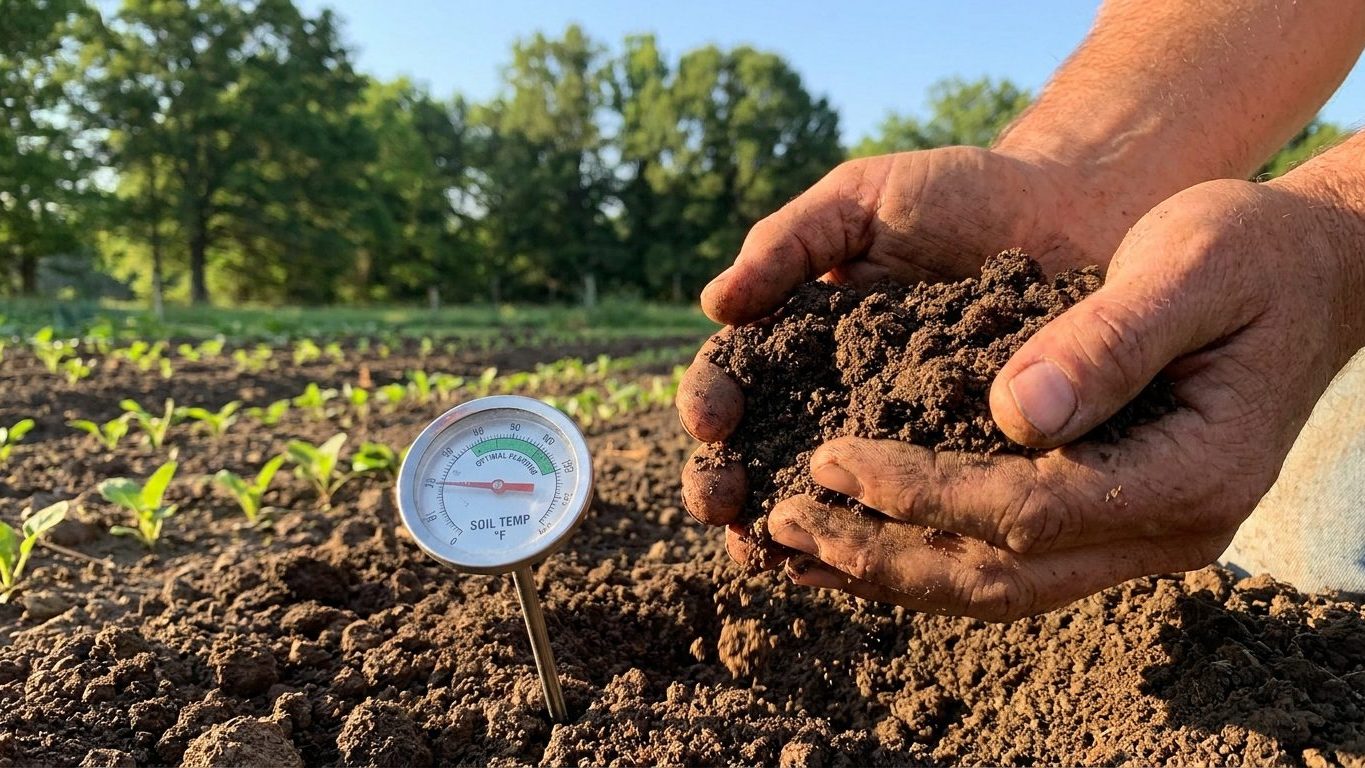

Winter Squash in Prince Edward Island goes into the ground once the soil itself is warm, not simply once frost risk passes, and that usually lands in late May to early June. The Island’s frost-free window runs roughly 154 days, its summers stay cool with essentially no heat stress, and July turns dry enough to matter. Those three facts, more than any calendar date, decide which squash types actually finish and cure before fall.
When the soil is warm enough in Prince Edward Island

The obvious question is “when do I plant,” and the honest answer starts with a date that gets misused constantly: the average last spring frost at CHARLOTTETOWN A, the Environment and Climate Change Canada reference station for the Island, falls on May 16 (Canadian Climate Normals, 1981-2010). That number is a mean, not a guarantee. Half the years on record, frost arrived after May 16. Treat it as the midpoint of a risk window, not a green light.
Winter squash doesn’t actually care about frost dates directly. It cares about soil temperature, and soil temperature lags behind the disappearance of frost risk by days or even a couple of weeks, especially on the Island’s heavier clay-loam soils, which hold cold longer than sand does. Squash seed sown into soil that’s still cool simply sits and rots, or germinates slowly and unevenly, which sets the whole plant back before it’s even out of the ground. So the practical rule is: let the frost date pass, then wait for the soil itself to warm before committing seed or transplants.
This matters more in Prince Edward Island than in warmer provinces because the Island sits in Canadian hardiness zone 5b, based on the 1991-2020 normals for the reference city (Natural Resources Canada, Plant Hardiness Site). That’s a Canadian zone number built from seven climate variables, and it does not convert cleanly to the USDA system used elsewhere on this site : Natural Resources Canada itself warns that a single Canadian zone can overlap nine different USDA zones. The takeaway for a gardener is simpler than the science behind it: PEI’s spring warms up slowly and unevenly, so the calendar is a starting point, not a substitute for checking the ground.
Warming the soil faster
Gardeners on the Island commonly speed this along with black plastic mulch laid a week or two ahead of planting, raised beds that drain and warm faster than flat clay ground, or row cover pulled over young plants on cool nights. None of these tricks erase the frost risk; they just narrow the gap between the calendar date and the day the soil is actually ready to support squash roots. For variety-specific timing trialled locally, the Prince Edward Island agriculture extension service is the source worth checking before seed goes in the ground.
How long the season lasts here
Subtract the two ECCC normals for CHARLOTTETOWN A and the frost-free window comes out to about 154 days: from the average last spring frost on May 16 to the average first fall frost on October 17. That’s a real number from a real station, and it’s the ceiling every winter squash planting on the Island has to work within.
What that length allows is narrower than it sounds. Winter squash needs its full maturation period on the vine, followed by a curing stretch before storage, and none of that can be rushed. A 154-day window sounds generous next to a short prairie season, but once you subtract the slow early weeks while the soil catches up and the cooler fall stretch when growth slows, the effective productive window shrinks. That’s why, for winter squash specifically, a second sowing rarely pays off here the way it might for quick crops like lettuce or radish, there simply isn’t enough season left after a June planting to bring a second wave to full maturity before October.
Where the 154-day window does change the decision is transplanting versus direct seeding. On a shorter island season, starting squash indoors three to four weeks before the soil is ready and transplanting out gives the plant a head start it can’t get from seed sown straight into cool ground. The tradeoff is root disturbance: squash resents having its roots checked, so transplants need to go out in biodegradable or peat pots that go into the soil intact, rather than bare-root. For crops on this site where succession sowing genuinely extends the harvest, the succession sowing guide lays out which vegetables benefit and which, like winter squash, are better treated as a single planting.
Heat and water in Prince Edward Island

Here’s the number that separates PEI from most of the squash-growing map: 0.0 days per year above 90°F at the Charlottetown reference station (ECCC Canadian Climate Normals, 1981-2010). That’s not a rounding artifact. It means the Island effectively never sees the kind of heat load that drives water stress and rapid evaporation in squash fields further south or inland. This is a cool-summer climate, full stop, and it should be treated as one rather than borrowing advice meant for hot, dry growing regions.
Rainfall backs that up. Summer totals about 10.8 inches across June, July and August, out of 45.6 inches for the year, with the driest month landing on July at 3.15 inches. Broken down month by month:
- June: 3.89 inches
- July: 3.15 inches
- August: 3.77 inches
That’s a fairly evenly distributed, moderate summer rainfall pattern, not a drought risk. But rainfall figures never tell the whole story on their own. On the Island’s clay-based soils, an inch of rain can sit near the surface for days rather than draining through the way it would on sand, which changes how often a bed actually needs supplemental watering. And because there’s essentially no 90-degree heat driving evaporation, water that falls tends to stay available to roots longer than the same rainfall would in a hotter province.
The real risk in a cool, humid, low-heat summer like PEI’s isn’t drought stress on the fruit. It’s disease. Powdery mildew, downy mildew and other fungal pressure build up fast in a climate where humidity lingers and leaves don’t dry off quickly between rain events. That risk climbs with dense vine growth and overhead watering. The response is a practice, not a product: space plants for airflow, water at the soil line rather than over the foliage, and remove a few of the oldest lower leaves once vines sprawl, so air moves through the canopy instead of trapping moisture against it.
Which winter squash suit Prince Edward Island
Two facts should drive the choice here, not brand names or catalog claims: a 154-day frost-free window that leaves less margin than it first appears, and a cool, humid summer with zero days of real heat stress. Together they point toward earlier-maturing squash types that can finish and start curing well before the mid-October average frost, rather than long-season types bred for hot, extended growing regions.
Within that, disease pressure should be the first filter, not an afterthought. In a climate this humid, a squash type known for holding up against powdery and downy mildew has a real practical edge over one that simply promises a slightly bigger fruit. Acorn-type and delicata-type squash tend to mature faster than the larger, longer-season hubbard or large kabocha types, which makes them a more forgiving fit for the Island’s shorter effective window, but “tends to” is doing real work in that sentence, because performance varies by seed source and by the specific season.
This is exactly the point where naming a specific variety would do more harm than good. Seed catalogs change their offerings yearly, and the varieties that actually perform well on Island soils, under Island humidity, are the ones the Prince Edward Island agriculture extension service has trialled and tracked locally. That’s not a dodge; it’s the only recommendation that means anything at the level of an individual garden, since a variety that resists mildew in a trial plot near Charlottetown may behave differently on a foggy coastal lot twenty minutes away. Choosing by type first, then confirming the specific seed with a source that tests under Island conditions, is the sequence that actually holds up across a real growing season here.