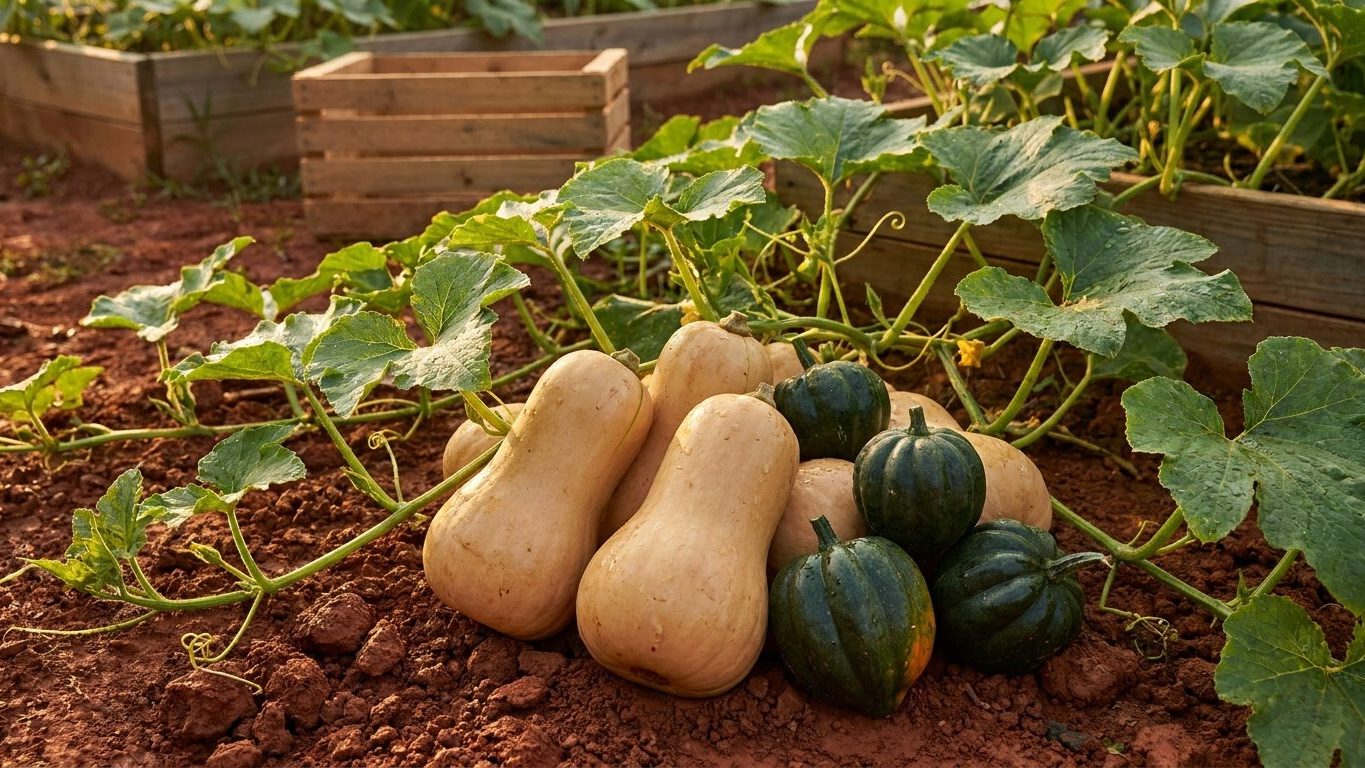

Short-season, small-fruited winter squash are the only reliable choice in Alaska: acorn, delicata, and short-season buttercup or kabocha types bred for northern gardens. Long-season butternut, hubbard, and giant pumpkin-type squash rarely mature before frost, even started early indoors. The reason comes down to two numbers: how many frost-free days the state’s mildest reference station gets, and how much summer heat it never sees.
The short answer for Alaska
Anchorage, the reference station for these normals, averages about 143 frost-free days a year, with the last spring frost falling between May 3 and May 12 and the first fall frost arriving September 22 to October 1. That’s the mild end of the state. Most winter squash catalogs list days-to-maturity in the 85-to-120 range, counted from transplant, not seed. A 143-day window sounds workable on paper, but subtract two to three weeks for cool soil slowing germination and early growth, and the real margin shrinks fast for anything rated past 100 days.
That math points straight at the fast end of the winter squash family. Acorn squash, many of which mature in 80 to 95 days, and delicata, usually 80 to 100 days, fit inside the Anchorage window with room to spare even after a slow, cool start. Short-season buttercup and kabocha cultivars bred specifically for northern and Canadian prairie growing, several land in the 95-to-105-day range, are the next-best bet, especially when started indoors three to four weeks before the last frost date.
Butternut squash is the tempting middle ground, and it’s where a lot of Alaska gardens come up short. Standard butternut varieties commonly need 100 to 120 days, and butternut also wants more heat to sweeten properly than the state’s climate provides. Anchorage averages 0.0 days a year at or above 90F. That’s not a rounding error, it’s a flat zero. Winter squash convert starch to sugar most efficiently in warm conditions, and a fruit that limps to full size in a cool summer without ever hitting real heat often ends up bland and watery even if it technically ripens.
The practical decision, then, is by type rather than by favorite variety name: pick from the acorn and delicata groups first, add a short-season buttercup or kabocha if you want variety on the plate, and treat anything advertised as a “long-season” or “large-fruited” squash as a greenhouse or hoop-house project rather than an open-garden bet.
What will not work here

Large hubbard squash, most winter squash bred for southern or Midwest growing seasons, and giant show-pumpkin types are the clearest failures. Many of these need 110 to 120-plus days and real summer heat to bulk up and cure. With a frost-free window that tops out around 143 days at the mildest station in the state, and zero days a year reaching 90F, these varieties are working against both limits at once. A grower who starts seed indoors in April and sets out husky transplants in late May can sometimes coax a hubbard to size, but getting it to actually ripen and develop storage-worthy skin before the September 22 frost date is a different problem, and heat-driven sugar development simply doesn’t happen without the heat.
Watering isn’t the obstacle it is in drier states. Summer rainfall across June, July, and August averages about 5.8 inches, with June the driest month at 1.02 inches and August the wettest at 2.93 inches. That’s a moderate, fairly reliable supply, not the weekly-irrigation grind that defeats squash in a hot, dry climate. Alaska’s winter squash problem is season length and heat, not drought.
Curing is the overlooked failure point
Even a squash that reaches full size and color in an Alaska garden still needs to cure, and curing wants warm, dry air for a week or two to harden the skin and concentrate flavor before storage. A climate that never sees a 90F day and gets meaningful rain right through August rarely offers that stretch outdoors. Growers who skip an indoor cure, a warm garage, a sunny back porch, a spot near a heat source, often see squash that looks fine at harvest soften or spoil within a few weeks in storage. Planting the right short-season type solves the growing half of the problem; curing indoors solves the other half.
What changes across Alaska
Alaska’s USDA hardiness zone range runs from 1a to 8a under the current Plant Hardiness Zone Map, based on 1991-2020 average annual extreme minimum temperatures. That’s an enormous spread, wider than the full zone range of most entire regions of the Lower 48, and it means there is no single squash calendar for the whole state. The frost dates and heat numbers used above come from the Anchorage reference station, and Anchorage sits toward the milder end of that range, not the middle and certainly not the cold end.
A gardener in the Interior, where winters run colder and the growing season is compressed further, is working with a narrower frost-free window than Anchorage’s already tight 143 days. Elevation compounds the same problem: even a modest gain in altitude near a mountain valley can push back the last frost and pull in the first one, shaving days off both ends of an already short season. In practice, that means the short-season varieties recommended above aren’t a safety margin for colder parts of the state, they’re closer to the ceiling. A grower outside the mild coastal and Southcentral areas has less room to experiment with anything slower than the fastest acorn or delicata cultivars, and more reason to lean on transplants, row cover, or a cold frame to buy back lost days.
None of this is something to guess at from a state-level article. The zone range spans eight full USDA categories, and where any one garden falls inside that 1a-to-8a spread changes the calculation enough that a reader should check the current USDA Plant Hardiness Zone Map for their own location rather than assume Anchorage’s numbers apply.
Where to check this for your own county
Alaska’s land-grant extension service is the University of Alaska Fairbanks Cooperative Extension Service. Alaska organizes local government by boroughs and census areas rather than counties, so the local extension office serving your borough or district is the equivalent of the “county extension” a reader in the Lower 48 would look for, and it’s worth searching the UAF Cooperative Extension site directly for the district nearest you.
Once there, look for two specific things rather than browsing generally. First, a local planting calendar built around the district’s own frost dates, not Anchorage’s. A garden in a different borough, at a different elevation or latitude, can have a meaningfully different last-frost and first-frost window than the May 3-to-May 12 and September 22-to-October 1 range used in this article. Second, look for any variety trial results or extension bulletins naming specific winter squash cultivars that have actually performed in that district’s soil and season. Extension offices in shorter-season parts of the state sometimes maintain their own short lists of acorn, delicata, or buttercup cultivars that have proven out locally, which is more useful than any general type recommendation.
This page answers the question at the state level, using one reference station’s climate normals. A local extension recommendation, built on a specific district’s frost data and its own variety trials, will always be more accurate for one garden than a state-wide answer can be. Treat this article as the starting framework, the type of squash to plant, and the local extension office as the place that narrows it down to a specific variety and a specific sowing date.
Checking this against your own garden
Calendar dates are averages built from decades of data at one weather station. The actual soil in front of a gardener, on a given spring day, outranks all of them. Three simple checks tell more about a specific garden’s microclimate than any frost date table.
Feel the soil itself before setting out transplants or direct-sowing seed. Winter squash germinate poorly and sulk in cold ground, and a soil that still feels chilly and damp to the hand at a two-to-three-inch depth, well after the calendar’s last-frost date has passed, is a sign that a particular spot runs colder than the regional average, whether from shade, poor drainage, or a low-lying frost pocket. Waiting a few extra days for that soil to warm usually beats forcing an early planting date.
Watch for the first male flowers once the vines are running. Squash produce male blossoms before female ones, and a burst of male flowers with no females yet is normal, not a failure. It’s a sign the plant is building energy before it starts setting fruit, and it gives a rough read on how much of the frost-free season remains for that fruit to actually size up and mature.
Check the true leaves after the seedling stage. The first rounded seed leaves aren’t the plant’s real foliage; the jagged, more deeply lobed true leaves that follow are what indicate the plant has moved past its most frost-vulnerable stage and into active growth. Slow true-leaf development well after other gardeners in the area report it is a useful, low-tech signal that a plot runs cooler than the district norm, and that squash choices there should lean toward the shortest-season end of the range discussed above.