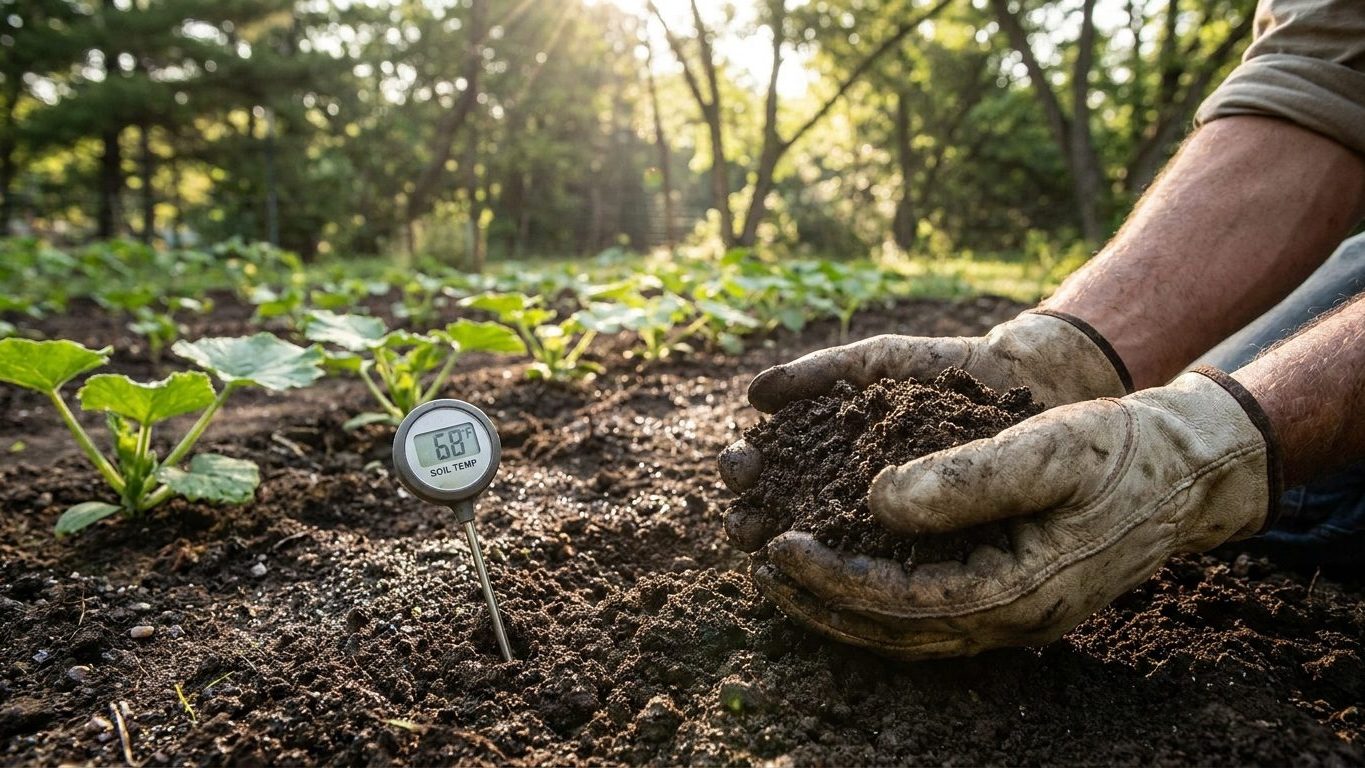

In Connecticut, direct-sow winter squash outdoors between May 20 and June 10, once soil has warmed past the danger of a late frost. That window sits after the state’s last spring frost date range of April 2 to April 12, measured at the Bridgeport reference station, and leaves enough of the frost-free season for even the slower-maturing varieties to ripen before fall frost arrives.
The short answer for Connecticut
The frost dates behind that window come from NOAA’s 1991-2020 Climate Normals, station USW00094702 in Bridgeport, and they describe a probability band, not a guarantee. April 2 to April 12 is the range in which the last 32F freeze falls 30% to 70% of the time in a given spring. Read the other way: there’s still meaningful frost risk into mid-April even at this coastal station, and squash seedlings have zero frost tolerance. That’s why the safe sowing window doesn’t start the day after the last frost date. It starts several weeks later, once the soil itself has caught up.
Winter squash germinates poorly in cold soil. Seeds sown when the ground is still in the 50s F often rot before they sprout, or limp along stunted for weeks. The plant wants soil in the mid-60s F and warmer, which in Connecticut typically doesn’t happen until mid-to-late May even in a mild spring. That’s the real gate here, more than the calendar date of last frost.
On the other end of the season, the first fall frost at the same Bridgeport station falls between October 28 and November 10. That gives a frost-free stretch, coastal, of roughly 199 to 222 days depending on exactly where in each range the actual frost lands that year. Winter squash varieties run anywhere from about 80 days (acorn types) to 100-plus days (many butternuts, and most large hubbard or kabocha types). Even sowing as late as June 10, a 100-day variety reaches maturity by mid-September, well ahead of the earliest fall frost date. That margin is the reason the window can run a full three weeks without putting the harvest at risk.
The caution attached to these frost dates matters here: Bridgeport sits on Long Island Sound and is the mildest station in the state. Inland and northwest Connecticut freeze earlier in fall and later in spring than these numbers show. What the range does tell you is the direction of the adjustment: push the sowing window later in spring, and don’t count on the full 199-to-222-day season if you’re away from the coast.
What will not work here
Sowing winter squash outdoors in early May, right after the earliest possible last-frost date, is the most common way to lose a planting in Connecticut. A frost that lands anywhere in that April 2-12 band, or a late cold snap after it, kills tender squash seedlings outright. Because the band is a 30-70% probability range and not a hard cutoff, treating April 12 as a safe start date ignores that frost still occurs after that date in a meaningful share of years, especially away from the coast.
Long-season varieties pushed past a mid-June sowing are the second failure mode, and it’s less obvious than frost. A 110-day hubbard or a slow kabocha sown in late June is racing the October 28 fall frost date with almost no buffer. Add a cool, cloudy stretch in September, which slows fruit ripening and rind hardening, and that squash can still be immature when frost hits. The fix isn’t a different frost date; it’s matching variety maturity length to how late you’re actually sowing.
Water management is where a lot of Connecticut gardens go wrong in a different direction. The state’s reference station averages about 11.1 inches of rain across June, July and August, with July the driest month at 3.32 inches. That sounds like enough rain to skip irrigation, and in a wet year it might be. But that rainfall figure never reads alone. Connecticut also averages 6.2 days a year at or above 90F, and heat load that drives fast evaporation from leaves and soil. Rain that falls as one heavy thunderstorm, which is common in a Connecticut summer, mostly runs off a squash bed rather than soaking down to root depth. A gardener who waters on a fixed weekly schedule because “we get plenty of summer rain” can still end up with a drought-stressed planting during a dry, hot stretch in July.
Tight spacing is the last common mistake, and it interacts with that same rainfall pattern. Winter squash vines sprawl, and packing hills close together traps humidity around the leaves after rain or heavy dew. In a summer with 3.98 inches of rain in August, powdery mildew and other fungal problems spread fast through crowded plantings. Give plants the room the seed packet calls for, not less, even in a small yard.
What changes across Connecticut
Connecticut’s USDA hardiness zone range runs 6a to 7b, per the USDA Plant Hardiness Zone Map, built on 1991-2020 normals. That’s the average annual extreme minimum winter temperature, a single variable, and it spans a wide range for a state this size. A 6a-to-7b spread means there is no single planting date that fits the whole state equally well. The gap between a 6a winter and a 7b winter is real, and it shows up as a difference of weeks in when the ground actually warms enough to plant, not just a line on a winter hardiness map.
The Bridgeport frost dates describe the mild end of that range: a coastal station on Long Island Sound, buffered by the water from both early fall frosts and late spring cold snaps. The caution attached to both frost-date facts is direct about this: inland and northwest Connecticut freeze noticeably earlier in fall and later in spring than Bridgeport does. A reader gardening in the Litchfield Hills or the higher elevations of the northwest corner should expect a shorter effective growing season than the 199-to-222-day range calculated from Bridgeport’s normals.
What that means in practice: treat the late-May-to-mid-June sowing window as a coastal and lowland Connecticut answer, and shift it toward the later half, or push it into mid-to-late June with a shorter-maturity variety, if you’re gardening well inland or at higher elevation. Which zone your own property sits in is a question for the map, not for a state-level planting calendar.
Where to check this for your own county
The University of Connecticut runs the state’s Cooperative Extension System, University of Connecticut Cooperative Extension System.
Two things to look for once there. First, a county- or region-specific planting calendar, if the local extension office publishes one. UConn Extension operates through county offices and Master Gardener programs, and local planting guidance from an office covering, say, Litchfield or Windham County will reflect that area’s actual frost timing far better than a statewide range built on Bridgeport data ever can. Second, look for variety trial results specific to Connecticut growing conditions. Extension services often run or publish squash variety trials that note which butternut, acorn, or kabocha cultivars performed well under the region’s actual disease pressure and season length, not just a seed catalog’s national maturity-day estimate.
A county recommendation beats a state one every time, for a simple reason: a state-level answer is built from a single reference station and a hardiness zone range covering roughly two full USDA zones. It’s a starting point for understanding the mechanics, frost probability, growing-season length, heat load, that shape a Connecticut planting decision. It isn’t a substitute for guidance calibrated to Fairfield County’s coastline versus Tolland County’s inland hills. If UConn Extension’s local office has published something more specific for your county, that supersedes the ranges given here.
If you follow the almanac, here is when to plant winter squash by the moon. It is a tradition, not a proven method.
Checking this against your own garden
None of the dates above beat what your own soil and plants tell you directly. Three signs are worth watching, and none require any equipment beyond your hands and eyes.
Soil warmth by feel is the first and most direct check. Push a finger a couple inches into the planting bed in mid-morning. If it still feels cold and slightly damp rather than merely cool, the soil hasn’t reached the mid-60s F that squash seeds want for reliable germination, regardless of what the calendar says about frost dates having passed weeks earlier.
The first flush of male flowers on an already-growing squash plant is the second signal, and it tells you something different: how well the plant has settled into your specific microclimate. Male flowers typically appear before female flowers on winter squash, sometimes by a week or two, and a strong early flush suggests the plant is getting adequate warmth and light where it’s planted. A plant that sits without flowering well past when nearby gardens are blooming may be sited somewhere cooler or shadier than the label conditions assume, which matters more on a property with a lot of tree cover or a north-facing slope than any state average does.
The first true leaves, the ones that appear after the initial rounded seed leaves, are the third check. If they emerge stunted, yellowed, or slow compared to a neighbor’s planting sown the same week, that’s a local soil or drainage issue worth investigating before blaming timing. Taken together, these three observations, soil feel, first male flowers, first true leaves, tell you more about your own patch of ground than any regional frost date range can.