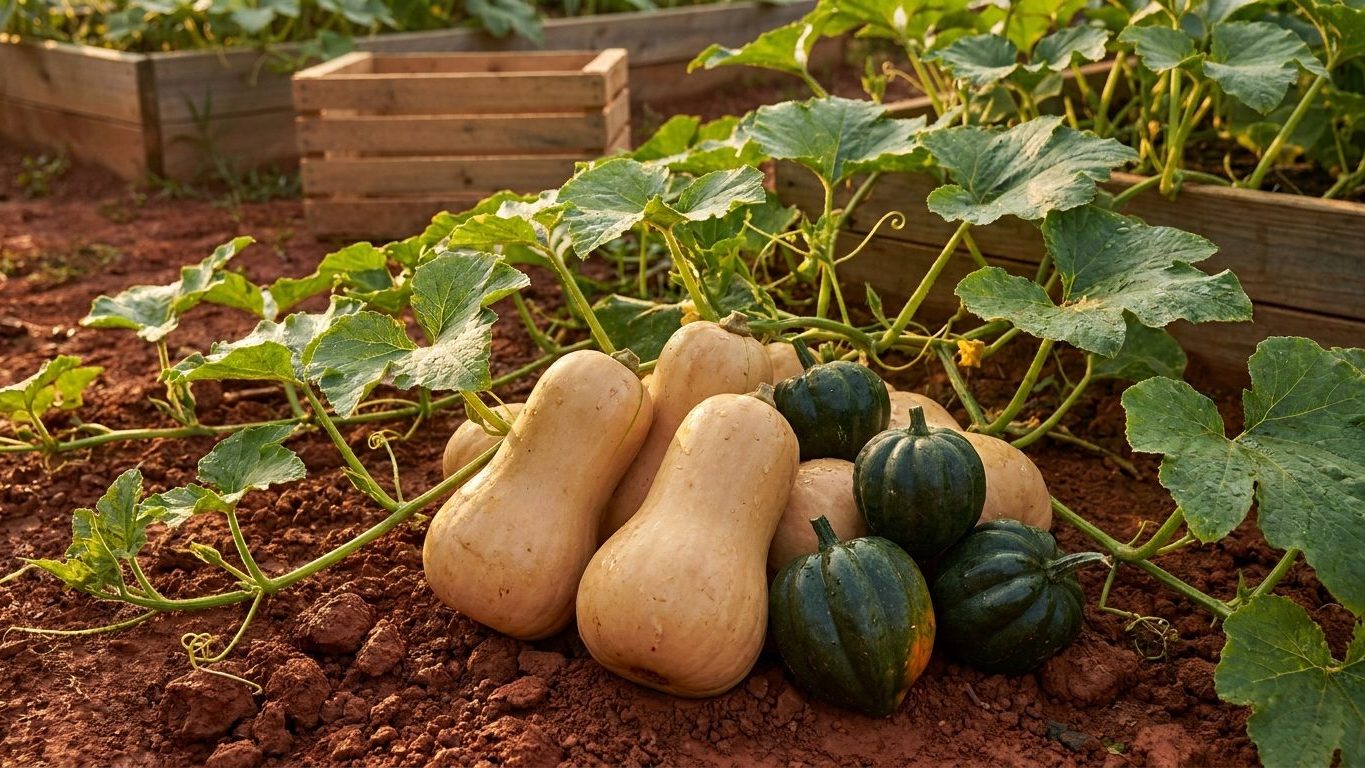

Winter squash success in Kentucky comes down to matching maturity length to a season that runs roughly 212 to 233 days, and matching watering habits to a summer that packs 37 days above 90F into just three months. Fast-maturing types clear both bars easily. Slow, giant varieties clear the calendar but not always the heat.
The short answer for Kentucky
Start from the two frost windows: last spring frost falls between March 24 and April 4, first fall frost between November 2 and November 12. Pair the latest safe planting date with the earliest fall frost and you get a worst-case season of about 212 days. Pair the earliest planting date with the latest frost and it stretches to 233 days. Either way, that is a long season by winter squash standards, and it changes which types deserve consideration here.
Fast-maturing types, acorn and delicata among them, typically finish in 80 to 100 days. Planted even at the late end of the spring window, they are done and curing well before the earliest fall frost date arrives. Butternut and spaghetti squash, usually 90 to 110 days, still finish with a comfortable buffer in a worst-case year. Hubbard and the larger kabocha types run longer, often 110 to 120 days, and here the margin gets tighter: planted late and hit by an early fall frost, there is less slack for the fruit to finish curing on the vine before it needs to come off the ground.
The hardiness zone rating (6a-7a across the state, per the USDA Plant Hardiness Zone Map) does not factor into this decision the way it might for a perennial. Winter squash is an annual killed outright by frost, not something that overwinters in the ground, so the frost-date window drives the variety choice, not the winter minimum temperature the zone map measures.
| Type | Typical days to maturity | Fit within Kentucky’s 212-233 day season |
|---|---|---|
| Acorn / Delicata | 80-100 days | Wide margin, even planted late |
| Butternut / Spaghetti | 90-110 days | Comfortable margin |
| Hubbard / Large Kabocha | 110-120 days | Fits, but tighter in a worst-case year |
The bigger filter for Kentucky is not the calendar. It is the heat load, and that is the subject of the next section.
What will not work here

Season length is not the trap in Kentucky. Heat and moisture timing are. The reference station averages 37.2 days a year at or above 90F, almost all of them landing in July and August, right when squash vines are flowering hardest. Sustained heat during that window drops blossoms and shifts the flower ratio toward more males and fewer females, which means fewer pollinated fruit even when bees are working the patch. A variety that flowers over a long, drawn-out period is more exposed to this than one that sets its fruit in a tighter burst early in the season.
Watering habits compound it. Summer rainfall averages about 12 inches across June, July and August, but it does not arrive evenly: June brings 4.27 inches, July 4.05, and August drops to 3.71, the driest of the three. August is exactly when many varieties are sizing fruit and need steady moisture at the root zone. A gardener watering once a week on the theory that “it rained enough this summer” is working from an annual average that does not hold up in the driest month, and on sandy soil that same rain drains through in a day, leaving the root zone dry again well before the next watering.
Humidity is the third piece. Warm nights plus August rainfall create the kind of damp, still air that favors powdery mildew on squash leaves, and the disease spreads fastest where vines are planted close and airflow is poor. Sprawling, dense-vined varieties packed into a small bed are the most exposed. Wide spacing, or a bush-type variety that keeps its foliage more compact, holds up better under Kentucky’s combination of heat and humidity than a variety bred for a drier, cooler climate that happens to have the right days-to-maturity number.
Put together, what fails here is rarely a plant that ran out of season. It is a plant that dropped blossoms in a July heat run, or went thirsty in an August dry spell, or caught mildew in a crowded, humid bed before the fruit finished sizing.
What changes across Kentucky
Kentucky spans hardiness zone 6a to 7a, and that spread by itself tells you there is no single answer for the whole state. A garden at the cooler end of that range, typically higher ground or the state’s northern edge, works with a shorter effective season than one at the warmer end. The frost-date window cited above (March 24 to April 4 for the last spring frost, November 2 to November 12 for the first fall frost) is drawn from a single reference station, and USDA’s National Weather Service office in Louisville has flagged that this urban station itself runs later in spring and earlier in fall than the rural county around it. A rural garden anywhere in the state should assume a tighter frost-free window than the station numbers suggest, not a wider one.
That has a direct effect on variety choice. A grower working from the shorter end of the range, whether because of elevation, latitude, or rural exposure, gets more benefit from leaning toward the 80 to 100 day types and less margin to gamble on a 120-day hubbard planted a week late. A grower at the warmer, longer-season end of the state’s spread has more room to plant a slower variety and still finish comfortably.
None of this is a reason to guess. It is a reason to check where a given property actually sits within that 6a-7a spread before picking a variety, rather than assuming the state-level frost dates apply evenly from the Ohio River to the Cumberland Plateau. The next section covers where to find that local answer.
Where to check this for your own county
Everything above is a state-level picture, built from one reference station and a statewide hardiness zone range. It is useful for narrowing down squash types, but it is not a substitute for a county-level answer, and Kentucky has one available. The Cooperative Extension Service publishes planting calendars and variety guidance organized by county, and that is where the frost dates and variety notes cited here should get checked against local conditions.
Two things are worth asking the local extension office specifically. First, the planting calendar for that county, since frost timing shifts with elevation and local terrain in ways a single statewide station cannot capture, particularly given the known lag between the urban reference station and surrounding rural areas. Second, which winter squash varieties have actually been trialled or recommended for that county, since local extension agents often track what has performed well against local disease pressure and soil conditions, information this state-level page does not have.
A county recommendation beats a state one every time, for the simple reason that it is built on conditions closer to the actual garden. Statewide frost-date ranges and a statewide hardiness zone spread are useful for a first pass at variety selection, but neither one is adjusted for a specific county’s soil, slope, or microclimate. Treat what is written here as the starting filter, and the extension office as the source that narrows it down to what actually grows well a few miles from home.
Checking this against your own garden
Frost dates and rainfall averages describe a region. They do not describe a specific patch of ground, and the garden itself will always have the more current answer. Three things to watch, none requiring anything more than hands and eyes.
Soil warmth by feel, checked by pushing a finger a couple of inches into the planting bed in the morning before the sun has warmed the surface. Winter squash seed sits and rots in cold soil rather than germinating, so a bed that still feels cool and damp days after the calendar says it should be plantable is telling the gardener that this particular spot, maybe shaded, maybe low-lying, runs behind the regional average.
The first flush of male flowers, which typically opens well before any female flowers appear and before any fruit can set. A long stretch of male-only blooms during a hot spell is a sign the plant is under heat stress and holding back on female flowers, the exact pattern described above for Kentucky’s 90-degree-plus stretches. That is a cue to increase watering consistency rather than wait it out.
The first true leaves, the second set that appears after the initial rounded seed leaves, since their timing shows how the plant is actually responding to the soil and light in that spot compared to a neighbor’s garden or a seed packet’s stated timeline. A plant slower to reach true leaves than expected is reporting on its own microclimate, and that report outranks any regional average.