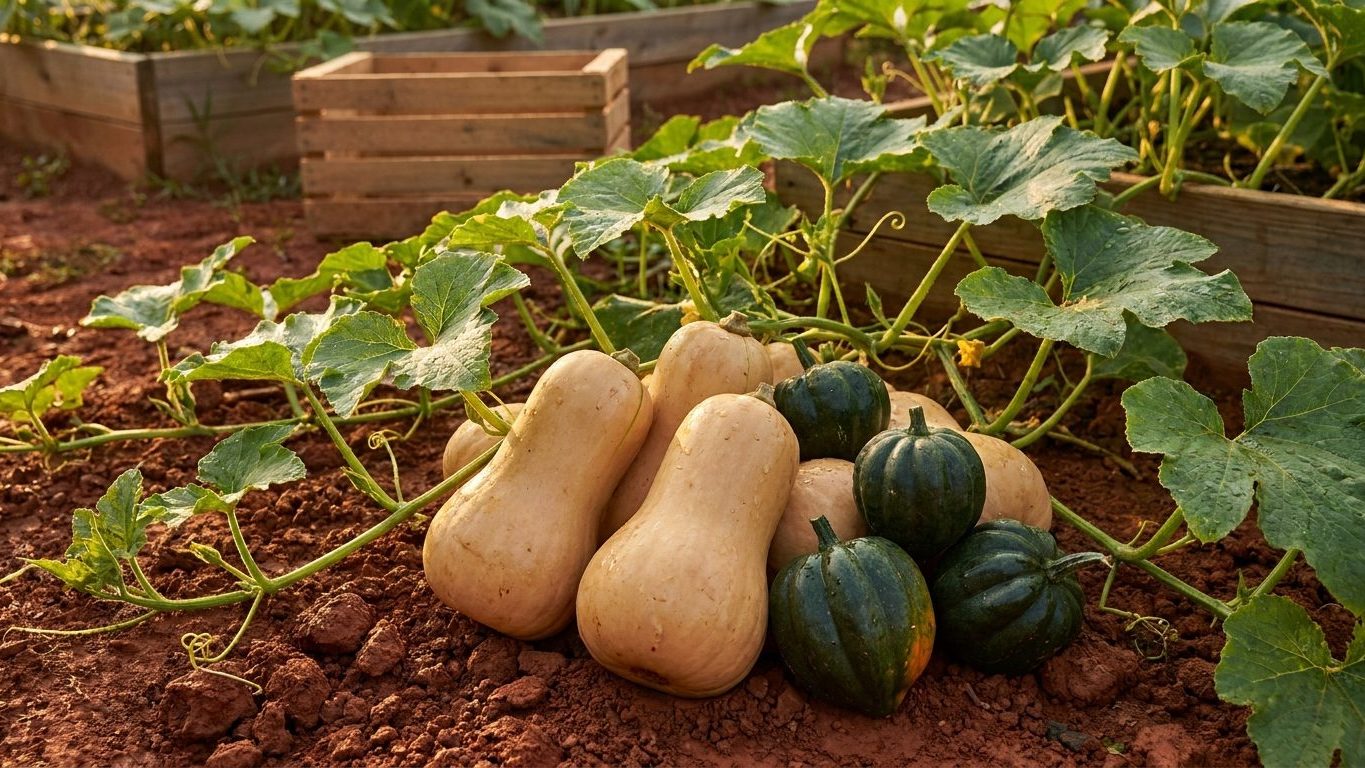

Maine’s growing season runs roughly from the last frost in late April or early May to the first fall frost in mid-October, giving most of the state somewhere between 140 and 160 frost-free days depending on location. That window rules out the slowest-maturing winter squash and favors varieties bred for short, cool seasons: acorn, buttercup, and delicata over butternut or the giant Hubbards.
The short answer for Maine
Acorn squash is the safest bet almost anywhere in the state. Most acorn varieties mature in 80 to 95 days, which fits comfortably inside Maine’s frost-free window even on the shorter end. Buttercup squash runs close behind, typically 95 to 105 days, and its dense, sweet flesh holds up well in the state’s cooler nights. Delicata, often overlooked, matures in about 80 days and tolerates the erratic early-season temperature swings that show up along the coast and in river valleys.
Butternut is the variety that separates a good Maine garden from a struggling one. Standard butternut needs 100 to 120 days of reliable warmth, and in a season where the last frost lands on May 1 and the first fall frost arrives October 9, that leaves as few as 131 days total, not all of them warm enough to push a heat-loving vine. Newer short-season butternut types bred for 85 to 100 days close that gap, and they’re worth seeking out specifically for Maine rather than assuming any butternut seed packet will do.
Hubbard squash, the classic New England storage squash, is a mixed bag. It needs 100 to 115 days and a good stretch of heat to size up properly. Coastal Portland’s mild frost dates give it a fighting chance; inland and northern growers are gambling with a variety that may not fully mature before the first hard frost.
The days-above-90°F figure for the reference station sits at just 3.8 per year, which tells the real story here: Maine is not a heat-driven growing region. Every winter squash variety that depends on sustained heat to convert its starches into full flavor and dense flesh is working against the climate, not with it. That’s why the varieties that succeed reliably in Maine gardens tend to be the ones bred for cooler summers and shorter days, not the ones bred for maximum size or the longest storage life. A gardener choosing between a 90-day acorn and a 120-day Hubbard is choosing between a squash that finishes and one that’s racing the calendar.
Spaghetti squash, at 90 to 100 days, sits in the same comfortable middle ground as buttercup. It’s a reasonable choice for most of the state, though northern and high-elevation gardens should treat it the way they’d treat butternut: fine in a warm year, risky in a cool one.
What will not work here
Long-season Hubbard varieties and full-size butternut are the two most common disappointments in Maine winter squash beds. Both were bred for regions with a longer run of warm nights and more accumulated heat than Maine’s 3.8 days above 90°F can offer in an average year. A butternut vine that needs 120 days planted right after the May 1 frost date won’t reach maturity until early September in the best case, and any early fall frost, even one arriving on the early end of Maine’s October 9 to October 21 window, cuts the ripening process short. The result is a pile of squash with hard, pale flesh and thin skin that won’t cure or store.
Giant pumpkin-type winter squash and the largest Hubbard cultivars fail for the same reason, compounded by size: bigger fruit needs more total heat units to finish, not just more days. A gardener who’s grown giant squash successfully in Ohio or Pennsylvania will find the same seed performing poorly here, because the problem isn’t the calendar day count, it’s the accumulated warmth those days provide.
Watering habits imported from hotter, drier states also cause trouble, just in the opposite direction. Maine’s summer rainfall averages about 11.2 inches across June, July, and August, with July as the driest month at 3.43 inches. That’s a meaningful amount of natural moisture, and a gardener used to watering winter squash on a strict weekly schedule, a habit that makes sense in a drier climate, risks overwatering here, especially on clay soils that hold moisture for days after a rain event. Overwatered winter squash vines are more prone to powdery mildew and blossom drop, both common complaints in humid Maine summers.
Spacing mistakes tied to humidity
Maine’s rainfall doesn’t arrive as a steady drizzle. It tends to come in thunderstorm bursts, particularly in June, which means foliage gets soaked and then stays wet for hours in humid, low-airflow plantings. Winter squash spaced the way a catalog recommends for a drier climate, tight rows meant to save space, will hold that moisture on the leaves longer and invite fungal disease. Wider spacing than the seed packet suggests, with attention to airflow between plants, matters more in Maine than in a drier state growing the same variety.
What changes across Maine
Maine spans USDA hardiness zones 3b to 6a, a range wide enough that a single planting recommendation for “Maine” is really an average of very different growing realities. Zone 6a, the milder end, covers parts of the coast near the reference station; zone 3b, the coldest, reaches into the state’s northern interior and higher elevations. That’s not a minor spread. It’s the difference between a coastal garden that might squeeze in a 100-day butternut in a warm year and a northern garden where even a 90-day acorn is pushing its luck.
The frost date ranges, a last spring frost between April 22 and May 1 and a first fall frost between October 9 and October 21, describe the milder, coastal end of that spread. A gardener working land at higher elevation or further north and inland should expect a later last frost in spring and an earlier first frost in fall than these figures show, which shortens the already tight window for slower varieties even further.
Practically, this means the “safe” list for Maine, acorn, delicata, and short-season buttercup, gets safer the further north or higher up a garden sits, while the riskier choices, butternut and Hubbard, become reasonable gambles only in the state’s mildest pockets. A gardener in a zone 6a coastal spot has real flexibility. A gardener in a zone 3b northern county is better off treating every borderline variety as a no.
The USDA Plant Hardiness Zone Map, built on average annual extreme minimum temperatures, is the tool for that, and it’s worth checking directly rather than guessing from a town name, since local terrain and elevation shift zones within short distances.
Where to check this for your own county
Maine at the state level is built around the frost dates and heat normals from a single reference station. That’s useful for comparing varieties in general terms, but it’s not a substitute for what University of Maine Cooperative Extension publishes for individual counties. A county-level recommendation accounts for local microclimate effects, soil surveys, and years of variety trials that a statewide page simply can’t capture.
The extension service is reachable at extension.umaine.edu. Two things are worth looking for there specifically. First, the local planting calendar for the reader’s own county, which will narrow the frost date ranges given here down to something more precise for that specific location, particularly important given how much Maine’s frost timing shifts between the coast and the interior. Second, any variety trial results the extension office has published for winter squash grown in that county’s conditions, since these trials test how specific cultivars actually perform against local soil, rainfall, and pest pressure rather than relying on the seed catalog’s general maturity estimate.
County extension offices also tend to track disease and pest issues specific to their area, which matters more for winter squash than it might seem. Squash vine borer and powdery mildew pressure both vary meaningfully across Maine’s counties depending on local humidity patterns and previous season’s pest populations, information a statewide page has no way to reflect.
The state-level answer is a starting point. It’s a reasonable starting point for narrowing down variety types by maturity length and heat tolerance, but the county extension office is where that general answer becomes a specific one, tied to the reader’s actual soil, actual microclimate, and actual local growing history.
Checking this against your own garden
Every date and range describes averages built from decades of weather data. A reader’s own garden, on any given year, might run ahead of or behind those averages, and three direct observations settle that faster than any calendar.
Soil warmth by feel is the first and most reliable check. Winter squash seed germinates poorly in cold soil, and a gardener can simply press a hand into the planting bed a few inches down. Soil that still feels cold and damp in early May, even after the calendar’s last frost date has passed, signals a slower-warming microclimate, often tied to heavy clay, shade, or low-lying ground that holds cold air.
The first flush of male flowers is the second signal. Winter squash produces male flowers before female ones, and a healthy flush of male blooms shows the plant has moved past its early establishment stress and into active growth. If male flowers are slow to appear well past the point other seasons have shown them, that’s a sign the plant is running behind the season, whether from a cool spring, poor soil fertility, or transplant shock.
The first true leaves, the leaves that appear after the initial seed leaves and actually look like squash foliage, mark the point where the plant has shifted from surviving on stored seed energy to actively photosynthesizing. Their timing, compared against when they appeared in a previous season on the same plot, is one of the clearest personal benchmarks a gardener can build over a few years of growing in the same spot, more reliable for that specific garden than any regional frost date.