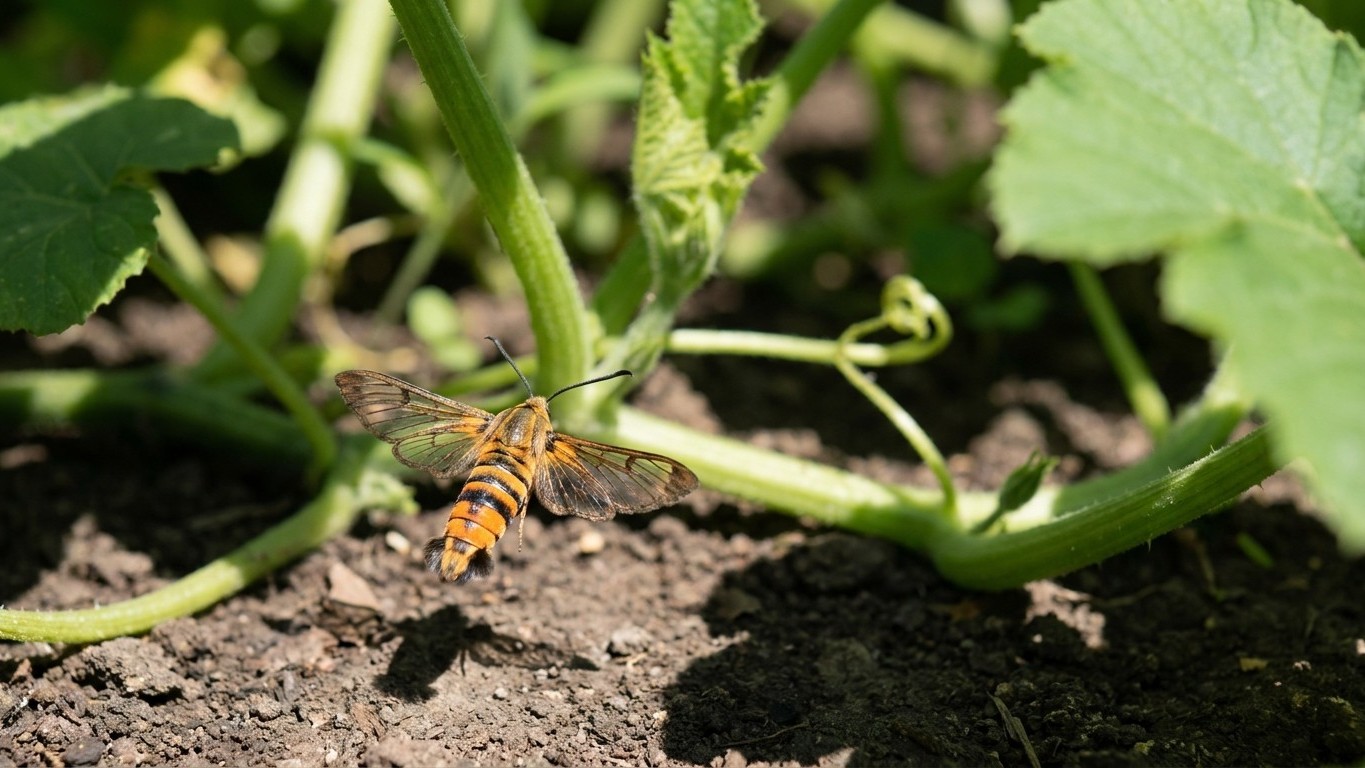

Squash vine borer becomes a real threat to Maine gardens starting in late June, with peak activity through July and into early August. Unlike southern states where this pest cycles through two generations a season, Maine’s shorter growing window limits it to one generation a year, which actually gives northern gardeners a narrower, more predictable window to intervene.
That single-generation pattern is the most important thing to understand if you grow squash, zucchini, or pumpkins anywhere from Portland to Presque Isle. Miss the early window and you’re often looking at collapsed vines by August, with little to salvage.
The weeks to watch

The adult moth overwinters as a larva or pupa tucked inside a tough cocoon in the top few inches of soil. It doesn’t stir until soil temperatures climb enough to trigger emergence, which in Maine’s cooler spring usually lags two to four weeks behind Massachusetts or Connecticut. Gardeners in southern Maine (York and Cumberland counties) typically see the first adults in the last week of June. Farther north and inland, in Aroostook or Franklin counties, emergence can push into mid-July.
The adult itself is easy to mistake for a wasp. It has an orange and black body, clear hind wings, and flies during the day rather than at night like most moths. That daytime activity means you can actually spot it hovering around the base of your squash plants if you’re paying attention in early summer.
Once mated, the female lays eggs individually at the base of stems, often right where the stem meets the soil. Eggs hatch within a week to ten days, and the young larvae immediately tunnel into the stem. From that point, the damage is happening inside the plant, out of sight, for roughly four to six weeks before the larva finishes feeding and drops back into the soil to overwinter.
Why Maine’s short season changes the strategy
With only one generation, Maine gardeners don’t need to worry about a second wave of adults emerging in August like growers in Virginia or the Carolinas do. That’s the upside. The downside is that the state’s cool, wet springs can delay squash planting, which sometimes lines up young, tender plants exactly when the borer moths are most active, since there’s less time buffer between planting and moth flight.
Which plants get hit hardest
Not every squash plant is equally vulnerable. The borer strongly prefers plants with hollow or semi-hollow stems, which puts summer squash and zucchini at the top of the target list. Pumpkins and most winter squash varieties with hollow stems, like acorn and delicata, are also frequently attacked.
Butternut squash stands out as a partial exception. Its stem is more solid and less hollow than other cucurbits, which makes it noticeably harder for larvae to establish inside. Gardeners who’ve lost zucchini to borers year after year sometimes shift toward butternut for that reason alone, though it’s not a guarantee against damage, just a lower-risk option.
Cucumbers and melons are rarely bothered. If your cucumber vines are wilting but your zucchini next to them looks fine, vine borer usually isn’t the culprit, another pest or a soil-borne disease is more likely.
Spotting the damage before it’s too late
The classic sign is sudden wilting of a single vine or an entire plant, even though the soil is moist and the rest of the garden looks healthy. This happens because the larva has chewed through the internal tissue that moves water up the stem, so the leaves are essentially cut off from their water supply even while sitting in wet soil.
Look closer at the base of the stem and you’ll often find a small entry hole with a sawdust-like frass pushed out, greenish-yellow and slightly wet-looking. That frass is the giveaway. Aphid damage, squash bug feeding, and bacterial wilt can all cause wilting too, but none of them produce that telltale sawdust residue at the stem base.
By the time wilting is visible, the larva has usually been feeding for one to three weeks already. That’s the frustrating part of this pest: the damage is invisible until it’s already substantial, which is why prevention matters more than reaction.
What actually stops Squash vine borer in Maine gardens
Row covers are the single most effective preventive tool, and Maine’s timing makes them especially practical. Since moth flight doesn’t typically start until late June, gardeners who plant squash in May or early June can keep floating row covers on for the first several weeks of growth, physically blocking females from reaching the stem base to lay eggs.
The covers need to come off once the plants start flowering, since squash depends on bees for pollination and a sealed cover blocks that access too. This creates a short window of vulnerability right at flowering, which is exactly when many Maine gardeners see their first egg-laying activity, so timing the cover removal to coincide with the tail end of moth flight (rather than the moment the first flower opens) reduces exposure.
A few other tactics work well together:
- Stagger planting dates by two to three weeks so not every plant is at peak vulnerability during the same moth flight window.
- Mound soil or wrap stem bases with aluminum foil or nylon stocking material to create a physical barrier at the exact spot where eggs are laid.
- Check stems weekly starting in late June, running a finger along the base of each plant to feel for the slightly soft texture that signals early tunneling.
- Remove and destroy spent vines at the end of the season rather than tilling them into the soil, since larvae inside old stems can still complete their cycle and overwinter.
Yellow pan traps filled with soapy water, placed near squash plants starting in mid-June, can help home gardeners track when adult moths become active in their specific location. Since Maine’s climate varies enough between the coast and the interior that emergence dates shift by weeks, a trap gives you a personalized signal rather than relying on a statewide average.
If borers are already inside the stem
Once you’ve found frass and confirmed a larva is inside, a targeted surgical approach can sometimes save the plant. Slitting the stem lengthwise near the entry hole with a sharp knife, removing the larva by hand, then mounding moist soil over the wounded section to encourage new root growth, works often enough to be worth trying on a plant you’d otherwise lose.
This only works if you catch it early, while the plant still has enough healthy stem tissue to recover. If wilting has spread through most of the vine, the stem is already too compromised and removing the plant to prevent the larva from completing its cycle in your soil is the more practical move.
Insecticide applications aimed at the stem base, timed to the egg-laying period rather than after larvae have tunneled in, can help in years with heavy moth pressure, but timing has to be precise since sprays don’t reach larvae once they’re inside the plant. For most home gardeners in Maine, physical barriers and vigilant stem checks do more good than chemical control, largely because the population pressure here tends to be lower than in warmer states with two generations per year.
Crop rotation offers a modest benefit too. Since larvae pupate in the soil directly beneath where the infested plant grew, moving squash to a different part of the garden the following year forces emerging adults to travel farther to find a host, which reduces but doesn’t eliminate the risk.
Related guides
- Squash vine borer in New Hampshire: When It Shows Up and What Stops It
- Squash vine borer in Manitoba: When It Shows Up and What Stops It
- Squash vine borer in Maryland: When It Shows Up and What Stops It
- Squash vine borer in South Dakota: When It Shows Up and What Stops It
- Squash vine borer in Quebec: When It Shows Up and What Stops It