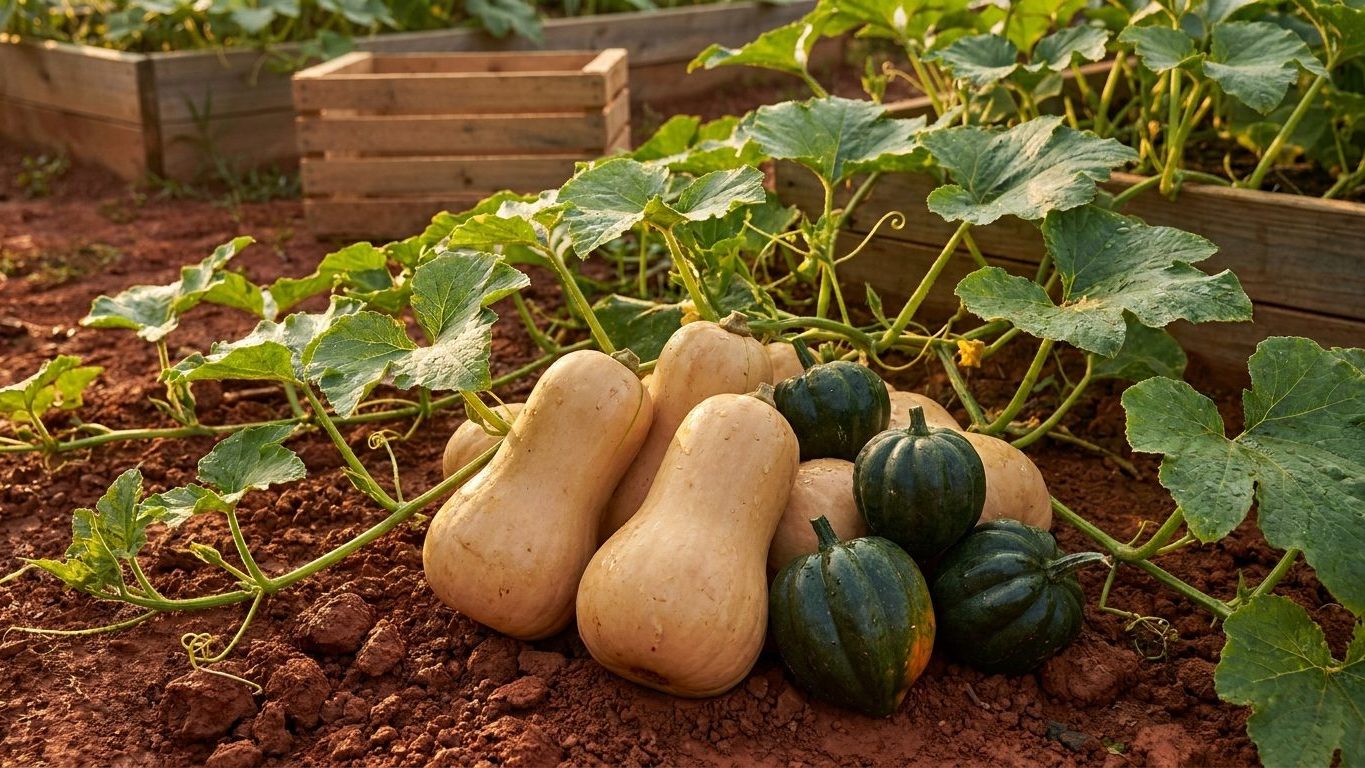

Short-season winter squash wins in Montana: acorn, delicata, buttercup, and spaghetti squash mature fast enough to beat the state’s frost dates. Long-season types like giant Hubbard or banana squash need a growing window most of Montana simply doesn’t have, except in a handful of milder valleys.
The short answer for Montana
Start with the number that actually matters: the frost-free window. At the Billings reference station, the last spring frost falls between April 29 and May 10, and the first fall frost arrives between October 1 and October 14. Stack the earliest spring date against the latest fall date and you get roughly 168 frost-free days in a good year. Stack the latest spring date against the earliest fall date and that window shrinks to around 144 days. And Billings is one of Montana’s milder valleys, not the state average.
That range decides which winter squash have a real shot at maturing before a hard freeze ends the season. Squash types that finish in 80 to 100 days from transplant, acorn, delicata, buttercup, and spaghetti squash among them, fit comfortably inside even the shorter 144-day version of that window. Butternut sits closer to the edge, often needing 100 to 115 days depending on the variety, which still works in most years but leaves less margin for a cool, wet spring that delays transplanting.
| Squash type | Typical days to maturity | Fits a 144-day window? | Fits a 168-day window? |
|---|---|---|---|
| Acorn | 75-90 | Yes, with room to spare | Yes |
| Delicata | 90-100 | Yes | Yes |
| Spaghetti | 85-100 | Yes | Yes |
| Buttercup | 90-105 | Tight, needs transplants | Yes |
| Butternut | 100-115 | Risky | Usually |
| Giant Hubbard / banana squash | 110-130 | No | Rarely |
The heat side of the equation matters too. Billings averages 28.3 days a year at or above 90 degrees, which is enough to push flowering and fruit set along quickly once the plants get going, but not so much that heat stress becomes the limiting factor the way it does farther south. In Montana, the season’s length is the constraint, not its intensity.
What will not work here

Giant Hubbard squash and banana squash are the two varieties most likely to disappoint a Montana gardener. Both routinely need 110 to 130 days to reach full maturity and develop the hard, storage-ready rind that defines a winter squash. Even in the milder Billings valley, a 144-day season leaves almost no cushion for a late transplant, a cool spell in June, or a wet week that delays fruit set. Push those varieties into a shorter-season part of the state and they simply run out of daylight before the vines finish their work, leaving green, thin-skinned fruit that won’t cure or store.
Direct-seeding any Winter Squash in Montana carries the same risk in miniature. Seed sown straight into cold spring soil sits and sulks rather than germinating, and every week lost at the start comes straight out of the maturity window at the end. Starting seed indoors three to four weeks before the last frost date and setting out sturdy transplants effectively buys back that lost time, which is often the difference between a butternut that finishes and one that doesn’t.
Water is the second failure point
Montana summers are dry. The Billings normals show about 4.3 inches of rain across June, July, and August combined, and August itself averages just 0.87 inches, the driest month of the growing season. Winter squash vines are heavy feeders on water, especially while fruit is sizing, and a garden that relies on rainfall alone through summer will see stunted vines, blossom drop, and small, poorly filled fruit. Watering once a week and hoping for the best does not match this climate. Squash beds here need a deliberate irrigation plan, deep and regular, because the rain simply isn’t going to show up on its own schedule, and a single summer thunderstorm mostly runs off dry ground rather than soaking down to the root zone.
Skip the varieties bred for humid, rain-fed regions that assume the sky will do the watering. In Montana, that assumption fails almost every summer.
What changes across Montana
Montana is not one growing zone, and treating it like one is where a lot of squash plantings go wrong. The USDA Plant Hardiness Zone Map places the state anywhere from zone 3a to zone 6a, a spread built entirely on average annual extreme minimum winter temperature. That’s a five-and-a-half-zone range inside a single state’s borders, and it tells a real story about the growing season, not just the winter.
Billings, the reference point for the frost dates and rainfall figures above, sits on the milder end of that range. Northern Montana and the higher mountain valleys sit much closer to zone 3a, where the growing season is shorter and less forgiving. The caution built into the frost data is worth repeating here: mountain valleys elsewhere in Montana can see a freeze in any month of the year, something that simply doesn’t happen in the milder valley the Billings numbers describe.
What that means practically: a gardener in a colder, higher-elevation part of the state should lean harder toward the fastest-maturing squash on the list, acorn and delicata over buttercup or butternut, and should treat every trick that adds heat or shaves days off the calendar, black plastic mulch, row covers, transplants started a week or two earlier indoors, as closer to necessary than optional. A gardener in one of the milder valleys has more room to experiment with butternut or even push toward buttercup with less risk. There is no single answer for “Montana” here. There’s a spread, and where a specific garden falls in that spread changes the whole calculation.
Which end of that spread applies to a given property is a question for the hardiness zone map. That’s what the hardiness zone map itself is for.
Where to check this for your own county
Montana at the state level is described by normals from one reference station. A real planting decision for a specific piece of ground needs county-level information, and that’s exactly what the Montana State University Extension provides.
Two things are worth looking for once there. First, the local planting calendar for the specific county, which will reflect the actual frost dates and elevation of that area rather than the Billings normals used here. A county in the Bitterroot Valley, a county up near Glacier, and a county down in the Yellowstone Valley can all carry meaningfully different dates, and the extension office serving that county has worked with growers on the ground long enough to know the local pattern. Second, look for any variety trial results or recommended cultivar lists specific to that county or region. Extension offices in short-season states often run their own variety trials precisely because a squash that performs well in a national seed catalog description doesn’t always perform the same way at 4,500 feet in Montana.
A county recommendation will always beat a state-level one. Think of this as the map and the county extension office as the terrain.
Checking this against your own garden
Every date here is a normal built from thirty years of station data, not a promise about this particular spring in this particular yard. The garden itself will always give better information than any calendar, and three simple observations tell most of the story.
Soil warmth by feel is the first. Winter squash seed and transplants sulk in cold ground no matter what the calendar says, so before planting, dig down two or three inches and feel the soil rather than trust the date. Ground that still feels cold and damp in the hand, even on a warm, sunny day, means the microclimate in that spot is running behind the regional average, and pushing transplants in early will only stall them.
The first flush of male flowers is the second signal worth tracking. Squash plants typically produce a wave of male blossoms before the female flowers, the ones with a tiny swollen bulb behind the petals, appear and start setting fruit. A garden that’s running warm and on pace will show that first male flush noticeably earlier than a garden in a cooler pocket nearby, even one just a few blocks or a few hundred feet in elevation away.
The appearance of the first true leaves, the second set that emerges after the initial rounded seed leaves, marks the point where the plant has real energy reserves and is settling into steady growth. If that first true-leaf set is slow to show up compared to what a neighbor’s garden or a seed packet’s timeline suggests, that’s the garden itself reporting a cooler, slower microclimate than the regional average, which is exactly the kind of local detail no state-level page can capture.