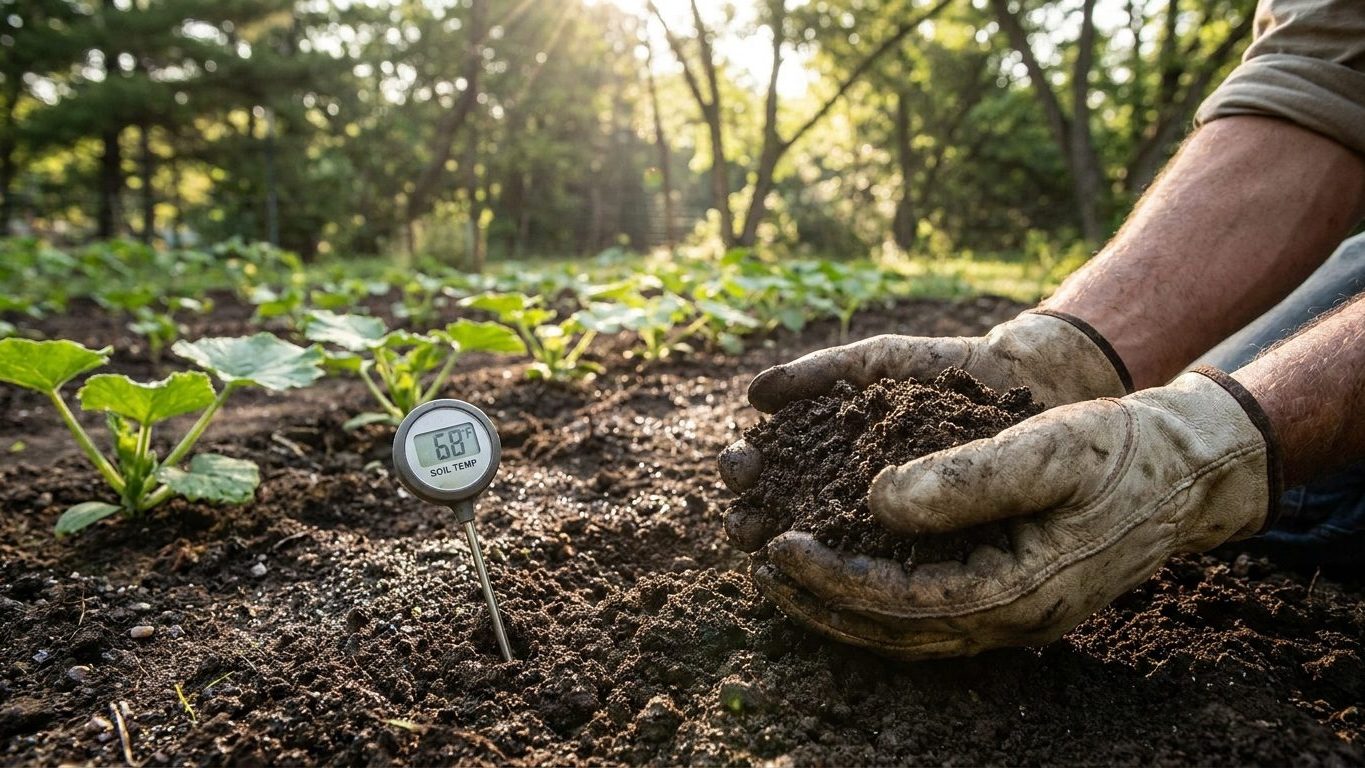

Winter squash goes into New Hampshire ground once the soil has warmed past 60°F and the last spring frost has passed, typically in the back half of May near the reference station. Count backward from October to pick a variety that finishes before frost shuts the garden down. That’s the calendar in one sentence. The rest is about which numbers you’re actually trusting.
The short answer for New Hampshire
NOAA’s 1991-2020 normals put the last spring frost at the Manchester reference station between April 16 and April 27, and the first fall frost between October 13 and October 26. Those two windows aren’t guesses. They’re the 30-70% probability band for a 32°F freeze, meaning on any given year there’s a real chance of frost landing earlier or later than either edge. Winter squash seed doesn’t germinate well in cold soil anyway, so gardeners here usually wait a week or two past the last-frost window, direct-sowing once soil has held steady warmth, rather than racing the calendar date itself.
That pushes direct seeding into the first half of May for most winter squash types (butternut, acorn, delicata) and sometimes later for growers who start seedlings indoors three to four weeks ahead and transplant after the frost risk has genuinely passed. The transplant route buys time but adds transplant shock risk if soil hasn’t caught up to air temperature.
The harder number is the fall side. Winter squash needs 80 to 110 days from seed to harvest depending on variety, and vines need those days to be warm ones, not just frost-free ones. If you take the early edge of the fall frost window, October 13, and count backward 100 days, you land around July 5. That’s alarmingly early, and it’s the reason a mid-May sowing date isn’t actually flexible for slower varieties: miss it by two weeks and a 100-day squash is racing a fall frost that could arrive before it’s done.
Faster-maturing types (75-85 days) have more cushion. They can go in through late May and still finish with weeks to spare even against the early end of the fall frost window. That cushion matters more in this state than the calendar dates suggest, because the spread between the earliest and latest fall frost date here is thirteen days, not a rounding error.
None of this accounts for a home garden sitting somewhere other than the airport where these normals were recorded. Rural and suburban yards in New Hampshire routinely see later spring frosts and earlier fall frosts than the reference station, sometimes by one to two weeks, more at elevation. Treat the dates above as the state’s reference point, not your yard’s actual risk.
What will not work here
Start with the days-to-maturity math, because it’s the failure mode that catches people every year. A 110-day heirloom variety, sown even right at the early edge of the last-frost window (April 16), needs to finish by early August to have any buffer. But soil in mid-April is rarely warm enough for squash seed to germinate reliably, so real sowing slides into May regardless of what the frost date allows. That compresses the season further. Growers chasing the slowest, largest winter squash varieties in New Hampshire are working against a fall frost that can arrive as early as October 13, and a 110-day count from a realistic late-May sowing lands past that date more often than not.
Heat is the second trap, and it runs the opposite direction from what people expect. The reference station averages just 10.9 days a year at 90°F or hotter. That’s a modest heat load. Winter squash varieties bred for long, hot growing regions (some of the larger squash and pumpkin-type winter squashes) want more sustained warmth than this state reliably delivers, and they respond to a cool, short summer with slow vine growth and undersized fruit rather than outright failure. It’s not a dramatic collapse. It’s a squash that never quite gets there.
Watering habits built for a wetter or drier state also misfire here. Summer rainfall averages about 10.7 inches across June, July and August, with July running driest at 3.3 inches. That’s enough rain to lull a gardener into skipping supplemental watering altogether, but July’s dip means a real dry stretch can open up right when vines are setting fruit and need the most consistent moisture. A garden on sandy soil dries out within a day of that rain; on clay it lingers. Watering on a fixed weekly schedule regardless of what the soil actually feels like is the habit that fails here, in either direction.
Tight spacing is the last one. New Hampshire summers aren’t the most humid in the country, but the rain that does fall tends to arrive in bursts rather than gentle soaking, and vines packed close together stay wet longer after each storm. Powdery mildew and other fungal issues show up faster in crowded plantings here than the seed packet’s minimum spacing suggests.
What changes across New Hampshire
New Hampshire’s USDA hardiness zone range runs from 3b to 6a, a spread built entirely on average annual extreme minimum winter temperature. That’s not a small range. It’s the difference between a coastal or southern garden that rarely sees the deep, prolonged cold of a zone 3b winter, and a northern or high-elevation garden that does every year. This matters for winter squash mainly through what it implies about the growing season length on either end, not the winter cold itself, since squash is a warm-season annual killed by the first hard frost regardless of zone.
A gardener in the state’s southern tier, closer to the milder end of that range, can generally count on a longer stretch between last spring frost and first fall frost than someone farther north or up in elevation. The frost dates cited above come from one station; a garden two hours north or a thousand feet higher will see both frost dates compress toward each other, spring later and fall earlier, shrinking the growing window from both sides at once.
What should a reader in the north or at altitude actually do differently? Lean toward the faster end of the maturity range, the 75-85 day varieties rather than the 100-plus day ones, and treat late May sowing as the safer default rather than an option. Starting seedlings indoors three to four weeks before transplant also buys back some of that lost window, since it shifts the germination and early-growth phase off the outdoor calendar entirely.
There’s no single answer for “when does the season start in New Hampshire” because the state genuinely spans that zone range. A reader trying to pin down exactly where their own garden falls on it should check the map rather than guess from a town name, since elevation and local cold-air drainage shift things in ways county lines don’t capture.
Where to check this for your own county
The state-level picture is built from one reference station’s normals. That’s useful for understanding the shape of the season, but it isn’t a substitute for a county-level recommendation, and it was never meant to be one. The University of New Hampshire Cooperative Extension is the source built for that finer level of detail.
Two things are worth looking for there specifically. First, a local planting calendar, if the county or regional office publishes one, will reflect actual local frost data rather than a single airport station. Second, records of which winter squash varieties have been trialled or recommended in that specific county. Extension offices often track which varieties actually perform well in local soils and microclimates, information that a state-wide page simply can’t capture because it varies field to field.
A county recommendation beats a state one every time, for the same reason a weather forecast for your actual town beats one for the nearest big airport. This page can tell you the shape of a New Hampshire growing season and where the risks generally sit. It can’t tell you what a particular hillside in a particular county does with cold air on a still night in late April, and that’s exactly the kind of detail extension offices collect.
If you follow the almanac, here is when to plant winter squash by the moon. It is a tradition, not a proven method.
Checking this against your own garden
Every date here is a normal, an average built from thirty years of data at one station. Your own garden will tell you something more current and more specific, if you know what to watch for.
Soil warmth by feel is the first check. Squash seed wants soil that stays warm through the day and doesn’t chill back down hard overnight. If a handful of soil from a few inches down feels cool and slightly damp rather than warm and crumbly, the ground hasn’t caught up yet, regardless of what the calendar says about the last frost having passed.
The first flush of male flowers is the second signal. Squash plants typically produce male flowers before female ones, and a strong early showing of males, several days to a week before any female flowers with the tiny swollen fruit behind the bloom appear, tells you the plant has settled in and is putting energy into reproduction rather than just survival. A long gap with no male flowers at all after weeks of growth suggests stress, often from cooler-than-expected conditions.
Third, watch how fast true leaves develop after the first seed leaves (cotyledons) unfold. Quick, sturdy true-leaf growth within the first one to two weeks signals a microclimate running warmer and more favorable than the state average. Slow, stunted true-leaf growth is worth taking seriously as a sign your particular spot runs cooler than the reference numbers suggest, and that a faster-maturing variety next season might suit it better.