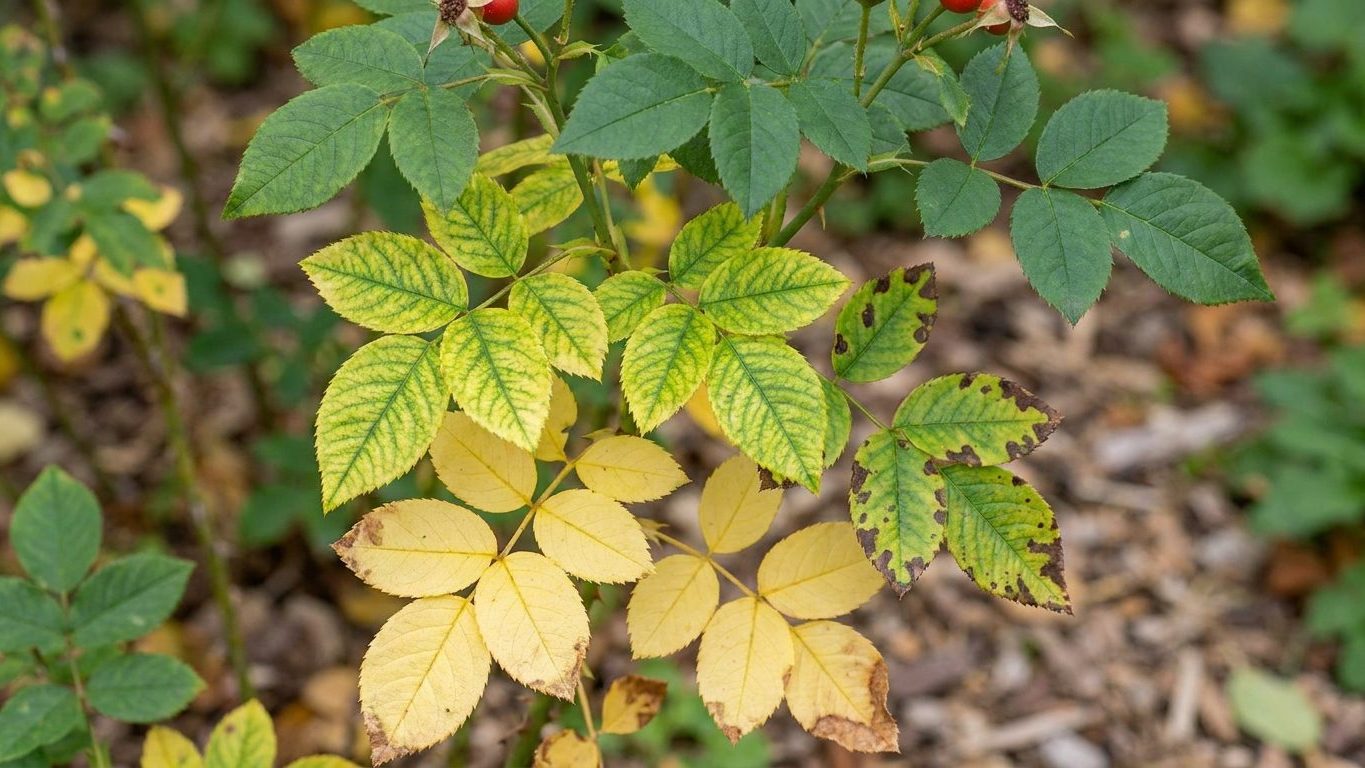

Yellow leaves on roses almost always start at the bottom of the plant, and in most cases they signal something fixable rather than a dying rosebush. The real diagnostic clue isn’t the yellow color itself, it’s exactly which leaves turned first and what’s on them when they did.
What you are looking at
Start at the base of the cane and work up. If the lowest, oldest leaves are turning a uniform pale yellow while the newest growth at the tip stays deep green, that’s one pattern. If instead you’re seeing yellow leaves scattered higher up the plant, with black or purple-edged spots on them before they drop, that’s a different problem entirely, and one that spreads.
Look closely at the yellowing itself. Uniform yellow across the whole leaf, veins included, points one direction. Yellow tissue between veins that stay green, especially on middle-aged leaves, points another. A leaf that goes yellow, then brown, then drops within a week or two behaves differently than one that yellows slowly over a month while clinging to the stem.
Don’t confuse this with a few things that look similar but aren’t the same issue. New rose growth on many varieties emerges reddish or bronze, not yellow-green, and that’s normal pigmentation, not a deficiency. Some older leaves yellow and drop every year in late summer as the plant sheds its oldest foliage to push energy into new canes, this is routine senescence, not a symptom. And wilted, yellowing leaves following a heavy rain or missed watering stretch often point to root stress rather than a nutrient or disease issue, even though the leaf color looks the same at a glance.
The presence or absence of spots matters more than anything else here. A yellow leaf with no markings at all is telling you about nutrition or water. A yellow leaf with dark, irregular spots ringed by a yellow halo is telling you about a fungus. Check five or six leaves before deciding which pattern you’re actually dealing with, a single leaf isn’t enough to diagnose the whole plant.
What actually causes it
Four mechanisms produce yellow rose leaves, and they don’t overlap as much as gardeners assume.
Nutrient movement, not nutrient absence
Nitrogen is a mobile nutrient inside the plant. When the rose doesn’t have enough, it pulls nitrogen out of its oldest leaves and redirects it to new growth, which is why nitrogen deficiency always shows up on the lowest, oldest leaves first, turning them a flat, even yellow while new tips stay green. This is the most common cause of bottom-up yellowing on an otherwise healthy-looking bush.
Magnesium behaves similarly but produces a different look: yellowing between the veins on middle-aged leaves while the veins themselves stay green, sometimes with a slight reddish tinge at the leaf edge. Iron deficiency does the opposite of both, showing up on the newest leaves first, with strong interveinal yellowing and green veins, usually because soil pH is too high for the rose to take up iron even when it’s present in the soil.
The one that isn’t a deficiency at all
Black spot fungus is the cause most gardeners misdiagnose as a nutrient problem. It infects leaves at any height on the plant, produces circular black or dark brown spots with feathered edges, and the leaf tissue around those spots turns yellow as the fungus kills it. The yellowing here is a side effect of tissue damage, not a deficiency signal, and spraying fertilizer on it does nothing because there’s no shortage to correct. Black spot spreads by water splash, which is why it worsens after rain or overhead watering and why it clusters on lower, more shaded leaves that stay wet longest.
Overwatering and compacted soil cause a fourth pattern: yellowing paired with soft, wilted stems and sometimes a sour smell at the base, because waterlogged roots stop absorbing nutrients at all, mimicking a deficiency even in fertile soil.
What to do now
A leaf that has already turned yellow will not turn green again. That tissue’s chlorophyll is broken down and its nutrients, if the cause was nitrogen or magnesium, have already been pulled back into the plant. The goal now is protecting the leaves that haven’t yellowed yet, not reversing the ones that have.
If the pattern points to black spot, remove and destroy the affected leaves promptly, don’t leave them on the ground under the bush, since fallen infected leaves are the main source of next season’s spores. Prune out any cane with heavy spotting to open up airflow. A fungicide labeled for black spot, applied at the first sign of new spots, protects the leaves that are still clean, but it won’t cure the ones already yellow and dropping.
If the pattern points to nitrogen deficiency, a balanced rose fertilizer applied now, following the label’s rate, feeds the new growth the plant is already redirecting energy toward. Don’t overcorrect with a heavy dose hoping to speed things up, roses take up nitrogen gradually and a large dump can burn roots that are already under stress. If magnesium looks like the culprit, based on that interveinal pattern on mid-aged leaves, a diluted Epsom salt drench (magnesium sulfate) at the base can help, though this only applies if magnesium is actually short, not as a blanket practice.
If the base of the plant is soft, wet, or smells off, stop watering and let the soil dry before doing anything else. Adding fertilizer to a rose with damaged roots from overwatering won’t help and can make the injury worse.
Whatever the cause, this season’s yellowed leaves are gone. The plant’s response to your fix will show up in the next flush of growth, not in the leaves already on the ground.
What does not work
Crushed eggshells scattered around the base are a calcium source, but calcium deficiency isn’t what causes yellow rose leaves, so this does nothing for the actual problem. Gardeners reach for it because it’s a common tomato fix and the logic doesn’t transfer.
Foliar sprays marketed as quick greening treatments, misted directly onto yellow leaves, can’t undo chlorophyll breakdown that’s already happened. A yellow leaf stays yellow no matter what you spray on it. Any visible improvement people report is usually just newer leaves emerging normally while the old yellow ones eventually drop on their own.
Dumping lime into soil “just in case” is a common overcorrection, and if the soil pH is already neutral to slightly acidic, which is what most roses want, added lime pushes it too high and locks up iron, causing the exact interveinal yellowing on new growth that gardeners were trying to prevent. Test soil before adding anything that changes pH.
Stripping off all the lower yellowing leaves as a preventive measure, treating them like they’re contagious even when there’s no black spot present, doesn’t stop nutrient-driven yellowing and just removes leaf surface the plant could still be using for photosynthesis while it redirects nitrogen elsewhere.
Spraying the foliage down with water to “wash off” whatever’s causing the spots, if black spot is present, is the worst instinct of all. Water splash is exactly how black spot spores travel from leaf to leaf, so hosing down an infected bush accelerates the spread rather than cleaning it up.
Preventing it next time
Sanitation matters more than anything else on this list. Clear fallen leaves from under rose bushes every week during the growing season, and do a thorough cleanup at the end of the season, because black spot spores overwinter in leaf litter and reinfect the plant from the ground up every spring. This single habit does more to prevent recurring yellow, spotted leaves than any spray or fertilizer schedule.
Water at the base of the plant, not overhead, and do it in the morning so any splash that does happen has time to dry before evening. This starves black spot of the wet-leaf conditions it needs to establish.
Set up a fertilizing rhythm rather than reacting after leaves have already yellowed. A slow-release balanced feed at the start of the growing season, followed by lighter feedings through the summer, keeps nitrogen available before the plant is forced to cannibalize its own lower leaves.
Prune for airflow. Crowded canes trap humidity around lower leaves, extending the time they stay wet after rain or watering, and that extra wet time is often the difference between a healthy bush and one dealing with recurring black spot every August.
Common questions
Are yellow leaves on roses always a sign of disease?
No. Yellowing on the lowest, oldest leaves with no spots is usually a nitrogen deficiency or normal leaf shedding, not disease. Spots ringed in yellow point to black spot fungus specifically.
Should I remove all the yellow leaves from my rosebush?
Remove leaves with black spot symptoms and dispose of them away from the garden. Don’t strip healthy-looking yellow leaves that show no spotting, since the plant may still be using them while it redirects nutrients to new growth.
Will a yellow rose leaf turn green again if I fix the cause?
No. Once a leaf yellows, that tissue doesn’t recover. Correcting the underlying cause protects the leaves that haven’t yellowed yet and improves the next flush of growth.
Can overwatering cause yellow leaves even in good soil?
Yes. Waterlogged roots lose the ability to take up nutrients regardless of what’s in the soil, producing yellowing that looks identical to a nutrient deficiency until the watering pattern is corrected.