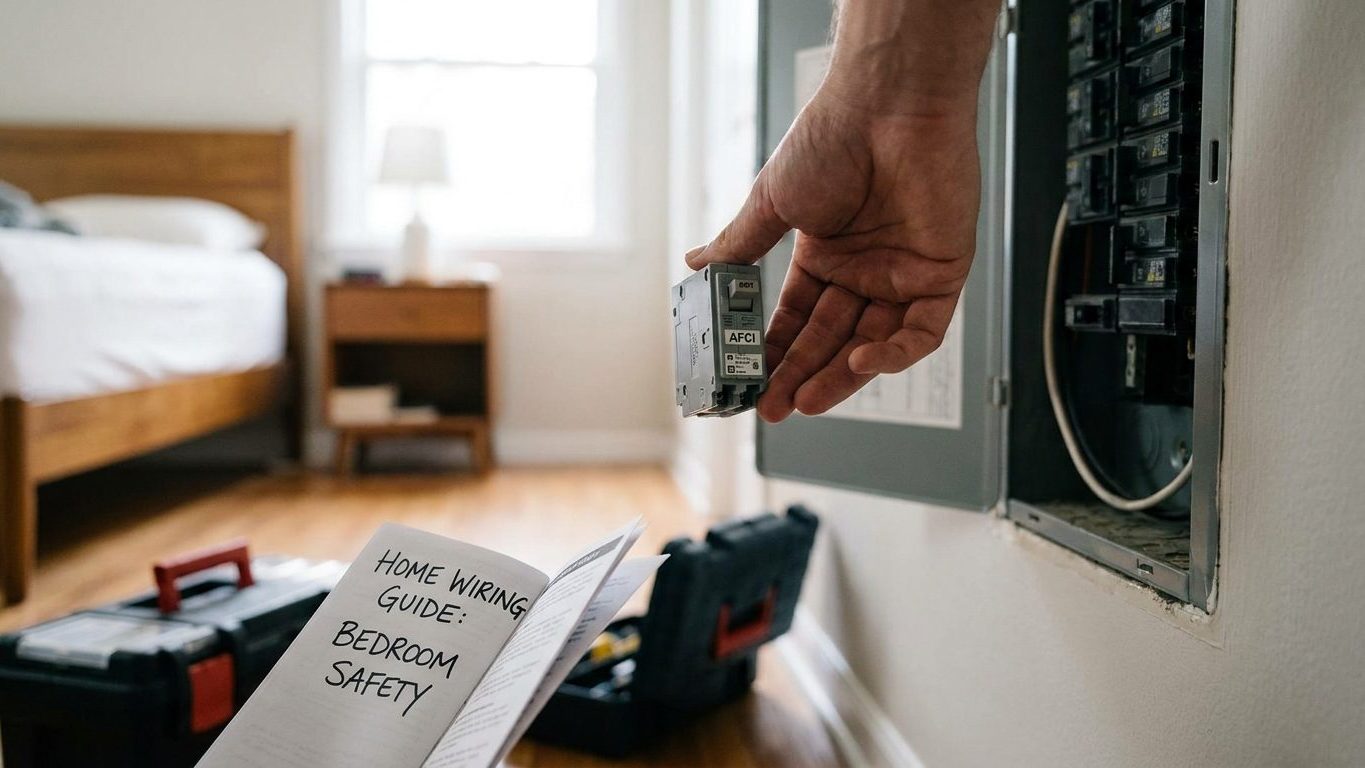

Bedroom circuits carry a rule that other rooms in the house don’t: every 120-volt, 15- and 20-ampere circuit feeding an outlet in that room has to run through arc-fault protection. That’s not tied to how the room gets used day to day, it’s tied to the circuit itself, wherever it runs. Check the breaker for that bedroom at the panel. If it isn’t marked AFCI or Combination AFCI, the circuit as wired today doesn’t meet that standard.
What the code requires on a bedroom circuit

The 2020 National Electrical Code, section 210.12(A), requires arc-fault circuit-interrupter protection on all 120-volt, 15- and 20-ampere branch circuits that supply outlets in a bedroom. This is a requirement, not a trade habit or a builder’s preference. It doesn’t distinguish between a lamp plugged into the wall, a phone charger, or a smoke alarm wired into the same circuit. It applies to the branch circuit as a whole, from the breaker at the panel to the last device on the run.
Where the coverage starts and stops
The scope runs wider than most people expect on first read. “Outlets” in the code’s language covers receptacle outlets, lighting outlets, and anything wired permanently into the circuit, so an overhead light fixture or a ceiling fan on that circuit gets the same protection as the wall plugs beneath it. A single AFCI breaker installed at the panel, or a combination-type device installed at the first outlet on the run, protects everything downstream of it on that circuit.
The requirement also follows the wiring, not the label on a floor plan. A closet or an attached bathroom fed from the same 15- or 20-ampere circuit as the sleeping area doesn’t get an exemption just because it’s technically a different kind of room. Protect the circuit at its source and every outlet downstream, whatever room it happens to sit in, is covered along with it.
What an arc fault is, and why a breaker misses it
A standard circuit breaker is built to catch overcurrent: too many amps drawn at once, the kind of overload that happens when a space heater and a hair dryer share an outlet, or a dead short where a hot wire touches a neutral directly. It trips on current, and only on current.
An arc fault is a different failure entirely. The 2020 NEC, section 210.12, describes what an AFCI is built to catch as the signature of an arcing fault, a damaged cord, a nail through a cable, something a standard breaker has no way to see because it never draws enough current to trip one. A staple driven through cable insulation years earlier, or a nail from a picture hook that just nicked a wire behind the drywall, can arc quietly for a long time before anything looks wrong from the room side.
That’s the gap AFCI protection closes. The device reads the electrical waveform for the specific pattern an arc produces, not just how much current is flowing, and that’s how it catches damage a standard breaker never registers. A lamp cord frayed where it bends into the plug, chewed by a pet, or pinched under a headboard leg for months, is exactly the kind of slow damage that produces that pattern over time rather than all at once.
Bedrooms draw this rule for a plain reason: how they’re furnished. Lamp cords run under rugs, chargers sit behind headboards, extension cords feed a space heater or a string of lights, and furniture gets pushed up against outlets, leaving too little clearance around a bed to keep a cord from getting pinched behind it. None of that is careless. It’s just the ordinary way a bedroom gets used, and it happens to be exactly the kind of slow cord damage an arcing fault comes from.
AFCI is not GFCI, and neither replaces the other
A GFCI protects against a ground fault, the kind that sends current through a person instead of back along its intended path, which matters most near water. An AFCI protects against an arcing fault, the fire hazard described above. The 2020 NEC, sections 210.8 and 210.12, treats these as separate requirements guarding against separate hazards, and AFCI and GFCI are not interchangeable. A bedroom outlet protected only by a GFCI breaker or a GFCI receptacle doesn’t satisfy the bedroom’s arc-fault requirement, even though it’s doing real work against shock.
Some outlets elsewhere in a house need both kinds of protection, a receptacle within a set distance of a sink is the common example, but that’s a different code question from what governs a bedroom on its own. What decides a bedroom circuit is an arc-fault question, not a ground-fault one.
The requirement also shifts depending on whether you touch the circuit. Under the 2020 NEC, section 210.12(D), replacing or extending a bedroom circuit generally triggers the requirement to add AFCI protection, even in a bedroom that was never required to have it when the house was originally wired. Swapping a breaker, adding a receptacle, or extending a cable run into that bedroom is enough to bring the whole circuit under the current rule, not just work done in new construction.
Adoption isn’t uniform either. Not every jurisdiction has taken up the 2020 edition of the NEC on the same timeline, and some adopt it with local amendments, the same way adoption of the International Residential Code and the International Property Maintenance Code varies from one city to the next. A trade habit isn’t enforceable anywhere unless it’s written into a code your jurisdiction has actually adopted, so confirm the edition and amendments in force with your local building department before assuming a section applies exactly as written where you live.
Identifying what your panel already has

You can generally tell what a breaker does without opening a wall. Open the panel door, find the breaker for the bedroom circuit in question, and read what’s printed on the breaker face itself.
What to look for on the breaker
- The words “AFCI” or “Combination AFCI” printed on the breaker face, not on a sticker added after the fact
- A small test button built into the breaker, usually a bright color
- A pigtail or wire lead running off the bottom of the breaker to the panel’s neutral bus, which standard breakers don’t have
- A panel directory, if one exists, listing which breaker feeds which room
The mistake that trips people up most: a GFCI breaker also has a test button and also connects to the neutral bus with a pigtail, so a test button by itself tells you nothing about which protection you actually have. Read the words printed on the breaker face, not just whether it has a button, because a plain GFCI breaker on a bedroom circuit does not meet the arc-fault requirement no matter how similar it looks sitting in the panel.
If the panel directory is missing or out of date, which is common in an older house, tracing the circuit means turning off one breaker at a time and checking which bedroom outlets go dead. Do that with the panel cover in place and only the breaker handles exposed. In a shared kids’ room with a bunk bed pushed against the wall, moving furniture out of the way to reach an outlet is its own hassle, and the same room usually raises a separate question worth checking, how much ceiling height a bunk bed needs, if the top bunk sits anywhere near a fixture on that circuit. If you’re not confident reading a panel safely at all, that’s a job for a licensed electrician rather than a guess with the lights on.
The nuisance trip that gets the protection removed
AFCI breakers do trip on things that aren’t arc faults. Certain vacuum motors, some dimmer switches, and older appliances with worn brushes can all produce a waveform close enough to an arcing signature to trip the breaker. When that happens often, the usual response isn’t to find the cause, it’s to swap the AFCI breaker for a standard one and stop the annoyance. That’s the moment a bedroom’s protection quietly disappears, often without the swap being written down anywhere.
At a home inspection ahead of a sale, that swap tends to get noticed. A missing AFCI breaker on a bedroom circuit, in a house wired recently enough to require one, is exactly the kind of item that shows up on an inspection report and holds up a closing while it gets corrected. On a permitted renovation, the inspector will not sign off on the electrical rough-in if a bedroom circuit lacks arc-fault protection where the code calls for it, and the work has to be reopened to fix it.
The real cost of getting this wrong doesn’t show up until something else goes wrong first. A frayed cord under a rug, a nail through a cable during a later renovation, a wire chewed inside a wall cavity, any of these is the exact failure AFCI protection exists to catch, and a bedroom that’s had its protection pulled for convenience has none of that coverage left when it happens. If a bedroom breaker is tripping often enough that someone’s tempted to swap it for a standard one, that’s a signal to find the actual cause. A licensed electrician can trace a nuisance trip to its source, and your local building department can tell you what’s required for the specific work you’re planning.
Common questions
Does a ceiling light or fan in a bedroom need AFCI protection too?
Yes, if it’s on the same 120-volt, 15- or 20-ampere circuit that also feeds outlets in that bedroom. The 2020 NEC’s definition of an outlet on that circuit includes lighting outlets and permanently wired fixtures, not just wall receptacles, so an AFCI breaker protecting the branch protects the fixture too.
Can one breaker give me both AFCI and GFCI protection?
Dual-function devices exist that combine both protections in a single breaker. Whether one is the right fit for a particular bedroom circuit depends on the rest of that circuit and what else it feeds, so confirm the choice with a licensed electrician rather than assuming one device covers every case.
Does a plug-in AFCI adapter count instead of a breaker at the panel?
Whether a plug-in device satisfies the code requirement for that circuit depends on how it’s listed and how it’s installed, and that’s not something to settle by guesswork. Ask a licensed electrician or your local building department before relying on a plug-in device to cover a bedroom circuit.
My bedroom wiring is old, do I have to add AFCI protection right now?
Not automatically, but the trigger is narrower than people assume. Under the 2020 NEC, section 210.12(D), the requirement generally kicks in when you replace or extend that circuit, not simply because the circuit already exists. If you’re not touching the wiring at all, check with your local building department on whether any other local rule applies to your specific situation.