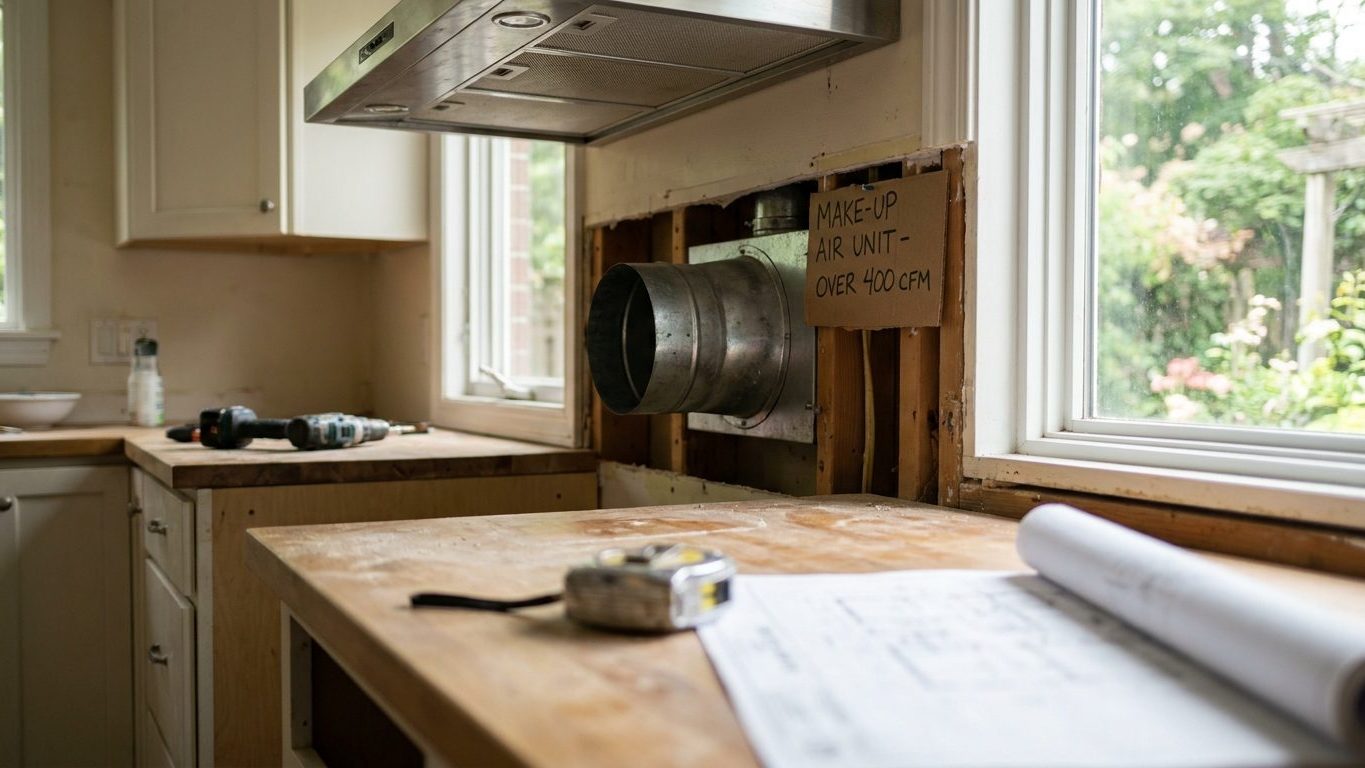

Four hundred CFM is the line. Below it, a range hood can just exhaust straight outside and nobody has to think about where the replacement air comes from. Above it, the house has to be given a way to let air back in automatically whenever that hood turns on. Before you buy or upgrade a hood, find the CFM number on its spec sheet or nameplate first, because that single number decides whether ductwork for incoming air is part of the job too.
The threshold that changes what you are allowed to install

The 2021 International Residential Code, section M1503.6, requires make-up air for any exhaust hood rated above 400 CFM. This is a code requirement, not a manufacturer suggestion or a kitchen designer’s preference. CFM stands for cubic feet per minute, and it measures the volume of air the hood’s fan is pulling out of the kitchen and pushing outside through the duct, not how loud the fan is or how big the hood canopy looks over the cooktop.
A hood rated at 350 CFM sits under the line and needs nothing extra under this code section. A hood rated at 600 CFM, which is common on a wide commercial-style range, sits well above it and triggers the requirement. The number that matters is the rated exhaust capacity of the fan itself, not the size of the duct connected to it and not the width of the hood canopy. Two hoods of the same physical size can carry very different CFM ratings depending on the blower installed, so the canopy dimension tells you almost nothing about which side of 400 CFM you’re on.
This is also where duct sizing and duct run length start to matter, because a long duct run or a lot of elbows can knock down the effective airflow a hood delivers even if its rated CFM is higher. If you’re weighing a ducted hood against a recirculating one for this reason, Ducted or Recirculating? What the Duct Run Costs You in CFM walks through how much airflow a real duct run actually loses. A recirculating hood filters and returns air to the room instead of exhausting it outside, which changes the make-up air question entirely since there’s no exhaust volume leaving the house to replace.
The threshold applies at the point the exhaust system is rated, not at the point you happen to run it on a lower speed setting. A 600 CFM hood run on its lowest fan speed is still a 600 CFM hood as far as this code section is concerned. The rating is what the equipment is capable of, not what setting you leave it on most nights.
What a 600 CFM hood does to a closed house
Why airflow this large needs somewhere to come from
A hood exhausting above 400 CFM is moving a serious volume of air out of the house every minute it runs. That air has to be replaced from somewhere. In an older, leakier house, it seeps in through gaps around windows, door frames, and other small openings without anyone noticing. In a newer or well-sealed house, those gaps are mostly gone, and the air the hood is exhausting has nowhere obvious to come from.
When there’s nowhere for replacement air to come from, the house depressurizes instead. Running that hood starts pulling the whole building slightly below outdoor pressure, and the house looks for the path of least resistance to equalize. Sometimes that path is a bathroom exhaust fan running backward. Sometimes it’s the flue of a water heater, furnace, or fireplace, because a flue is one of the few large openings still connecting the inside of the house to the outside air.
That’s the part the 2021 IRC, section M1503.6, is actually written to prevent. If the depressurized house pulls air down through a combustion appliance’s flue instead of letting that appliance vent normally, it can drag combustion gases back into the living space along with it. This isn’t a comfort or efficiency issue. It’s a carbon monoxide risk, which is why the code treats it as a safety rule rather than a suggestion to consider if you feel like it.
The 2021 IRC, section N1102.4, is part of why this shows up more in new construction than in a fifty-year-old farmhouse. Newer building codes push for tighter envelopes for energy reasons, sealing up the small leaks that used to supply that replacement air without anyone designing for it. A tighter house reaches the depressurization point sooner than a leaky one, which is exactly why a contractor installing the same 600 CFM hood in new construction and in an old drafty house can end up with two very different pressure situations in the kitchen.
Interlocked, powered, tempered: the ways it is done
The 2021 IRC, section M1503.6.1, requires that the make-up air opening be interlocked with the exhaust, meaning it has to open automatically whenever the hood runs, not sit open all the time and not need a homeowner to remember to open it manually. A damper that only opens when someone flips a separate switch doesn’t satisfy this. The opening and the hood have to be tied together so one can’t run without the other.
Beyond that interlock requirement, the facts available here don’t specify a fixed list of accessory options, like whether the incoming air has to be heated before it enters the house or whether it can enter cold through a passive vent. Manufacturers of make-up air units vary in what their equipment does with that incoming air, and some kitchen designers have preferences about where the air enters the room. None of that changes the underlying code requirement, and it’s not something to guess at.
What’s worth being clear on is that model codes like the IRC only apply where a jurisdiction has adopted them, and jurisdictions frequently amend the version they adopt. A county two towns over can be working from a different edition or a local amendment to this same section. The IRC sets the baseline text, but the local building department is what tells you which edition and which amendments actually apply to a permit pulled in that county.
A kitchen design guideline from a professional body like the NKBA is a different kind of document entirely. A professional recommendation can suggest good practice, but it isn’t enforceable by an inspector and isn’t a substitute for the code section that actually governs the permit. If a contractor or hood installer tells you make-up air isn’t required at your hood’s rating, the way to settle it is a call to the local building department, not a guess based on what worked in a different house or a different state.
Finding the rating of a hood already installed

Where the number actually lives
The CFM rating isn’t something you can eyeball from the size of the hood or guess from how strong the fan feels standing under it. It’s a specific number the manufacturer publishes, and it’s usually in one of three places.
- The nameplate or rating label riveted or stickered inside the hood, often behind the baffle filters or on the blower housing itself
- The installation manual or spec sheet for that model number, which you can usually find from the manufacturer using the model number on that same nameplate
- An inline or remote blower’s own rating plate, if the motor isn’t mounted inside the hood body but sits in the duct run or on the roof
The most common measuring mistake is reading the duct diameter and treating it as the CFM figure. A 6-inch or 8-inch duct tells you almost nothing about airflow on its own, because the same duct size can carry very different CFM depending on the blower driving it and how long and how twisted the duct run is. Check the nameplate rating, not the duct size, and if the hood has multiple fan speeds, note that the published CFM is almost always the highest speed setting, not whatever speed the previous owner left it on.
If you’re already pulling cabinets or opening up a wall to trace ductwork for this, it’s a reasonable point to handle other decisions in the same kitchen at once, since the electrician is already there and the walls are already open. Where to Put Under-Cabinet Lights So They Don’t Glare is worth reading before that drywall goes back up, since fixing light placement afterward means opening the same wall twice.
Backdrafting, and why this rule exists at all
If a hood above 400 CFM runs in a house without make-up air, the failure isn’t always dramatic or immediate. Sometimes it shows up years later, when a homeowner adds weatherstripping or new windows and the house gets a little tighter than it was when the hood was installed, and a combustion appliance that vented fine for a decade suddenly starts spilling into the kitchen on cold mornings with the hood running.
At inspection time on new construction, this is a straightforward pass or fail against the 2021 IRC, section M1503.6, and an inspector checking a hood over 400 CFM will look specifically for the make-up air opening and its interlock. In an existing house, nobody is coming to check unless a permit is pulled for the hood itself or for related HVAC work.
The real cost of getting this wrong isn’t a failed inspection. It’s a combustion appliance’s flue gases getting pulled backward into a house full of people who have no way of knowing it’s happening, since carbon monoxide has no smell. That’s the entire reason this section exists in the code, and it’s why it’s written as a requirement rather than a suggestion.
If you’re planning a hood rated anywhere near or above 400 CFM, the next call is to the local building department for the permit and applicable code edition, and to a licensed HVAC contractor or the hood manufacturer for how the make-up air unit and interlock actually get sized and wired for that specific kitchen.
Common questions
Does a 350 CFM hood need make-up air?
No, the 2021 IRC’s make-up air requirement in section M1503.6 applies to exhaust systems rated above 400 CFM. A 350 CFM hood sits under that threshold.
Can I just crack a window instead of installing a make-up air system?
A cracked window can supply replacement air, but it doesn’t satisfy the code’s interlock requirement in section M1503.6.1, which calls for an opening that operates automatically with the hood. A window has to be opened and closed manually by a person remembering to do it, so it doesn’t meet that automatic-interlock standard on its own.
What if my hood has multiple speed settings and only goes over 400 CFM on the highest one?
The rating that governs this is the equipment’s rated exhaust capacity, and the published CFM figure for a multi-speed hood is its top-speed rating. Confirm the exact rated CFM with the local building department, since that’s the figure they’ll check against the threshold, not the speed setting a homeowner typically leaves it on.
Does a recirculating hood ever need make-up air?
A recirculating hood filters air and returns it to the kitchen rather than exhausting it outside, so there’s no exhaust volume leaving the house for make-up air to replace under this rule. The 400 CFM threshold and its make-up air requirement are specific to ducted exhaust systems.