
In Louisiana, timing a cover crop has less to do with frost than with heat. Winters here are mild enough that many species never fully die back on their own, and the long, hot summer sets the real planting deadline. Get the fall sowing window right and a cover crop can hold soil and build organic matter almost year-round.
When the soil is warm enough in Louisiana
Ask when to plant, and the calendar answer for south Louisiana looks strange compared to most of the country: NOAA’s 1991-2020 Climate Normals put the last spring freeze (32°F) at station USW00012916 somewhere between January 18 and February 8, based on the 30-70 percent probability band. That is weeks ahead of almost anywhere else in the eastern United States.
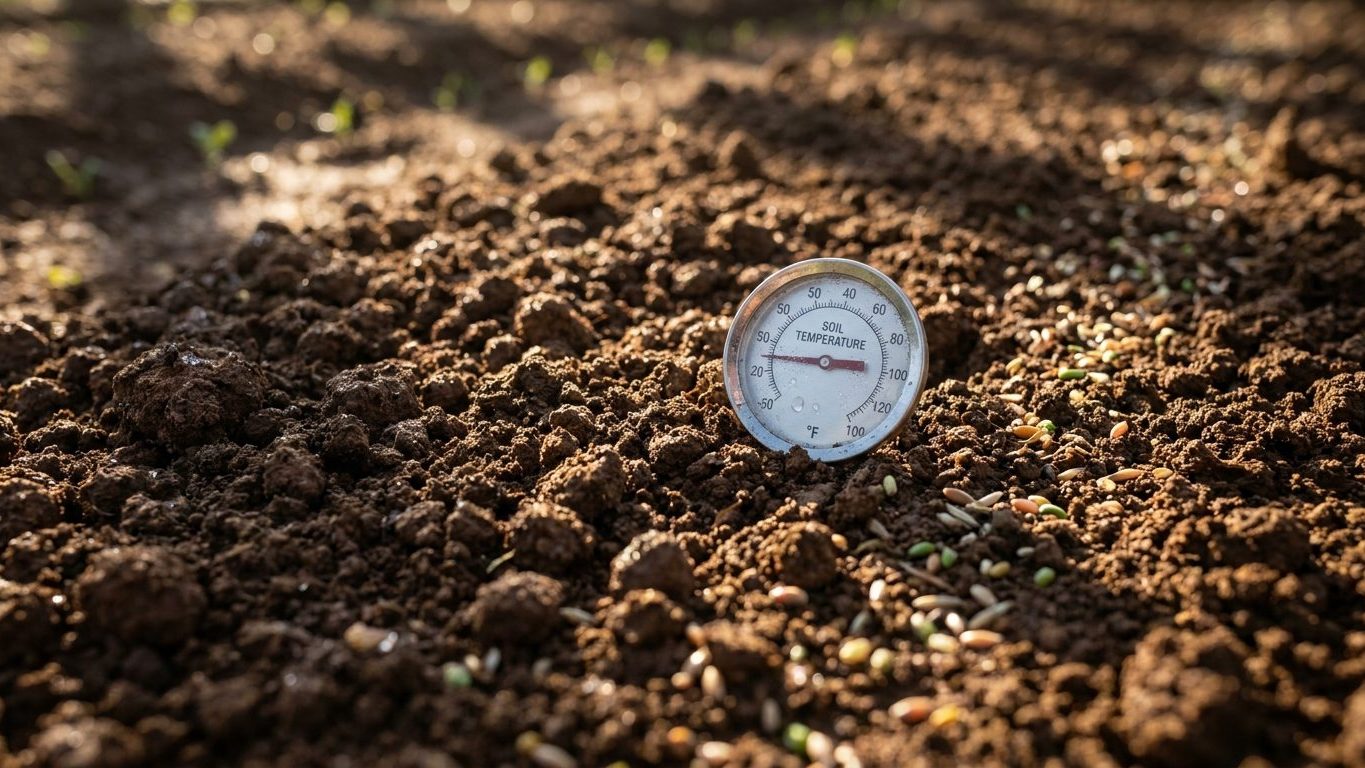
But that date is a proxy, not the actual trigger. Cover crop seed does not care what the calendar says; it cares whether the soil itself has warmed enough to germinate and push roots, and soil temperature lags air temperature by days to a couple of weeks depending on how wet and shaded the ground is. So the frost date tells you when the risk of a killing freeze has mostly passed, not when the ground is ready. A quick way around the guesswork is a soil thermometer pushed a couple of inches down at the same time each morning; once it holds steady above the germination floor for the species you’re planting, you’re closer to a real answer than any date on a chart.
One caution worth saying plainly: a frost date is a probability, not a promise. At this station, a 32°F freeze occurs in only 86.8 percent of years, which means roughly one winter in seven brings no hard freeze at all. That single fact changes how you should read the whole spring window here. In a typical northern state, “last frost” is a hard line the garden waits behind. In south Louisiana, some years there’s no line to wait behind in the first place. North Louisiana, sitting farther from the Gulf’s moderating water, freezes far more reliably and on a schedule closer to what gardeners elsewhere expect.
For a warm-season cover crop, species suited to heat and quick growth can go in once soil warms reliably, which for most of the state means late winter into early spring rather than a fixed date. For a cool-season cover crop meant to carry a garden bed through winter, the more useful date is the one on the other end of the calendar, covered next. Exact seeding rates depend on the species, the seeding method, and the source of the seed, so that number is one to get from the LSU AgCenter rather than from a generic chart. Termination, when the time comes, is mechanical here: mowing, crimping, or cutting the stand down rather than reaching for a herbicide.
How long the season lasts here
Put the two frost dates side by side and the shape of the Louisiana growing year becomes clear. The last spring freeze runs January 18 to February 8; the first fall freeze runs December 17 to January 8. Subtract one from the other and the frost-free stretch runs from roughly early February to mid-December, something close to ten months. Very few states in the continental U.S. offer a frost-free window that long.
That length changes what’s worth attempting. In a state with a short frost-free season, a gardener gets one real shot: sow the cover crop, let it grow, terminate it, and move on to the cash crop with no room for a second round. Louisiana’s window is long enough to support more than one pass. A warm-season cover crop can occupy a bed through spring and summer, get terminated, and hand off to a fall-sown, cool-season species that then carries the bed through the mild winter described above. That two-season rhythm is worth planning deliberately rather than falling into by accident, and the mechanics of staggering sowings so one crop’s termination lines up with the next one’s planting are covered in this site’s succession sowing guide.
The long window also lowers the stakes on how a cover crop gets established. Where the season is short, gardeners sometimes start seed indoors and transplant it out to save a few precious weeks. In Louisiana, with ten months of frost-free time to work with, that extra step buys little. Direct seeding, timed to soil temperature rather than a calendar date, generally does the job without the added handling, and it avoids the root disturbance that transplanting a cover crop crown or taproot species can cause. The long season doesn’t make timing unimportant, it just moves the cost of a mistake from “the whole cover crop plan fails” to “shift the next sowing by a couple of weeks.”
Heat and water in Louisiana
Summers here run long, humid, and consistently hot, and that reality shapes which crops can even survive a June-through-September stretch. But for cover crops specifically, the more decisive season is winter, not summer, and the numbers back that up in an unexpected way.
The first fall frost, arriving somewhere between December 17 and January 8, sets the last practical date for sowing a cool-season cover crop that needs to establish before cold slows growth. Miss that window and a fall-sown crop goes into winter too small to do much good. But the number that really decides which species make sense here is the mean daily minimum of the coldest month: 46.1°F at the New Orleans reference station. That is not a hard freeze. It’s barely a cool night by the standards of most of the country, and it’s the figure, more than the extreme record low, that determines whether a plant experiences real winter dormancy or simply keeps growing through it.
That mild floor, combined with the one-in-seven-years chance of no hard freeze at all, means species that reliably winterkill farther north often don’t winterkill here. A grain that’s prized elsewhere for dying back on its own into a tidy mulch can instead limp through a Louisiana winter, green and growing, turning from a convenience into a spring weed problem that has to be mowed or cut down by hand. The same mild winter that makes species selection tricky is a double-edged advantage: crops that do survive keep photosynthesizing and adding root mass through months when colder states have bare, frozen ground.
Humidity carries its own cost year-round. Gulf Coast air holds enough moisture, most of the year, that fungal pressure on dense plantings is a bigger practical worry than drought stress. A cover crop stand that’s too thick, or a legume planted where air can’t move through the canopy, is more likely to show mildew or leaf spot here than to wilt for lack of water. That single fact should weigh into spacing and species choice as much as any date on a calendar.
Which cover crops suit Louisiana
Reasoning from the territory rather than a generic chart, three things about Louisiana push the choice: the frost-free window is unusually long, the winter is mild rather than reliably killing, and humidity makes airflow and disease resistance a real concern rather than a footnote.
A long, hot growing season favors warm-season legumes and quick-growing broadleaf types for spring-through-summer cover, since they thrive in the heat that limits so much of the rest of the country. Because winter here rarely delivers a dependable killing frost, cool-season species chosen for a fall sowing need to be picked with an honest expectation about termination: some will die back on their own in a hard winter, and some, in a mild one, will simply have to be mowed, crimped, or cut down by hand come spring. Humidity pushes the decision further, favoring types known for looser growth habit and better airflow over dense, disease-prone stands.
| Cover crop type | Season | Why it suits Louisiana | Watch for |
|---|---|---|---|
| Warm-season legumes (cowpea, sunn hemp) | Spring through summer | Heat-tolerant, fixes nitrogen, grows fast in the long warm window | Well-drained soil; can rot in waterlogged spots after heavy rain |
| Cool-season legumes (crimson clover, hairy vetch) | Fall sown, over winter | Fixes nitrogen through the mild winter months | Slower to establish in warm fall soil; fungal pressure in wet winters |
| Cereal grains (cereal rye) | Fall sown, over winter | Reliable stand, strong weed suppression and biomass | Rarely winterkills here; expect to mow or crimp it down in spring |
| Oats | Fall sown | Fast fall growth | Winterkills reliably farther north, but may survive Louisiana’s mild winters and need mowing |
None of these are recommendations for a specific cultivar, and that’s deliberate. Which particular strain of clover or rye performs best runs through local extension variety trials, not a general guide, because performance shifts with soil, rainfall, and disease pressure that vary parish to parish. The LSU AgCenter keeps those trial results current, and that’s the only source worth trusting for a variety-level decision. Seeding rate is the same story: it depends on the species chosen, whether it’s broadcast or drilled, and the source of the seed, so that number belongs in the same conversation with the extension office rather than pulled from a chart that wasn’t built for Louisiana’s climate. And when the stand is ready to come down, plan on mowing, crimping, or cutting rather than a chemical shortcut; that’s the termination method this guide sticks to throughout.