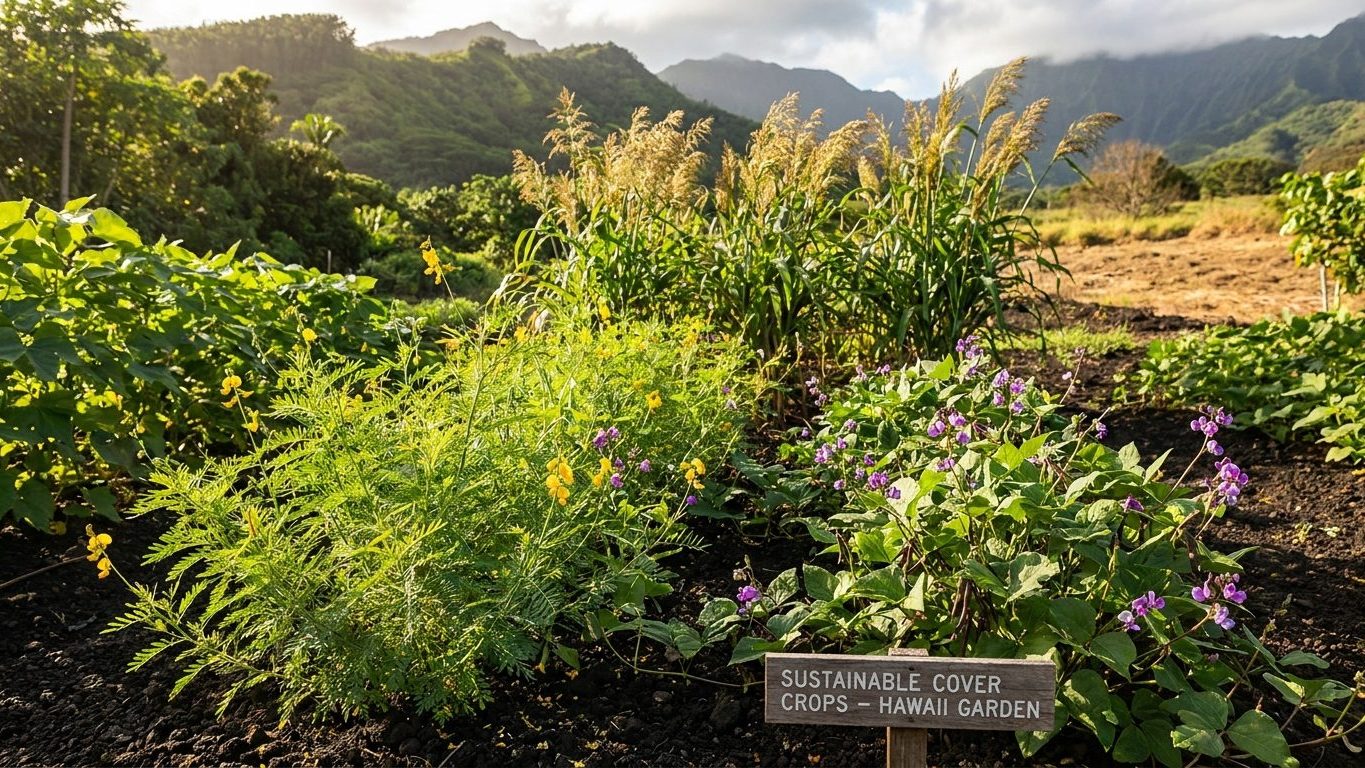

Wyoming’s short, high-elevation season rules out slow-growing cover crops and rewards fast, cold-tolerant ones. Cereal rye, spring oats, field peas, and forage radish handle the state’s roughly 130-day frost-free window and its wide swings in winter cold, while warm-season legumes built for longer, hotter seasons mostly fail here.
The short answer for Wyoming
Pick by type, not by brand name on a seed bag. Wyoming’s growing season runs from a last spring frost that lands anywhere between May 7 and May 18 to a first fall frost between September 24 and October 5, depending on where in the state a given garden sits. That leaves roughly 130 frost-free days at 6,000 feet, and the NOAA data behind those dates is explicit that frost is possible in any month once elevation climbs high enough. That single fact should drive every cover crop decision made in this state.
Quick-cycling cool-season crops are the safest bet across nearly all of Wyoming. Spring oats, field peas, and forage radish germinate in cool soil, grow fast, and either winterkill cleanly or get terminated before they set seed, which matters when a killing frost can arrive weeks earlier than the calendar suggests. Buckwheat fits the same quick-turnaround logic for a summer fallow window between a spring vegetable crop and a fall planting, though it needs watching since a single cold night ends it outright.
For anyone who wants a cover crop to survive the winter and resume growth in spring, cereal rye is the standout. It tolerates cold far better than hairy vetch or crimson clover, both of which are only reliably winter-hardy in the warmer end of the state’s hardiness range. Winter wheat is a reasonable second choice for the same over-wintering role, particularly at lower elevations where the season stretches closer to the September 24-October 5 end of the fall frost window rather than the earlier date.
Legumes for nitrogen are worth including, but the choice of species matters more here than in milder states. Field peas fix nitrogen and finish their cycle inside the frost-free window without needing to survive a Wyoming winter, which makes them lower-risk than a legume that’s supposed to overwinter and doesn’t.
What will not work here
Warm-season cover crops built for long, hot growing seasons are the clearest failure category in Wyoming. Sorghum-sudangrass, cowpeas, and sunn hemp typically need 90 to 120 days of consistently warm soil and warm nights to reach the growth stage where they deliver the biomass or nitrogen fixation they’re planted for. Wyoming’s frost-free window, at roughly 130 days at elevation and shorter than that in many valleys, leaves little margin, and a single early frost event, which the data flags as possible in any month at higher elevations, can end the attempt before it produces anything useful.
Hairy vetch is a specific trap. It’s a popular nitrogen-fixing cover crop nationally, but its winter hardiness tops out around USDA zone 4, and Wyoming’s hardiness range dips down to 3a in its coldest pockets. A gardener at the cold end of that range who plants hairy vetch expecting it to overwinter and resume growth in spring is likely to find a dead stand instead, because the coldest month’s mean daily minimum, 18.1°F at the Cheyenne reference station, already sits below what hairy vetch reliably tolerates without heavy snow cover acting as Insulation.
Crops that depend on frequent irrigation to stay actively growing also struggle across most of the state. Annual ryegrass and some clover mixes are marketed as easy cover crops elsewhere, but they’re bred for regions with regular rainfall or humidity that Wyoming’s high, dry climate simply doesn’t offer. Without a watering schedule tighter than most home gardeners maintain, these crops stall out, go dormant early, or die back well before they’ve built the root mass or biomass a cover crop is supposed to provide.
Buckwheat deserves a caveat rather than a full rejection. It’s fast and useful for a short summer gap, but treating it as a set-and-forget crop is a mistake in a state where frost timing shifts by nearly two weeks from one part of the state to another. A gardener who plants it in early July assuming a full growing season may lose it to an unexpectedly early September frost.
What changes across Wyoming
Wyoming is not one growing zone, and treating it that way is the fastest way to pick the wrong cover crop. The USDA Plant Hardiness Zone Map places the state’s growing conditions somewhere between 3a and 6a, a spread wide enough that a crop safely hardy in one part of the state will winterkill in another. That range is built on a single variable, the average annual extreme minimum temperature, so it speaks specifically to winter survival, not to summer heat or frost-free days.
The practical effect is that a cover crop strategy built around overwintering, like a fall-seeded cereal rye or a winter wheat, carries very different odds of success depending on where in that 3a-6a range a given plot falls. Toward the zone 6a end, winter survival is far more forgiving, and even moderately hardy legumes have a reasonable shot at making it through to spring. Toward the 3a end, only the toughest cereals should be counted on to survive winter without protection.
Elevation drives a second layer of variation that the hardiness zone number alone doesn’t fully capture. Higher ground compresses the frost-free window further and raises the odds of an out-of-season frost hitting in a month that would be safe at lower elevation. That’s the practical reason the NOAA data behind this page flags frost as possible in any month at 6,000 feet and up, a detail that matters more in Wyoming than in most cover crop guides because so much of the state’s farmland and gardens sit at exactly that elevation or higher.
None of this can be resolved from a state-level page. The right move is checking a hardiness zone map against the specific location in question, then matching cover crop hardiness ratings to that number rather than to the state’s range as a whole.
Where to check this for your own county
The University of Wyoming Extension is the authoritative source for anything more specific than what this page can offer, and it’s reachable at https://www.uwyo.edu/uwe/. County-level extension offices under that umbrella maintain planting calendars built around local frost data rather than the state-wide range cited here, and those calendars account for the elevation and microclimate differences that make one Wyoming county’s growing season meaningfully different from another’s.
Two things are worth looking for specifically once there. The first is a local planting calendar, which will narrow the May 7-May 18 spring frost window and the September 24-October 5 fall frost window down to dates that actually apply to a specific county rather than the state as a whole. The second is any list of cover crop varieties that have been trialed in that county, since local extension programs often test which cultivars of oats, peas, or cereal rye perform best under that county’s specific combination of elevation, soil, and precipitation.
A county-level recommendation will always beat a state-level one, and it’s worth being direct about that here: this page describes Wyoming broadly, using statewide climate normals and a hardiness zone range that spans from 3a to 6a. It cannot tell an individual reader which end of that range applies to their own plot, and it shouldn’t try to. County extension staff can look at soil type, local frost history, and irrigation access in a way no state-wide article can replicate, which makes them the better resource once the broad strokes here have narrowed down the type of cover crop worth trying.
Checking this against your own garden
Every date on this page is a probability built from climate normals, not a guarantee for a specific garden in a specific year. Three direct observations will tell a gardener more about their own microclimate than any calendar figure.
Soil warmth by feel is the first and most reliable check. Cover crop seed, especially legumes like field peas, germinates poorly in soil that still feels cold to the touch even if the calendar says the last frost date has passed. Waiting for soil that feels consistently warm rather than just frost-free avoids the common mistake of seeding into ground that hasn’t caught up with the air temperature yet, which happens often at Wyoming’s elevations.
The timing of first true leaves on an already-seeded cover crop is the second signal. A crop that’s slow to push past its seedling stage is responding to something the regional frost dates don’t capture, whether that’s a cold pocket in a low-lying part of the yard or soil that drains and warms more slowly than the surrounding area. That lag is worth noting for next season’s timing.
Watching how a stand handles the first light frost of fall is the third check, and the most useful one long-term. A cover crop that browns and collapses well before the region’s typical first fall frost date is likely sitting in a frost pocket that runs colder than the county average, information that’s worth writing down and using to adjust planting dates the following year rather than trusting the same calendar date twice.