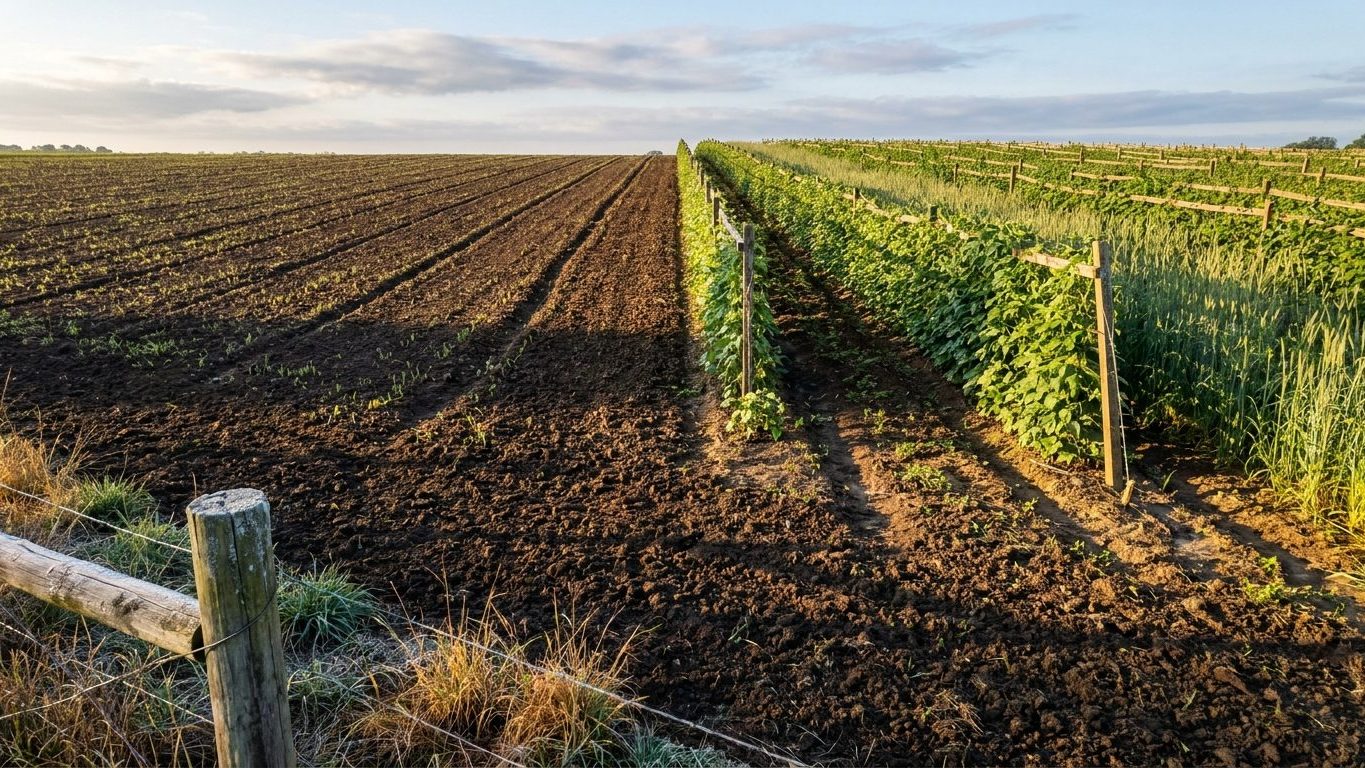

Wyoming’s cover-crop window runs from mid-May through late September, and it’s tight. With last frost landing between May 7 and May 18 and first fall frost arriving as early as September 24, you’re often working with barely four months of frost-free soil. That’s the whole calendar. Everything else, variety choice, seeding rate, whether you bother at all, depends on squeezing real growth into that gap.
The short answer for Wyoming
Sow Cover Crops in Wyoming once soil has warmed past the last spring frost window of May 7 to May 18, and plan to terminate or let winterkill take over before the first fall frost, which lands between September 24 and October 5. Those dates are not guarantees. They’re a 30-70% probability band from NOAA’s 1991-2020 climate normals at station USW00024018, meaning frost has a real chance of showing up on either side of those windows. At higher elevations, that risk doesn’t shrink, it grows.
The number that matters most for planning is roughly 130 frost-free days at 6,000 feet. That’s the entire growing season for a cover crop to germinate, establish, and do whatever job you planted it for, whether that’s nitrogen fixing, erosion control, or breaking up compacted soil. Compare that to a state with a 200-day season and it’s obvious why Wyoming growers can’t just copy a calendar built for Kansas or Nebraska.
Above 6,000 feet, the caution in the NOAA data becomes literal: frost is possible in any month. That’s not hyperbole for high-altitude ranch country in places like the Wind River foothills or the Bighorn benches. A cover crop seeded in June at elevation can still get nipped in July. This is why season extension, whether that’s row cover, cold frames, or simply picking a fast crop, isn’t a bonus technique here. It’s baseline.
So the actionable date to write down is May 18, the late end of the spring frost window. If you seed after that date, you’ve cleared the higher-probability frost risk for most of the reporting station’s area. Seeding earlier is possible but you’re gambling on the lower end of that 30-70% band, and a late frost can wipe out young seedlings before they’ve built any root reserve.
What this means practically: pick species that can complete a useful growth cycle in under 100 days, because that’s roughly what you have once you subtract a safety margin from both ends of the 130-day frost-free estimate. Anything slower is fighting the calendar, not working with it.
What will not work here
A short season defeats slow cover crops outright. Something that needs 120 days to flower and set seed, many clover varieties fall into this category, simply won’t finish before the first fall frost shows up between September 24 and October 5. You’ll get partial biomass and none of the soil-building payoff you were counting on. If a seed packet or extension sheet lists a maturity window longer than about 100 days, that’s a red flag for most of Wyoming’s growing zones.
The coldest month here averages a daily minimum of 18.1°F, and that figure, not the record low, not a seasonal average, is what determines whether a cover crop survives winter standing or gets killed outright. Many “winterkill” cover crops marketed for milder climates are rated to survive down into the low 20s or high teens at best. At 18.1°F as a routine nightly average across the coldest month, anything borderline is going to die faster and less predictably than growers in warmer states experience. That’s actually useful if you want winterkill for spring tillage ease, but it’s a problem if you were hoping for a crop that persists and regrows.
Heat and drought management schemes built around weekly watering also fail here, though for a different reason than in genuinely hot climates. Wyoming’s issue isn’t sustained high heat so much as a short window combined with wind and low humidity that dries surface soil fast. A cover crop that needs consistent moisture to establish in its first two weeks will struggle if you’re relying on a once-a-week watering habit borrowed from a garden guide written for a wetter region.
Spacing and density mistakes
Close spacing recommendations designed for humid, high-rainfall states don’t translate well to Wyoming’s dry air. Tight rows that make sense where fungal pressure from humidity is the bigger risk can leave Wyoming seedlings competing too hard for scarce topsoil moisture. Wider spacing, or a lower seeding rate than the bag suggests, often performs better in practice across the drier counties.
The through-line: any cover crop plan copied wholesale from a longer-season, wetter, or milder state is set up to fail here. The frost dates and the 18.1°F coldest-month minimum aren’t background details, they’re the filter every variety choice has to pass through first.
What changes across Wyoming
Wyoming isn’t one growing zone, it’s a spread. The USDA Plant Hardiness Zone Map puts the state across zones 3a to 6a, which is a wide range built on a single variable: average annual extreme minimum temperature. That range means a cover-crop plan that works in the mildest pocket of the state can fail completely in the coldest, and there’s no single sowing date that covers both honestly.
Zone 3a sits at the harsh end, associated with the coldest valleys and highest elevations, where extreme minimums drop lowest and the frost-free window shrinks well below that already-tight 130-day estimate. Zone 6a, the milder end, likely corresponds to lower-elevation river valleys and areas with more urban heat retention, where the growing season stretches longer and a wider range of cover crops becomes viable.
Elevation is the hidden variable driving most of that zone spread. Wyoming’s average elevation is among the highest of any state, and a difference of a few thousand feet between two points can shift the effective growing season by weeks. A grower at 4,500 feet and one at 7,500 feet are, in cover-crop terms, gardening in different states, even if they’re both technically “Wyoming.”
This is exactly why the page can’t tell an individual reader which zone applies to them. The honest answer is that the spread itself, 3a through 6a, is the finding: assume you’re on the harsher end unless you have specific reason to think otherwise, and treat any date on this page as the generous end of the estimate rather than a promise.
Readers in the northern part of the state or at higher altitude should shift their mental calendar later on the spring end and earlier on the fall end, compressing the usable window further than the statewide averages suggest. Readers in lower valleys with milder winters have more room to experiment with slower-maturing species, though even there, the 18.1°F coldest-month minimum from the Cheyenne reference station still applies as a rough statewide floor for winter survival planning.
Where to check this for your own county
Statewide frost data and hardiness zone ranges are useful for planning, but they’re not a substitute for what your specific county has actually tested. The University of Wyoming Extension, at https://www.uwyo.edu/uwe/, is the resource built for that gap, and it’s where a county-level recommendation should come from rather than a statewide guess.
What to look for once there: a local planting calendar specific to your county or region within the state, since Wyoming’s elevation range means the extension service typically breaks recommendations down further than a single statewide date range can. Also worth searching for are variety trial results, records of which cover crop species have actually been grown and evaluated in your county’s conditions, not just theoretical suitability based on hardiness zone alone.
County extension offices, reachable through the same university system, often carry additional detail that the statewide site summarizes or links out to. Where soils, wind exposure, or irrigation access vary sharply even within one county, staff there may have observations that never made it into a published calendar.
It’s worth being direct about the hierarchy here: a county recommendation beats a state one, and a state recommendation beats a generic national guide. This page falls into the state-level category. It’s built from statewide frost normals and a statewide hardiness zone range, both useful for understanding the general shape of Wyoming’s growing season, but neither one accounts for the microclimate differences that show up between, say, Sheridan and Laramie.
If your county’s extension office has published its own sowing calendar or variety list, that document should override any date given here. The gap between a state-level estimate and a county-level trial can be the difference between a cover crop that establishes and one that doesn’t germinate at all.
Checking this against your own garden
Every date on this page is a probability, not a promise, and your own soil will tell you more than any calendar once you know what to check. Start with soil warmth by feel: dig down about two inches and press your hand into the soil in the morning before the day heats up. Cold, clammy soil that feels colder than the surrounding air means germination will lag regardless of what the calendar says. Warm, slightly dry soil that matches or exceeds air temperature is a better sign that seed will sprout promptly rather than sit dormant and vulnerable to rot.
Second, watch for the first flush of male flowers on any flowering cover crop species you’ve planted, such as buckwheat or certain legumes. Male flowers typically appear before female structures and signal that the plant has moved past pure vegetative growth into its reproductive phase. If that flush shows up unusually early relative to when you seeded, your particular plot is running warmer than the statewide averages suggest, useful information for next season’s timing.
Third, track how long it takes for first true leaves to emerge after the initial seedling leaves. A fast transition, within a week or so of germination, points to soil and air conditions supporting vigorous early growth. A slow, stalled transition often means the plot is colder or drier than expected, even if it’s within the same county as a neighbor having better luck.
None of these checks require anything beyond your own hands and eyes. Taken together, they tell you more about your specific patch of ground than a statewide frost date ever could, and they’re the fastest way to catch a mismatch between the calendar and your actual microclimate before you’ve lost a season’s planting to it.