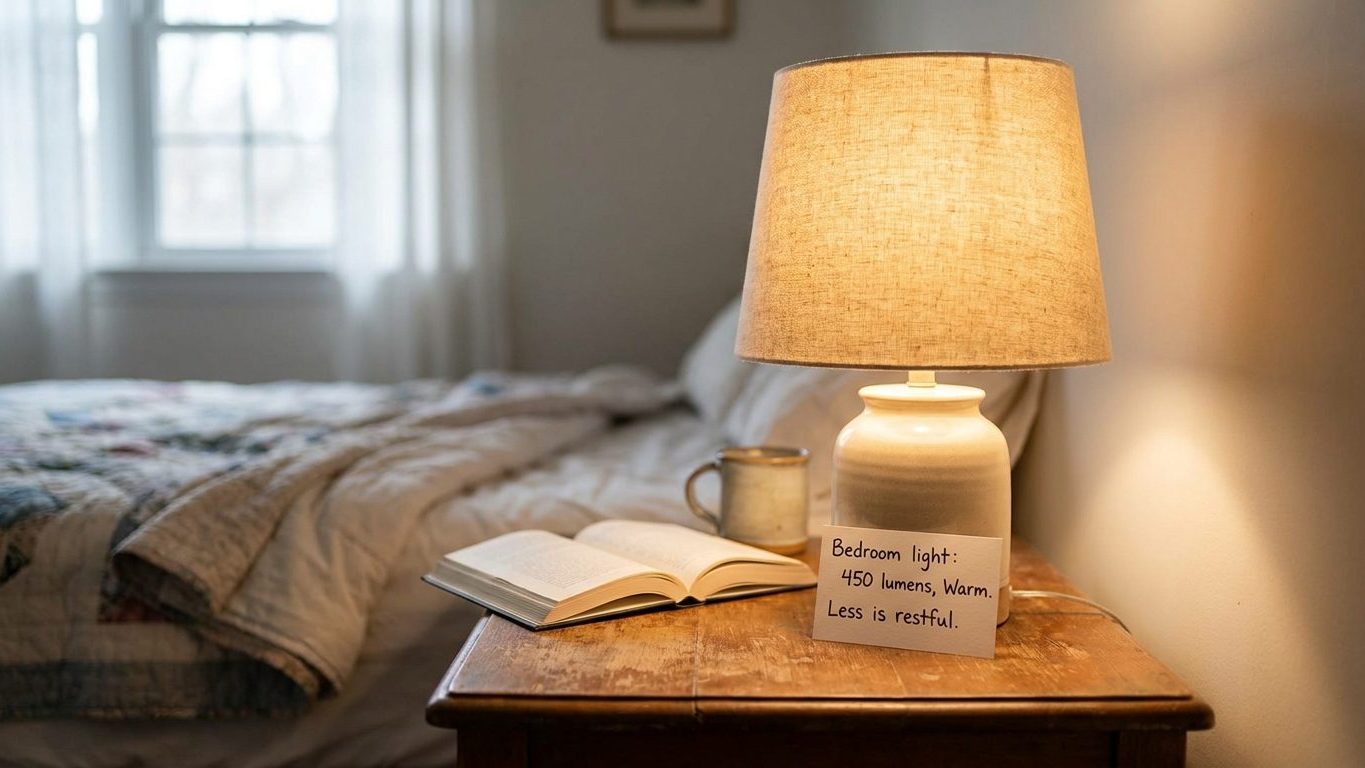

Ten to twenty lumens per square foot of general lighting is what makes a bedroom feel right, not a cave and not an exam hall. That range covers the ambient wash that fills the whole room, not the brighter pool a reader needs pointed at a book. Put a dimmer on whatever ambient fixture is already up there, and the same bulb that lights the room for folding laundry can drop low enough for the ten minutes before sleep. Start there. Dial the light down before you go shopping for a second lamp.
The light level a bedroom actually needs

Ten to twenty lumens per square foot of general lighting is the range the IES RP-1 recommended practice sets for a bedroom’s ambient layer, and it is a professional guideline, not a building code. Nobody enforces it at a permit desk. It is the number a lighting designer plans to, the way a carpenter plans to a stud spacing that nobody inspects either, but everybody who skips it can feel the difference in the room.
The figure measures floor area only, wall to wall, not including a closet or an attached bath. To use it, take the square footage of the bedroom itself and multiply by the range. A room with more floor to fill needs more total lumens to hit the same 10 to 20 per square foot, which is arithmetic worth doing before buying bulbs, not a fixed wattage that works for every bedroom regardless of size.
What the range does not include
This ambient figure is the room-filling layer only. IES RP-1 treats reading light as a task layer of its own, aimed at the page and not at the room, which means a bedroom can sit correctly at 10 to 20 lumens per square foot overall and still leave someone straining over a paperback in bed. The task layer is added on top, not folded into the ambient count. Where that reading lamp sits, and how it is aimed, is a separate question from how many lumens fill the room. How Tall Should a Bedside Lamp Be? covers the height and aim that keeps a task lamp doing its job without spilling into a sleeping partner’s eyes.
The two layers work independently. A room can be over-lit for ambient and still under-lit for reading, or the reverse, and neither problem is fixed by adjusting the other.
Why a bedroom is lit lower than any other room
A kitchen or a home office is lit for a task that fights fatigue: chopping, reading fine print, sitting at a screen for hours. A bedroom is lit for the opposite job, easing a body toward sleep, and the two things pull the number in opposite directions. IES RP-1 sets the bedroom’s ambient range lower than a kitchen’s or an office’s for that reason, not because a bedroom is a smaller or less important room to light well.
The mechanism runs through the eye, not the tape measure. Light, especially at higher intensity and cooler color, tells the body it is still daytime, and a bedroom lit like a workspace late in the evening is asking the brain to stay alert in a room built for the opposite. The 10 to 20 lumens per square foot range is not an arbitrary compromise between too bright and too dim. It is the level IES RP-1 treats as enough to move around a room safely and find a dresser drawer, without pushing the ambient light into a range that keeps the body from winding down.
This is also why a single overhead fixture, run at full output, is often the wrong tool for the whole evening even if its total lumens land inside the correct range. A fixture has one output unless it is dimmed. A bedroom’s needs change across a few hours, from full ambient light while getting dressed to something much lower right before sleep, and a fixed-output fixture cannot follow that curve on its own.
Color temperature, and what light does to sleep
The number that matters here is 2700 K or below in the evening, which IES RP-1 and IES TM-18 both point to as the color temperature range that avoids working against sleep. Above that, into the 3500 K to 5000 K territory sold as “daylight” or “cool white,” the same guidance is clear that higher color temperatures suppress melatonin and belong in a workspace, not a bedroom at night.
This changes with use, not with the calendar or a code cycle. A bedroom that doubles as a home office during the day can run a cooler, higher CCT bulb for that stretch and switch to something at or under 2700 K for the evening, either with a bulb that shifts color temperature as it dims or with two separate light sources for two separate jobs. There is no fixed hour when the switch has to happen. It happens when the room’s job changes from work to rest.
Where this is, and is not, enforceable
IES RP-1 is a recommended practice published by a professional society, not a section of the International Residential Code or the International Property Maintenance Code, so no inspector checks a bulb’s color temperature at a walkthrough. That matters because the IPMC, which governs how an existing home is occupied and maintained, is not adopted in every jurisdiction that has adopted the IRC for new construction, and a lighting recommendation like this one sits outside both. Nobody can hold a homeowner to 2700 K. What IES RP-1 offers instead is a target worth building toward voluntarily, because the body it is built on is measurable, not a matter of taste in warm versus cool light.
Working out what a room already delivers

Checking a bedroom’s current ambient level does not require special equipment. A basic light meter, or a smartphone app that reads lux, held at roughly the height of a nightstand or the surface of a made bed, gives a working reading. Take the measurement with the room’s ambient fixture on and any task lamp off, since the two layers are meant to be counted separately, and mixing them gives a number that matches neither IES RP-1 figure.
The mistake that costs people the most accuracy is reading the lumens printed on the bulb’s packaging instead of measuring what actually reaches the room. A bulb rated at a given lumen output loses a share of that light to the fixture’s shade, its finish, and the distance to the surface being lit. Two bedrooms with identical bulbs can deliver noticeably different ambient light depending on the fixture around that bulb.
A rough calculation to check the range against
Multiplying a room’s square footage by the 10 to 20 lumens per square foot range gives a target to compare a meter reading against, without needing to know the room’s exact code status or anyone else’s opinion of what looks right.
| Room size (square feet) | Ambient target at 10 lumens/sq ft | Ambient target at 20 lumens/sq ft |
|---|---|---|
| 100 | 1,000 lumens | 2,000 lumens |
| 150 | 1,500 lumens | 3,000 lumens |
| 200 | 2,000 lumens | 4,000 lumens |
This table is arithmetic drawn from the IES RP-1 range, not a separate figure. A bedroom that falls outside these numbers is not automatically wrong. It is simply a room to look at again, ideally with a dimmer in mind before a second fixture.
The bright ceiling fixture nobody ever switches on
The common outcome, when a bedroom’s only ambient fixture is a single bright overhead light with no dimmer, is that the switch stays off. People find the full-output ceiling light too harsh for the evening and default to a bedside lamp alone, which under-lights the room for anything but reading, or they leave the overhead fixture on at full output and it works against the wind-down the room is supposed to support. Either way, the fixture that was specified to hit the right ambient range never actually does the job it was installed for.
IES RP-1’s own fix for this is not a second fixture. A dimmed source shifts a bedroom from a task level to a rest level without adding anything to the ceiling or the wall, which means the cheapest correction is usually a dimmer switch and a dimmable bulb, not a redesign of the room’s lighting layout. Where the existing switch or wiring cannot support a dimmer safely, that is a job for a licensed electrician rather than a plug-in dimmer module, since the fixture and circuit need to be rated for it.
None of this is a matter a building inspector will ever flag, unlike a life-safety item such as the egress requirement covered in Does a Bedroom Need an Egress Window?. A lumens target left unmet costs comfort and sleep, not a failed inspection, which is exactly why it is easy to leave unfixed for years.
Common questions
How many lumens is one lamp actually putting out?
Check the packaging for the bulb’s rated lumen output, which is printed separately from its wattage on most modern bulbs. Wattage measures power drawn, not light produced, so two bulbs can use the same wattage and produce very different lumens depending on the bulb technology.
Do I need a dimmer on every lamp in the bedroom, or just the ceiling fixture?
IES RP-1’s guidance on dimming is about the ambient layer specifically, the fixture that fills the whole room. A bedside reading lamp is a task light aimed at a page, and it can stay at a fixed output since it is not the layer responsible for shifting the room toward a rest level in the evening.
Is a warmer bulb automatically dimmer, or are those two different things?
They are different things entirely. Color temperature, measured in Kelvin, describes whether light looks warm or cool, while lumens describe how much light a source produces. A bulb rated 2700 K can still be extremely bright, so getting the warm color IES RP-1 recommends for the evening does not by itself bring a room’s ambient level down into the correct range.
Why does my bedroom feel too bright even though I think it’s under the lumen range?
Color temperature is often the reason, not the total lumen count. A bulb above 2700 K reads as harsher and more alert-inducing than the same lumen output at a warmer color temperature, since IES TM-18 credits higher color temperatures with suppressing melatonin more than a warmer source at an equivalent brightness.