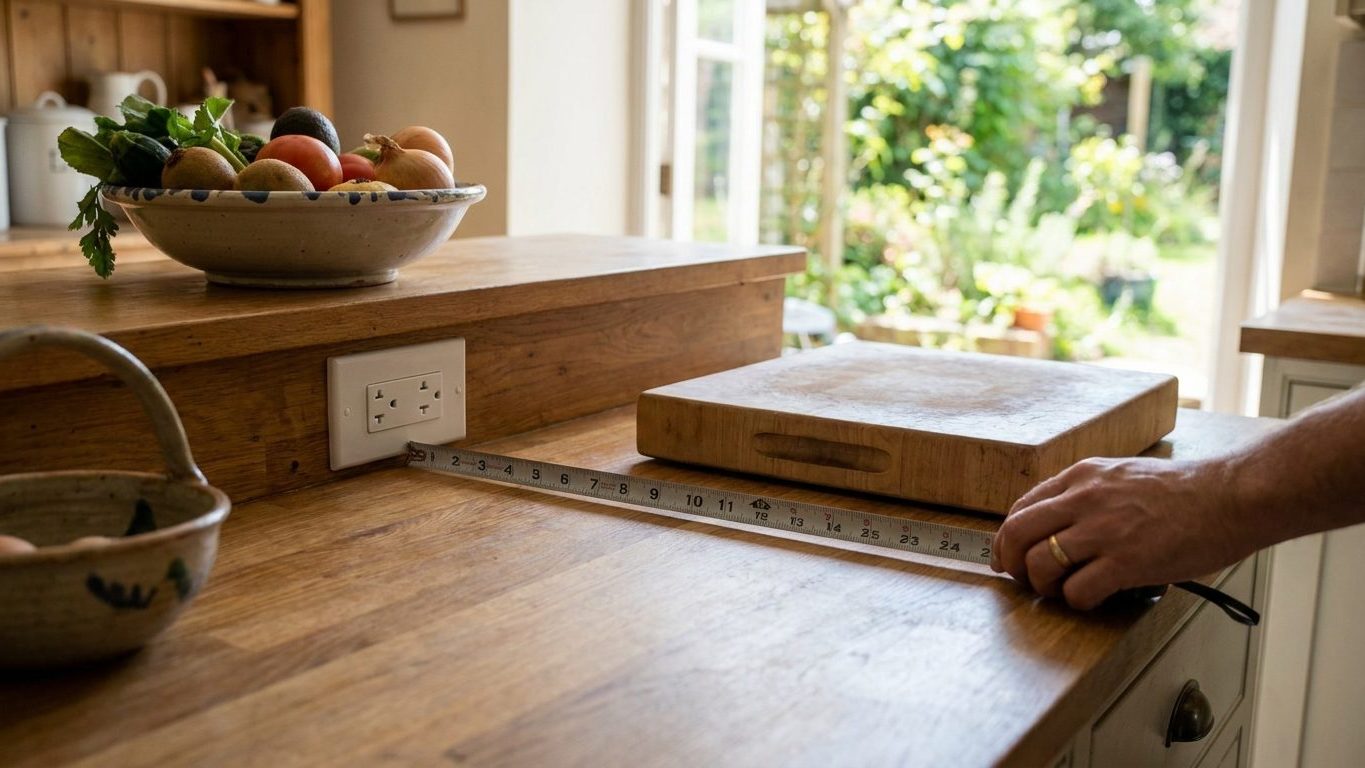

That gap in the middle of a long counter run, the one where the toaster cord won’t reach either outlet and someone ends up feeding a power strip across the sink, is exactly what this rule was written to prevent. No point along a kitchen countertop wall line can be more than 24 inches from a receptacle, measured horizontally. Pull a tape measure along the backsplash from outlet to outlet before you sign off on a kitchen plan, not after the tile is set.
The 24 inches, and what it is measured along

Twenty-four inches is the number, and the 2020 National Electrical Code, section 210.52(C)(1), is what carries it. This is a requirement, not a suggestion. It reads that no point along a kitchen countertop wall line may be more than 24 inches from a receptacle outlet, and where a jurisdiction has adopted this edition of the NEC, an inspector will hold a remodel to it before the wall closes up.
The measurement runs horizontally, following the countertop and the wall behind it, not as a straight line cut across a corner and not through a cabinet. Picture a tape measure laid flat along the backsplash, tracking every turn the counter makes. If the counter jogs around an inside corner, the tape follows the jog. That matters because a diagonal measurement across a corner will always read shorter than the actual distance a cord has to travel, and it will make a kitchen look compliant on paper when it is not.
Why the wall line, not the floor plan
The rule is anchored to the countertop wall line specifically because that is where small appliances actually sit and where cords actually run. A receptacle on an adjacent wall, or one buried behind where a refrigerator will stand, does not count toward this distance even if it happens to be close in a straight line through the air. The 24-inch figure applies to the usable counter surface, measured along it, which is the only version of “distance” that means anything to someone plugging in a mixer.
Why the rule is written as a distance and not a count
A code that simply required, say, two outlets per kitchen would leave a ten-foot run with a receptacle at each end and nothing in between, which technically satisfies a headcount and fails everyone who cooks at that counter. Writing the rule as a maximum distance instead of a minimum quantity forces the outlets to follow the counter, however long or short, however many turns it takes. A galley kitchen and a sprawling island kitchen end up governed by the same physical limit rather than by a number that happens to work for an average-sized room.
The distance also tracks something practical: how far a typical appliance cord reaches before someone starts routing it across a sink or over a range to find power. The code does not state a cord length anywhere in this section, and this page will not invent one, but the logic of a 24-inch maximum from any point is that it keeps a receptacle within comfortable reach no matter where along the counter you happen to be standing with a coffee maker or a hand mixer in your hands.
This is also why the rule is written in terms of distance from the receptacle rather than distance between receptacles. Two receptacles spaced 47 inches apart would leave a dead zone of more than 23 inches between them, further than either outlet reaches, even though the gap between the outlets themselves is under four feet. Measuring from every point on the counter, not just from one outlet to the next, is what closes that loophole. The number of outlets a kitchen ends up with under this rule also feeds directly into how the room’s circuits get divided up, which is worth working out at the same stage. That’s covered in more depth in How Many Circuits Does a Kitchen Need?.
The 12-inch counter that still needs an outlet
Any countertop space 12 inches wide or wider requires its own receptacle under the same 2020 NEC section, 210.52(C)(1). That threshold catches the narrow strip at the end of a peninsula or the sliver of counter beside a range that a homeowner might assume is too small to bother wiring. If it measures 12 inches or more, the code treats it the same as a full-length run and expects a receptacle to serve it.
There is no exception in this rule for counter length working the other way either. Every countertop receptacle, regardless of how short the run is or how far it sits from a sink, still requires GFCI protection under the 2020 NEC, section 210.8(A)(6). A short counter does not get a pass on ground-fault protection just because it only has one outlet.
Where local rules can differ
The National Electrical Code is a model code. It only governs construction where a state, county, or city has formally adopted that edition, and many jurisdictions amend sections as they adopt them. Nothing in this rule changes because a kitchen is small, but a small kitchen can make the 12-inch threshold feel tight, since a compact galley layout may have several counter segments that each clear it on their own. Working out receptacle count in a tight layout is one more reason a small kitchen needs its own electrical plan rather than a scaled-down version of a bigger one, a subject covered in How Small Can a Kitchen Be and Still Work?. If a specific counter segment in your kitchen sits near that 12-inch line, the local building department is the place to confirm which edition of the code is in force and whether it has been amended.
Counting outlets on a plan before the drywall

Check a kitchen plan the same way an inspector would: with a tape measure laid flat along the backsplash line, not eyeballed across the room. Start at one end of the counter run and walk the tape to the first receptacle, then continue from that receptacle to the next, following every corner the counter makes rather than cutting across it. The most common measuring mistake is treating a corner as a straight shot, which shortens the apparent distance and hides a gap that would otherwise be obvious.
The second common mistake is forgetting that a sink or a range interrupts a counter run. A receptacle cannot be installed inside a sink basin or a cooktop cutout, so the distance requirement has to be satisfied on each side of that interruption independently rather than averaged across the whole wall. Measure from the counter’s edge on each side of the sink or range, not from one continuous run through it.
Height matters too, separately from spacing. Receptacles are installed no more than 20 inches above the countertop under the 2020 NEC, section 210.52(C)(3), so a receptacle mounted higher than that, inside an upper cabinet backsplash for instance, does not count toward satisfying the 24-inch rule even if it happens to sit within range horizontally.
| Rule | Requirement | Code section |
|---|---|---|
| Maximum distance to a receptacle | No point on the counter more than 24 inches away | NEC 210.52(C)(1) |
| Minimum counter width needing an outlet | Any space 12 inches or wider | NEC 210.52(C)(1) |
| Maximum mounting height | No more than 20 inches above the counter | NEC 210.52(C)(3) |
| GFCI protection | Required on every countertop receptacle | NEC 210.8(A)(6) |
- Measure horizontally along the backsplash, following corners rather than cutting across them.
- Treat each side of a sink or range as its own segment when checking distance.
- Confirm mounting height separately from horizontal spacing.
- Confirm GFCI protection on every countertop receptacle, regardless of run length.
The stretch of counter where nothing can be plugged in
A gap wider than the code allows does not announce itself until someone is standing in front of it with an appliance in hand. In an existing kitchen that means a power strip stretched across a sink or a cord running behind a range, both routine fixes that carry their own hazards over years of daily use. In a kitchen under construction or remodel, it means a failed inspection at the point the electrician’s rough-in gets checked against the plan, which costs time and a return trip far more than it would have cost to catch on paper.
Ten years on, the practical cost shows up as a kitchen that never quite works the way it should. A counter with a dead zone gets used for setting things down rather than for prep work, because nothing can be plugged in there, and the workflow of the room quietly shrinks around a gap nobody planned for. None of this shows up as a visible defect, which is exactly why it is worth measuring against the 24-inch rule during planning rather than trusting a layout by eye.
If you’re checking an existing kitchen or planning a remodel, the local building department can confirm which edition of the electrical code applies and whether it has been amended locally, and a licensed electrician can tell you what it takes to close a gap once one turns up. For anyone specifying a fixed appliance near a counter run, the manufacturer’s installation instructions are also worth a look, since they sometimes call for clearances tighter than the code minimum.
Common questions
Does an island counter follow the same 24-inch rule?
The facts covered on this page apply to the countertop wall line under NEC 210.52(C)(1). Islands and peninsulas are addressed elsewhere in the same code article, and a licensed electrician or the local building department can confirm how those sections apply to a specific layout.
Can I use one outlet to cover counter on both sides of a corner?
Only if the horizontal distance measured along the counter, following the corner rather than cutting across it, keeps every point within 24 inches of that outlet. Corners are where this measurement gets miscounted most often, so measure the actual path along the backsplash before assuming one outlet covers both sides.
Does a counter under a window still need an outlet within 24 inches?
The rule in the facts is based on distance along the countertop wall line, not on what is above the counter. If a window sits behind a counter run, the 24-inch distance requirement still applies to that stretch of countertop unless the counter itself does not meet the 12-inch width threshold that triggers the requirement.
Do I need GFCI protection even on a counter with just one outlet?
Yes. Every countertop receptacle requires GFCI protection under the 2020 NEC, section 210.8(A)(6), regardless of how many outlets are on that counter or how long the run is.