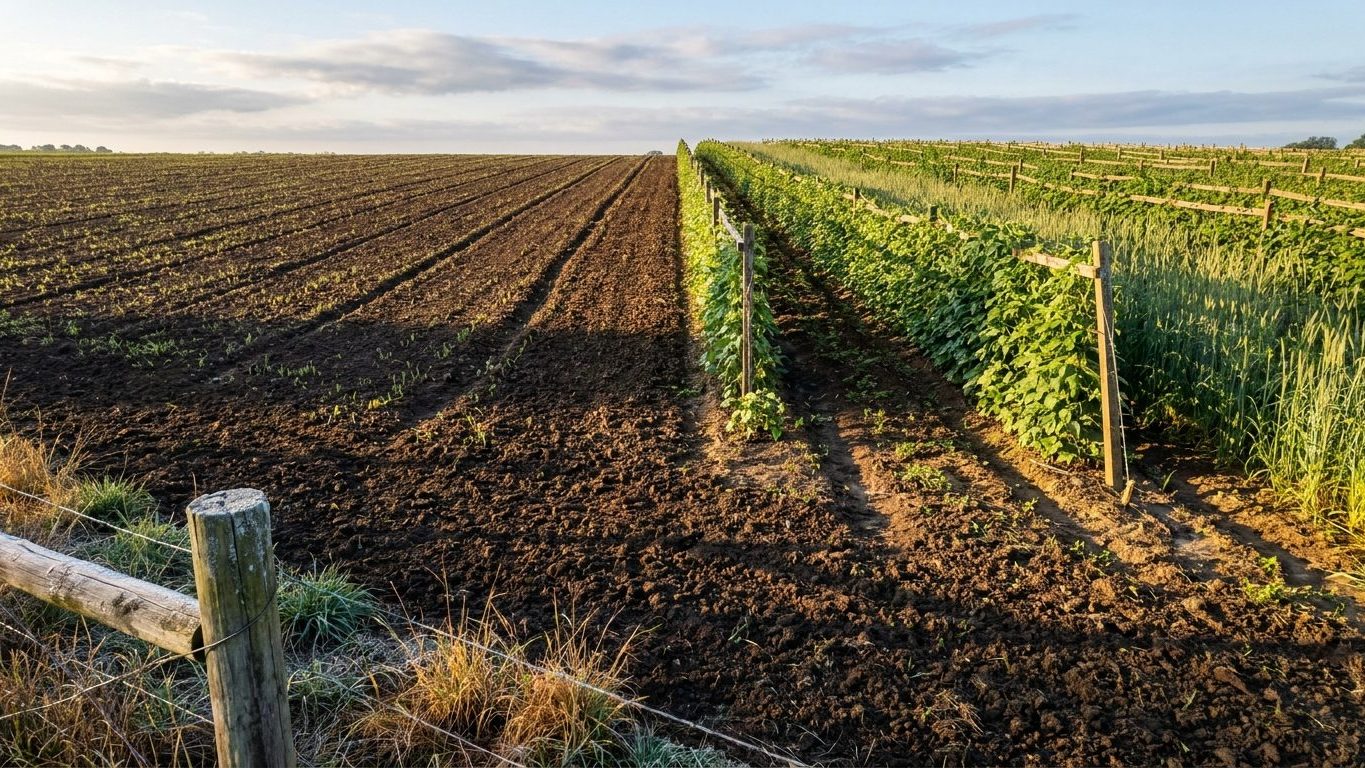

In Alabama, warm-season cover crops like cowpeas and sorghum-sudangrass go into the ground after the last spring frost, typically March 19 to April 3 at the reference weather station. Cool-season covers such as crimson clover, cereal rye, and hairy vetch go in four to six weeks before the first fall frost, November 2 to 16. Those dates come from a probability band, not a guarantee, and your own soil will tell you more than any calendar.
The short answer for Alabama
Start with what the frost dates actually measure. NOAA’s 1991-2020 climate normals for station USW00003856 put the last spring frost between March 19 and March 3, and the first fall frost between November 2 and November 16. These are the dates when the probability of a 32F freeze sits between 30% and 70%, meaning even at the airport station itself, a freeze after March 19 or before November 16 is a real possibility, not a fluke.
For warm-season cover crops (cowpeas, sunn hemp, buckwheat, sorghum-sudangrass), the working rule is to wait until soil has had time to warm past that spring frost window, generally two to three weeks after the last frost date. That pushes a safe sowing start into early-to-mid April for most of the state, later at higher elevations. These species germinate poorly in cold soil and a late frost can wipe out a stand sown too early.
For cool-season cover crops (crimson clover, cereal rye, oats, hairy vetch, winter wheat), the target is four to six weeks before the first fall frost so roots establish before growth slows. With frost arriving between November 2 and 16, that puts the sowing window at roughly mid-September through early October across most of the state.
The coldest month’s mean daily minimum here sits at 33.1F, measured at Huntsville. That number matters more than the record low because it tells you what a cover crop experiences on an average cold night, not a rare one. Crimson clover and cereal rye handle that easily and will overwinter green in most of Alabama. Hairy vetch does too, though it grows more slowly in the coldest weeks and picks up again once nights warm.
Alabama’s hardiness zone range, 7a to 9a under the USDA map, means the reference dates above apply best near Huntsville. Anywhere warmer, both windows shift wider; anywhere cooler or higher, they shift narrower. This page gives the state-level pattern. It cannot tell you your own county’s actual frost date.
What will not work here
Alabama’s problem is not a short season. With a hardiness range stretching to 9a in parts of the state, the growing season here is long by national standards. The problem is heat combined with humidity, and it catches gardeners who plant cover crops the way a drier climate would.
Dense, close-spaced stands of legumes like clover sown in the humid stretch of late summer are prone to fungal disease before they ever get established. A cover crop that would thrive at wider spacing in a dry western state can mildew and rot here if sown too thick during the hot, damp months. Thinning the seeding rate slightly and giving airflow between rows matters more in Alabama than it does in a low-humidity climate.
Counting on the full theoretical warm season also fails. The mild winter minimum of 33.1F means some tender warm-season covers, sorghum-sudangrass in particular, don’t reliably die back with the first light frost the way they would in a colder zone. Left unterminated, they can persist into a weedy stand that competes with whatever you plant next, instead of breaking down cleanly over winter as a cover crop should.
On the other end, gardeners who sow cool-season covers too late, banking on the November 2 to 16 window holding steady, run into trouble because that window is only where the freeze probability crosses 30% to 70%, not where it starts. A freeze can and does arrive before November 2 in a given year, especially inland and away from the moderating influence near the coast.
Suburban and rural gardens compound this. The NOAA figures above come from an airport weather station, and airport sites typically run warmer than the surrounding countryside. Expect your last spring frost to land later than March 19 to April 3, and your first fall frost to land earlier than November 2 to 16, often by one to two weeks, more at elevation. A cover crop schedule built strictly on the reference dates leaves no margin for that gap.
Finally, treating one cover crop as an all-purpose choice fails here. A legume chosen for nitrogen fixing in the humid Gulf-influenced south may sulk through a colder winter in the north of the state, while a cold-hardy grass suited to the north can bolt and set seed too fast in the milder south before you’re ready to terminate it.
What changes across Alabama
A range of 7a to 9a is not a rounding error. That spread covers roughly two full USDA zones, the practical difference between a spot where winter regularly dips hard enough to knock back a marginal cover crop, and a spot near the Gulf where frost is rare and mild enough that some warm-season species barely pause growth at all.
In the northern part of the state, closer to zone 7a, treat the fall sowing cutoff seriously. Cool-season covers need those four to six weeks of root establishment before real cold sets in, and a delay of even a week or two can leave a stand thin going into winter. Warm-season covers there should wait a little longer in spring too, since a slower-warming soil profile at higher latitude and elevation delays safe germination past the reference date.
Toward the southern part of the state and along the Gulf-influenced zones near 9a, both windows open wider. Frost risk drops off earlier in spring and arrives later in fall, sometimes barely arriving at all in a given year. Warm-season cover crops there can often be sown earlier and terminated later, and some gardeners in the mildest pockets keep a cover growing through what would be dead winter further north.
There is no single sowing date for Alabama, and any calendar that gives you one is flattening a real difference between the coldest and warmest corners of the state. Check the USDA Plant Hardiness Zone Map for your specific location rather than assuming which end of the 7a-9a range applies to you. Elevation matters here too, and a few hundred feet of gain can shift the effective zone down without changing the county.
Where to check this for your own county
The Alabama Cooperative Extension System is the source built to close the gap this page cannot close. State-level frost dates and hardiness ranges are a starting point. A county extension office works from local trial data, local soil temperature records, and years of direct observation in your specific area.
When you go there, look for two things specifically. First, a local planting or sowing calendar for your county, which will translate the state’s frost-date range into a working date range for your actual location, already adjusted for the gap between airport-station data and real ground conditions. Second, look for variety trial results or recommendations for cover crop species tested in your part of the state. Alabama’s spread from 7a to 9a means a cover crop that performs well in one county’s trial data may underperform in another’s, and the extension office will usually have an opinion on which species suit your specific conditions.
A county recommendation beats a state one every time, because it accounts for local microclimate, soil type, and the actual frost history of your area rather than a single reference weather station. This page describes Alabama in general terms, useful for understanding the pattern and the reasoning behind it, but not a substitute for what your county extension agent already knows about the ground near you.
If your county office does not have a published cover crop calendar, ask directly. Extension agents often have unpublished trial notes or informal guidance built from years of local questions, and a phone call or email can get you a more specific answer than any general resource, including this one.
Checking this against your own garden
Every date on this page describes an average year at one weather station. Your own garden runs on its own clock, and three simple observations will tell you more than any calendar once the season is underway.
Soil warmth by feel matters most for warm-season cover crop seed. Push your hand a few inches into the bed before sowing cowpeas, sunn hemp, or sorghum-sudangrass. If the soil still feels cool rather than warm at that depth, germination will be slow and uneven even if the calendar says the date has arrived. Wait a few more days and check again.
Watch for the first flush of flowers on whatever you’ve already sown. A cover crop moving from vegetative growth into bloom, buckwheat especially, is signaling it’s approaching the point where you want to terminate it before it sets seed and becomes a volunteer weed problem in the next planting. That timing varies year to year with heat and rainfall, and watching the plant beats guessing from a date.
First true leaves on a newly emerged stand tell you whether the season is progressing at a normal pace for your specific spot. Seedlings that emerge but stall at the cotyledon stage for an unusually long stretch are often responding to soil that’s colder or drier than expected for the date, a sign your particular microclimate is running behind the general pattern described here, and that next season you might shift your own sowing window later to match.