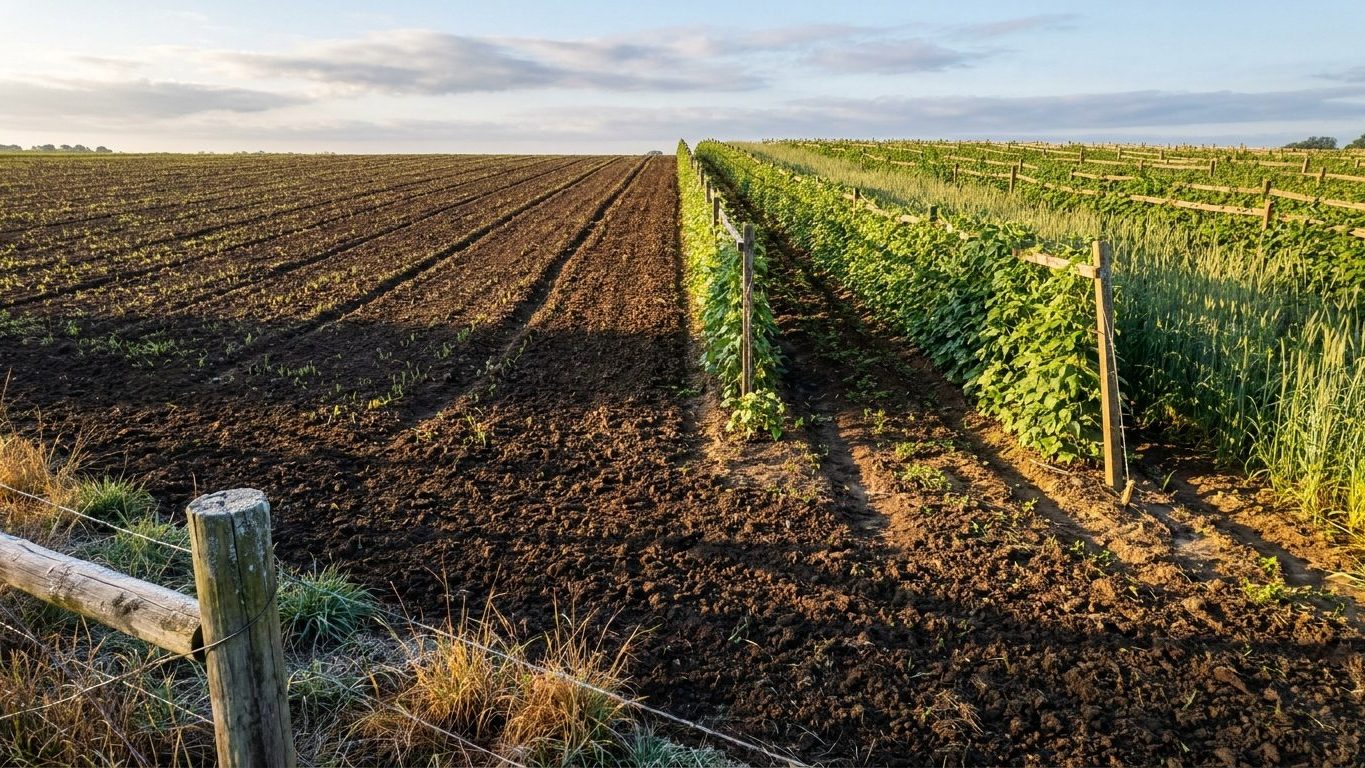

Cover crops in Alberta go in the ground within a narrow band bracketed by two mean frost dates: May 21 and September 16. That’s roughly 118 frost-free days on the calendar, but that number is a coin flip, not a guarantee. Spring-sown legumes and cereals wait for the soil to warm past that first date; fall-established covers need to be in and rooted well before the second one arrives.
The short answer for Alberta
The sowing window for cover crops here runs from late May, once the mean last spring frost of May 21 has passed, through the first week of August for anything meant to establish before the mean first fall frost of September 16. Those two dates come from Environment and Climate Change Canada’s 1981-2010 climate normals for the Calgary International Airport station, and they are averages, not safe dates. In roughly half of all years on record, frost at that station arrived later than May 21 or earlier than September 16. A grower who sows on the mean date is playing even odds, not banking a sure thing.
That 118-day stretch between the two mean dates is the outer limit of what a single-season cover crop has to work with in the reference climate this page draws from. Subtract two or three weeks for the coin-flip margin on each end, and the realistic working season shrinks to something closer to 90 days in a below-average year. That’s the number that should drive variety choice, not the full 118.
Within that window, the timing splits by what the cover crop is doing:
| Cover crop role | Typical sowing point | Why the timing matters |
|---|---|---|
| Spring-sown legume or cereal (peas, oats, spring vetch) | After the mean last frost, late May onward | Frost-sensitive seedlings need the soil warm enough for germination and above-ground growth |
| Fast summer cover (buckwheat, some brassica mixes) | June through mid-July | Needs a full growth cycle to bloom or bulk up before frost risk returns |
| Fall-established overwinter cover (winter rye, fall rye) | Late July to early August | Must root deeply and harden off before the mean first fall frost on September 16 |
Nothing here is a fixed rule for every backyard or field in the province. It’s the window that the Calgary reference station supports, and it should be read as a starting point that a reader adjusts once they check their own local data, covered further down this page.
What will not work here
A frost-free season built on a mean of 118 days, with a realistic working window closer to 90, defeats slow cover crops outright. Anything that needs a long season to bulk up its biomass, tillage radish grown to full size, or a sunn hemp-style tropical legume, simply doesn’t have the runway. If a species needs 100-plus days from seed to peak biomass and the reader sows it in June, it will still be immature when the first fall frost arrives on September 16, on average, and possibly weeks earlier in a cold year.
Anything not built to handle a real winter cold snap fails here too. The coldest month’s mean daily minimum sits at 8.2°F. That’s not the record low for the province, and it’s not a single bad night; it’s the average low across the entire coldest month at the reference station. A cover crop meant to overwinter and resume growth in spring has to shrug off that kind of sustained cold repeatedly, not survive one hard frost. Species without genuine winter hardiness for a Canadian zone 4a environment (a rating built from the region’s minimum temperatures, snow cover, and several other variables, not a single number) will winterkill outright, leaving bare soil through the exact months erosion control matters most.
Sowing too late is the most common and most avoidable failure. A fall cover crop sown in late August, banking on a warm autumn, is gambling against a mean fall frost date of September 16 that already carries even odds of arriving sooner. Add two or three weeks of establishment time a young seedling needs before real cold, and late-August sowing leaves almost no margin. The same math cuts the other way in spring: sowing before the soil has genuinely warmed past the May 21 mean invites rot and patchy germination rather than an early advantage, since a mean date carries just as much risk of a later, colder spring as an earlier one.
What changes across Alberta
Alberta is not one climate, and this page can’t pretend otherwise. The hardiness zone figure used above, Canadian zone 4a, belongs to the reference station this page is built on. It does not describe the whole province, and it should never be treated as a single answer for every county, district, or backyard in Alberta.
The Canadian hardiness system itself makes this explicit: it’s built from seven climate variables, not one, and Natural Resources Canada’s own comparison shows that a single Canadian zone rating can span nine different USDA zones depending on where in North America it falls. That’s a wide spread built into the system’s design, and it means a 4a rating in the foothills carries different real-world risk than a 4a rating on the open prairie, even where the number on paper matches.
In practical terms for cover crop timing, that spread shows up as elevation and latitude shifting both frost dates in the same direction: later spring, earlier fall, shorter working season. A reader farming or gardening in the Peace region to the north, or at higher elevation near the foothills, should expect the real local window to run narrower than the Calgary-based dates on this page, not wider. A reader in a warmer river valley or in the far south of the province may find their own local window opens earlier and closes later than these figures suggest.
This page cannot tell an individual reader which zone or which local window applies to their specific address. That call belongs to Natural Resources Canada’s Plant Hardiness Zone map, built from 1991-2020 normals down to the municipality level, which is the right tool for finding where a given county or district actually sits.
Where to check this for your own county
Everything on this page comes from one weather station and one provincial hardiness reference. That’s useful as a baseline, but it’s not a substitute for what Alberta’s own agricultural service publishes for specific districts and counties across the province.
Alberta’s provincial resource for this is Alberta’s Agriculture and Irrigation portal. Two things are worth looking for there specifically:
- A local or regional planting calendar that reflects the actual frost pattern in the reader’s own district, not the Calgary reference station used on this page
- Any cover crop varieties or mixes that have been trialled in the reader’s specific municipal district or agricultural region, since performance in one part of the province doesn’t automatically transfer to another
Alberta’s growing regions differ enough that a recommendation built for a specific county or district will consistently beat a province-wide figure, simply because it accounts for local elevation, local soil, and local microclimate patterns that a single reference station can’t capture. This page gives the provincial baseline, built from one station’s normals; the provincial agriculture service is the place to find out how much a specific county’s numbers diverge from that baseline, and in which direction.
That distinction matters most at the edges of the sowing window. A reader deciding whether to push a fall rye sowing into early August, right at the edge of the range given above, gets a much better answer from district-specific trial data than from a single station’s mean date, especially in a province where the hardiness rating itself is known to span such a wide range of local conditions.
Checking this against your own garden
Every date on this page is an average pulled from one weather station’s climate record. A reader’s own soil and plants, watched closely, will outrank all of it.
Three things are worth checking by hand before trusting a calendar date over what’s actually happening in the ground:
- Soil warmth by feel: cold, damp soil that still feels chilly to bare skin in late May is a sign the local spring is running behind the mean frost date, and sowing should wait regardless of the calendar
- The first flush of flowers on any quick-cycling plant already in the ground, cover crop or otherwise, marks the point where the local season has genuinely turned warm, a more reliable signal than any single date
- The first true leaves on a spring-sown seedling, appearing faster or slower than expected, tell whether the local microclimate is running ahead of or behind the station-based window used on this page
A garden in a low frost pocket, a sheltered south-facing slope, or a spot with heavier clay soil that holds cold longer will all diverge from the Calgary station’s averages in different directions. Watching for these three signs each season builds a much more accurate personal calendar than any single mean date ever could, and it costs nothing but a few extra minutes outside before the seed bag gets opened.