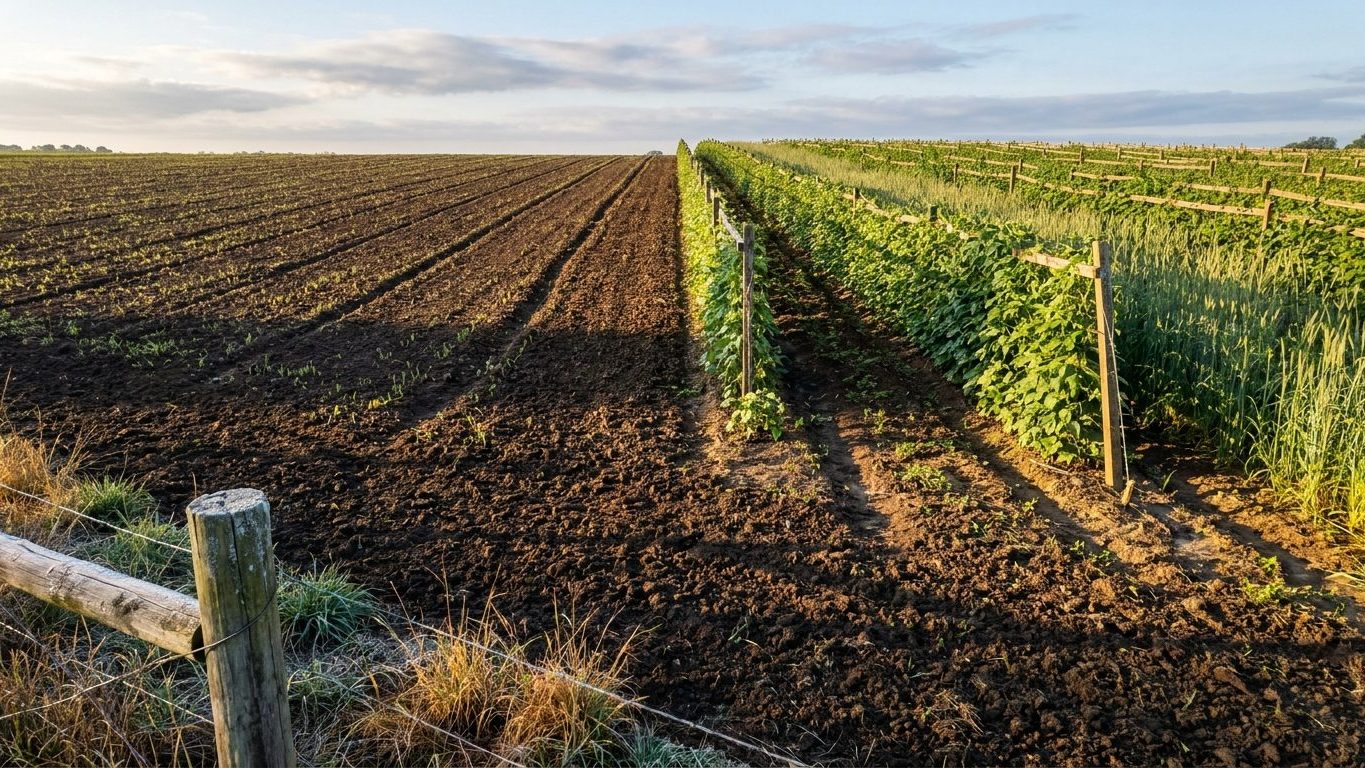

Coastal and Southern California don’t freeze in an average year, so cover crop timing there runs on heat and water, not frost. Sow cool-season covers in fall to catch the mild wet season. In the Central Valley, Sierra foothills, and northern interior, actual winter freezes reshape that calendar entirely, and this page doesn’t carry their specific frost dates.
The short answer for California
Start with what the numbers actually say. For the coastal and southern reference station used here, NOAA’s 1991-2020 climate normals show no computable freeze normal at all: thirty years of daily records turned up zero days at or below 32°F, and the frost-free season is listed at a full 365 days. That’s not rounding. It means gardeners in that part of the state aren’t picking a sowing window around frost risk, because there isn’t one.
What replaces frost as the limiting factor is heat and water. The mean daily minimum temperature in the coldest month sits at 49.1°F for this reference station, which is mild enough that winter cold never threatens a cover crop stand. So the practical sowing window for legumes and cool-season grasses like vetch, bell beans, field peas, oats, and crimson clover runs through fall, typically October into November, when the wet season arrives and daytime heat backs off enough for seedlings to establish without constant irrigation. The crop then grows through winter and gets terminated before the dry season and rising temperatures take over in spring.
That’s the answer for the frost-free zone this data describes. But California is not one climate, and the same NOAA station data that shows zero frost days for the coastal south says nothing about the Central Valley floor, the Sierra foothills, or the far north, where freezes are a normal part of winter. This page does not have station-level frost dates for those regions, and borrowing the coastal numbers for them would be wrong. If you’re gardening in Sacramento, Fresno, Redding, or anywhere above a few thousand feet in elevation, treat the fall sowing window as needing to close earlier, ahead of your local first freeze, rather than stretching into November the way it can along the coast.
The USDA hardiness zone range for California runs from 5a to 11a, which is one of the widest spreads of any state in the country. That range alone tells you a single “California sowing date” can’t exist. A recommendation built on the Los Angeles-area reference station describes real conditions for that city and similar frost-free coastal and southern locations, and nothing more.
What will not work here
The failure mode that trips up transplants from other states is assuming California’s mild winter temperature means an easy year-round growing window. It doesn’t, because the constraint here isn’t cold, it’s the dry season. California’s Mediterranean climate delivers most of its precipitation between roughly November and March, and the summer months are close to rainless in the coastal and southern zones this data covers. A cover crop sown in late spring or summer without a reliable irrigation source will not survive the gap between establishment and the next rain, no matter how mild the coldest month reads on paper. Weekly hand-watering rarely keeps pace with California summer evapotranspiration rates once temperatures climb.
That same dry summer defeats species bred for humid-summer regions. Cover crops that expect regular natural rainfall through their growing cycle, like some clover mixes commonly grown in the Southeast or Midwest, need supplemental irrigation here that many home gardeners aren’t set up to provide. Sowing them in spring and expecting them to coast to maturity on residual soil moisture is a common and avoidable mistake.
On the flip side, the frost-free coastal and southern zone described by this station’s data offers no winter chill to speak of, with a coldest-month mean minimum of 49.1°F. Species or specific seed lots that need a hard freeze to break dormancy or synchronize germination timed to a cold snap simply won’t get that trigger here. Anyone gardening from a calendar built for a genuinely frosty state and expecting the same dormancy behavior in coastal Los Angeles will be disappointed.
And the inverse problem shows up inland. In the Central Valley and higher-elevation parts of the state, which this page’s frost data doesn’t cover, an early fall sowing timed to the coastal calendar risks getting hit by a freeze the coast never experiences. Slow-establishing cover crops sown too late to build root mass before that freeze arrives are especially exposed. The lesson from these numbers is not “one date fits California,” it’s that the state contains at least two entirely different sets of failure risks, and using the wrong one for your location is the single most common error.
What changes across California
A hardiness zone spread of 5a to 11a means the coldest parts of the state and the mildest parts differ by roughly six full zones, each representing a 10°F step in average annual extreme minimum temperature. That’s the difference between a high Sierra location where the ground can freeze hard enough to kill unprotected plant tissue outright, and a coastal Southern California spot that, per the NOAA data cited above, records no freeze at all across thirty years of daily observations.
| Region type | Approximate hardiness zone character | Main sowing constraint |
|---|---|---|
| Coastal and Southern California (reference station) | Warmer end of the 5a-11a range | Summer heat and dry-season water availability, not frost |
| Central Valley floor | Mid-range, varies by county | Occasional winter freeze plus intense summer heat |
| Sierra foothills and northern interior | Cooler end of the range | Real winter freeze risk that shortens the fall sowing window |
Because this is a range and not a point value, it’s not useful for a reader to be told which zone applies to their own yard from a statewide article. The honest move is to point at the map itself: the USDA Plant Hardiness Zone Map (2023 edition, built on 1991-2020 normals) lets you look up your zone by ZIP code and see where your specific location falls inside that 5a-11a spread. A gardener at elevation in the Sierra should expect a materially shorter frost-free window than one near the coast, and should shift fall sowing earlier and treat any winter cover crop as needing to be well-established before the first local freeze, rather than following a coastal fall planting date that assumes no freeze will ever come.
Where to check this for your own county
The state-level answer above is a starting point, not a final one. California’s extension service, University of California Agriculture and Natural Resources, is reachable at ucanr.edu, and it operates through county-based offices precisely because a single statewide calendar can’t account for the range this article just described.
Once there, look specifically for two things. First, a county-level planting or cover crop calendar, since many UC ANR county offices publish guidance tuned to their local frost pattern, whether that’s the frost-free coastal strip, the Central Valley’s freeze-and-heat combination, or a mountain county’s shorter season. Second, look for which cover crop varieties have actually been trialled or recommended for your county’s soil and climate, since seed performance for vetch, bell beans, or clover mixes can differ meaningfully between a sandy coastal soil and heavy Central Valley clay even within the same general sowing window.
A county-level recommendation from your local UC ANR office will beat anything on this page, because this page works from a single reference station’s frost data and a statewide hardiness zone range. That’s useful for understanding the shape of the problem, wet-season sowing in the frost-free zone, freeze-timed sowing inland, but it isn’t a substitute for the local data your county extension has already collected for your specific conditions.
Checking this against your own garden
Every date on this page is a normal, meaning an average built from thirty years of records. Your actual yard this year can run ahead of or behind that average, and three simple checks tell you which.
Soil warmth by feel is the first. Push a finger a couple of inches into the bed where you plan to sow. If it feels cool and slightly damp rather than cold, cover crop seed is more likely to germinate promptly instead of sitting dormant and rotting. This matters more in California’s dry season transition than a calendar date, because soil in a sunny raised bed can warm weeks ahead of the shaded ground a few yards away.
The first flush of male flowers on a cover crop like bell beans or field peas tells you the plant has moved from vegetative growth into reproduction, a sign your local season is running on schedule or ahead of it. If that flush comes noticeably earlier than what neighbors or online growing logs report for a similar sowing date, your particular spot is likely running warmer than the regional average, whether from a south-facing slope, reflected heat off pavement, or simple microclimate luck.
First true leaves, the second set that emerges after the initial seed leaves, confirm the seedling has established real root contact with the soil and is drawing its own nutrients. Seeing them appear quickly after sowing is the best on-the-ground evidence that your soil temperature and moisture matched what the crop needed, regardless of what any calendar said the week should look like.