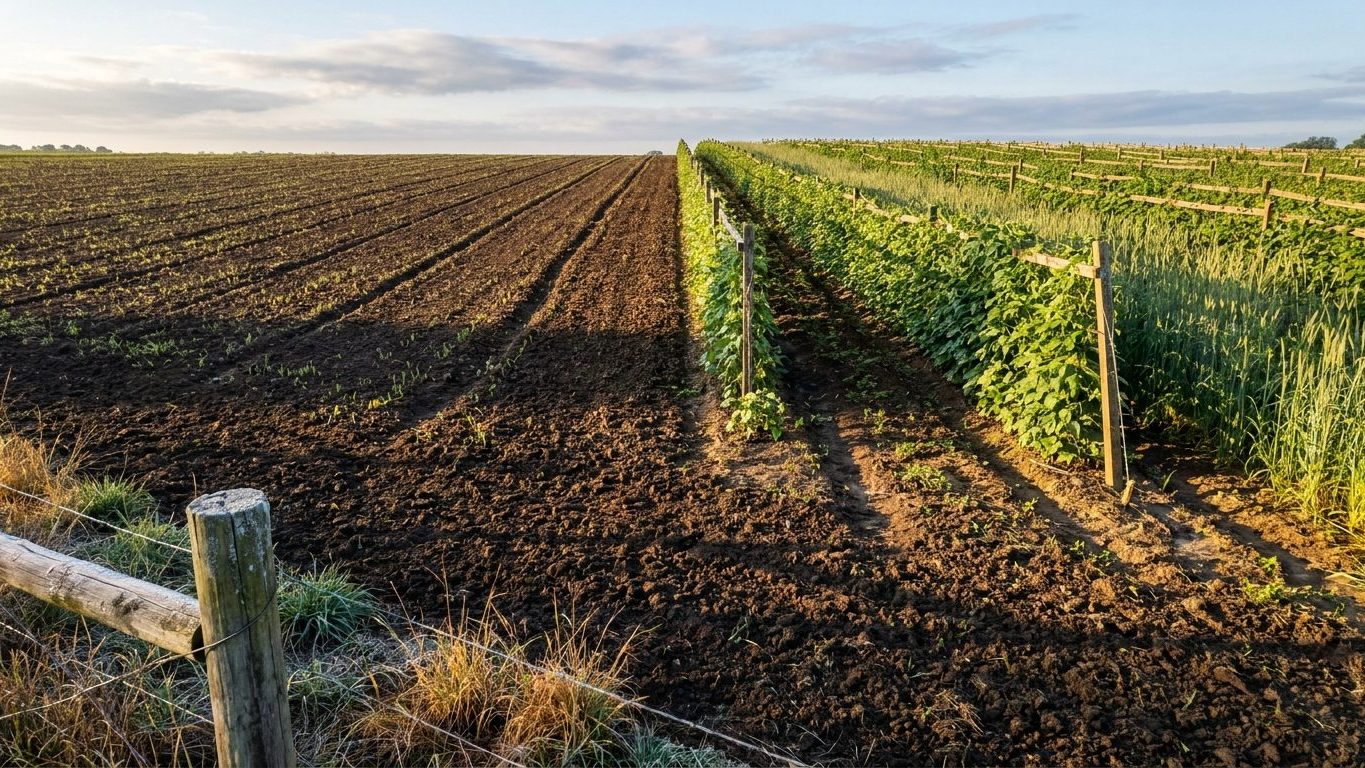

Kentucky’s sowing windows hang on two frost bands. Summer cover crops that die at frost go in after the last spring frost, and winter cover crops go in ahead of the first fall frost. Both bands come from the Louisville reference station, so they are a starting point, not a county answer.
The short answer for Kentucky
Sow frost-tender cover crops after March 24 to April 4, and sow winter-hardy ones before November 2 to November 12. Those two bands are the dates when a 32°F freeze has a 30 to 70 percent chance of showing up, per NOAA’s 1991-2020 Climate Normals for the Louisville station. They are not guarantees of when frost ends or begins.
That distinction changes how you read the numbers. A 30 to 70 percent band is the stretch where a freeze is closer to a coin flip than a sure thing. Before March 24, a freeze is still more likely than not to keep coming back. After April 4, it becomes the exception. Seed that can’t take a freeze belongs on the far side of that window, and seed that thrives in cold belongs on the near side of the fall one.
| Marker | Kentucky figure (Louisville reference) | What it means for sowing |
|---|---|---|
| Last spring frost (32°F, 30-70% probability band) | March 24 to April 4 | Tender summer cover crops go in after this band |
| First fall frost (32°F, 30-70% probability band) | November 2 to November 12 | Winter-hardy cover crops need to be sown and growing before it |
| Coldest month, mean daily minimum | 27.8°F | Average winter nights are below freezing, not deeply so |
| USDA hardiness zone | 6a-7a | A range across the state, not one zone |
The cold-hardy group, cereal rye and similar grasses, does its work through the cool months. It needs to be up and rooted before growth slows in late fall. The tender group, buckwheat and cowpeas among them, fills the warm gap between a spring crop and a fall one. Which crop fits your bed is a separate question, covered in The Best Cover Crops for Kentucky. For the wider picture of why to use cover crops here at all, start with Cover Crops for Kentucky Gardens.
One caution comes with the data. NWS Louisville warns that this urban station runs later in spring and earlier in fall than the rural land around it. For a country garden, that means the real window is tighter than the one printed above.
What will not work here

Calendar-day sowing fails first. The spring band is about 12 days wide and the fall band about 11. A gardener who marks “April 1” or “November 5” on the calendar and sows regardless is betting on the middle of a coin flip. Some years the freeze lands after the date, and some years the cold arrives before it.
Sowing tender seed at the front edge of the spring band is the classic loss. Buckwheat and cowpeas germinate quickly in warm soil, but a late freeze in the 30 to 70 percent stretch can erase a bed of seedlings. Wait until the back edge, April 4 and beyond, and you give up very little. Being a week early costs the whole sowing. Being a week late costs almost nothing.
The opposite mistake happens in fall. Winter-hardy cover crops put on growth only while the weather stays mild. Seed that goes in after the November 2 to 12 band has far less time to establish before cold slows everything. It often survives as thin, small plants that do little to hold soil or smother weeds. Sowing right at the band, instead of ahead of it, is the usual error.
The 27.8°F figure rules out another assumption. That is the mean daily minimum of the coldest month, not the record low, and it sits only about 4 degrees under freezing. Kentucky winters are cold enough to kill frost-tender crops reliably, but a typical night is not savage. That is why winter-hardy grasses and legumes make it through, while many oat plantings die back in the cold. Count on oats as a fall-only cover that winterkills, and if you want something standing in March, plan on rye.
Then there is the urban bias. If you use the Louisville dates as written in a rural county, you will sow tender crops too early and winter crops too late. Rural gardens should expect a tighter window, so lean conservative on both ends.
What the frost numbers do show is simple. The margin for error is narrow, and a fixed calendar date is the weakest tool you have.
What changes across Kentucky
Kentucky is not one garden. The USDA Plant Hardiness Zone Map (2023 edition, built on 1991-2020 normals) places the state in zones 6a to 7a. That span is about 10°F apart in average annual extreme minimum temperature, because each half-zone is 5°F wide. There is no single answer for the state, and the Louisville numbers describe Louisville and its surroundings.
Keep in mind what the zone measures. USDA zones are built on one variable only, the average annual extreme minimum. They tell you how cold the worst night of a typical year gets, which is useful for judging whether a plant survives winter. They do not tell you when frost arrives or leaves, and that second question decides your sowing date. Two places in the same zone can differ by weeks in the timing of the last freeze.
If you garden on the colder side
Colder sites, such as higher ground in the eastern part of the state and some northern counties, should shift both bands. Expect the last spring frost to run later and the first fall frost to arrive earlier. Tender summer seed waits longer, and winter-hardy seed goes in sooner. The shift is in the direction of the Louisville caution about rural gardens, but it may be larger.
If you garden on the warmer side
Warmer corners, in the lower and more southerly parts of the state, can work with a little more room at both ends. Even so, the data here is from a single reference station. Treat any stretch of extra time as a cushion, not a plan.
Not sure which zone you fall in? Check the USDA Plant Hardiness Zone Map for your ZIP code instead of guessing from a neighbor’s garden. The map gives a precise answer for your location, and it is the right tool to adjust the Louisville dates up or down.
Where to check this for your own county
The University of Kentucky Cooperative Extension Service is the place to go next. It is the state’s land-grant extension system, and it has offices serving local areas. Look there for two things: the local planting calendar for your county, and the cover crop varieties that have actually been trialled where you garden.
A county recommendation beats a state one. The statewide window is the broader one. It rests on a single reference station and a probability band, and it cannot know about your valley, your ridge, or the river fog on your lowland field. An extension agent who has watched local plantings for years knows which sowing dates held up and which varieties winterkilled in your county, and that is worth more than any statewide window.
When you reach the extension site, search for cover crop guidance and compare any dates you find against the frost bands above. Where the county calendar is later in spring or earlier in fall, trust the county.
The sowing window comes straight from the NOAA normals for the Louisville station, which you can review at NOAA’s National Centers for Environmental Information.
Checking this against your own garden
Your own observation outranks every date above. Three simple signs tell you more about your microclimate than a statewide band can, and none needs equipment.
- Soil warmth by feel. In spring, squeeze a handful of soil from a few inches down. If it feels cold and clammy against your palm, tender seed will sit and rot. Soil that warms faster than a neighbor’s suggests a sheltered, sunny, or well-drained spot.
- The first flush of male flowers. Watch your squash and other early bloomers, and the flowering of local trees and shrubs. Early flowering points to a warmer pocket, and late flowering to cold air that lingers.
- The first true leaves. On seedlings, the first leaves after the seed leaves show real growth. If seedlings stall before they appear, the soil is still too cold or the nights too chilly.
Keep notes for a season or two. Write down the date of the last frost you notice in spring and the first in fall. After a couple of years, your own record will tell you whether you sit at the early or late end of the frost bands, and whether the Louisville caution about cold rural air applies to your lot.
Some gardeners also time this by the Moon: when to plant cover crops by the moon, as almanac tradition rather than fact.
Common questions
When is the last spring frost in Kentucky?
For the Louisville reference station, the 32°F freeze probability band runs from March 24 to April 4. That marks when a freeze has a 30 to 70 percent chance of occurring, not a date after which frost is impossible. Rural and higher-elevation gardens should expect a later last frost.
When is the first fall frost in Kentucky?
The same station’s band runs from November 2 to November 12. It is a probability range for a 32°F freeze. NWS Louisville notes that the urban station runs earlier in fall than the rural land around it, so a country garden may see cold sooner than these dates.
What hardiness zone is Kentucky?
The USDA Plant Hardiness Zone Map (2023) lists the state as 6a to 7a, a range. Louisville is the reference city for the frost dates. Check the USDA map for your own ZIP code, because zones within the state differ.
Should I sow on the exact dates in the frost bands?
No. Treat the bands as boundaries, not targets. Tender crops belong after the back edge of the spring band, and winter-hardy crops belong ahead of the fall band. Then adjust for your own garden and your county extension office, because the Louisville figures come from a city station that tends to run warmer than the countryside.