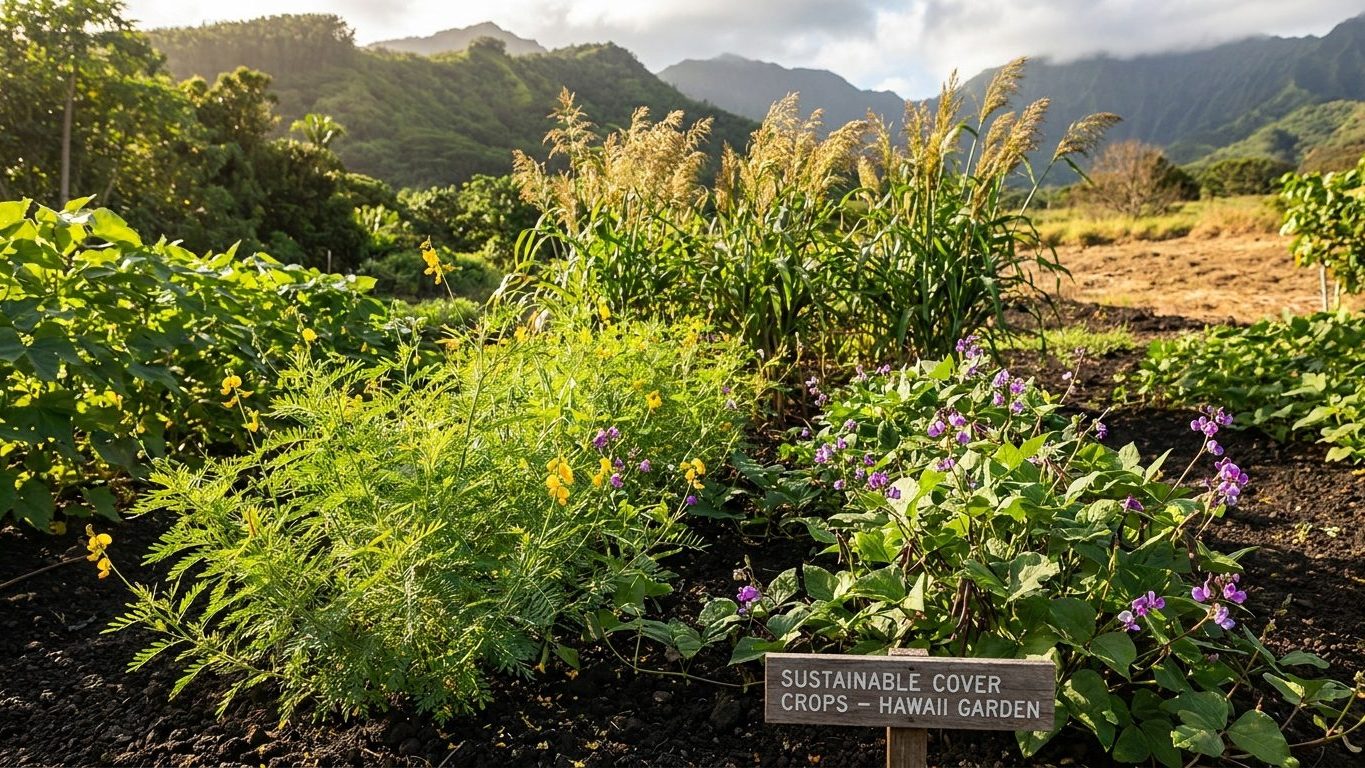

For most of California, the best cover crop choice depends less on the calendar than on which California you’re gardening in. Coastal and southern zones are frost-free, so summer legumes and mow-killed covers work best. The Central Valley, the north, and the Sierra foothills still freeze, so classic winter annuals terminated by frost remain the stronger option there.
The short answer for California
Start with the number that actually runs this state’s gardening calendar: at the reference station in Los Angeles, the coldest month averages a minimum of 49.1°F, and NOAA’s daily records show zero days at or below 32°F across three decades. That’s not a mild winter. That’s no winter at all, in the sense that matters for cover crops. A huge share of California’s population gardens somewhere that simply does not freeze.
That single fact flips the usual cover-crop logic on its head. In most of the country, you pick a winter-killed legume, let frost do the termination work, and till in the residue come spring. In frost-free California, nothing kills your cover crop for you. You have to mow it, crimp it, or till it under yourself, on your own schedule, whether or not it’s finished flowering.
Where real winter still exists, cover crop selection looks more conventional. USDA’s hardiness zone map puts California anywhere from 5a to 11a, a spread wide enough to cover both a Sierra foothill orchard and a Los Angeles backyard under the same state label. In the colder end of that range, in the Central Valley’s tule fog belt and up into the mountains, actual freezing events return, and classic winter annuals can be sown in fall to die back or at least go dormant before spring tilling.
So the decision comes down to type, not date:
| Cover crop type | Best fit in California | Why |
|---|---|---|
| Winter legumes (bell beans, vetch, Austrian winter peas) | Central Valley, north, foothills with real winter | Cold slows or stops growth naturally, easing termination |
| Summer legumes (cowpeas, sesbania) | Frost-free coastal and southern gardens | Tolerate heat, fix nitrogen without needing a freeze to stop them |
| Buckwheat | Statewide, as a fast summer smother crop | Matures in weeks, out-competes weeds before water gets scarce |
| Cereal rye or oats | Statewide, mixed with a legume | Adds erosion control and biomass regardless of frost |
Any dated recommendation on this page is built from the Los Angeles reference station. Gardeners elsewhere in the state need to shift that logic, not copy the date.
What will not work here
The most common mistake in frost-free California is planting a cover crop that depends on winter kill to finish its job. Crimson clover and hairy vetch are workhorses in colder states precisely because a hard freeze stops them on schedule. In Los Angeles and the rest of the frost-free belt, where NOAA records zero days at or below 32°F in thirty years, that freeze never arrives. Left alone, these legumes keep growing, keep flowering, and can turn from a soil-building cover crop into a tangled, seeding nuisance that has to be cut back by hand.
The reverse failure shows up with heat. A cover crop chosen for a cooler climate and left to establish through California’s dry Mediterranean summer often needs more water than the garden can spare. Much of the state runs long stretches with essentially no summer rain, and many counties layer on seasonal water restrictions during drought years. A cover crop that expects weekly irrigation to germinate and establish is competing directly with household water budgets, and it usually loses that fight before it ever builds meaningful biomass.
Spacing mistakes compound in the coastal fog belt. Recommendations written for the drier interior often pack seed closer together to maximize ground cover, which works fine where the air dries out fast. Along the coast, where marine fog keeps foliage damp well into the morning, that same close spacing traps humidity around the base of the plants and invites powdery mildew, especially on legume covers with dense leaf canopies.
Elevation adds its own limit
At the cold end of the state’s 5a-11a hardiness spread, in the Sierra foothills and higher desert basins, the growing season itself is short. A slow-establishing legume sown late in a compressed fall window may not build enough root mass before real freezing weather sets in, leaving thin, patchy cover that does little for the soil and offers no erosion protection through winter storms.
What changes across California
A hardiness range of 5a to 11a is not a rounding error. It’s the difference between a garden that never sees frost and one that regularly drops well below freezing in winter. There is no single cover crop answer for a state that wide, and treating California as one climate is exactly how the mismatches described above happen.
In the colder zones, roughly 5a through 7a, found in parts of the Sierra, the northeastern high desert, and some higher-elevation interior valleys, gardeners should lean into the conventional playbook: sow winter legumes and cereal grains in early fall, let the cold do real work slowing growth, and till in residue once the ground firms up in early spring. The season is shorter here, so earlier sowing matters more than in milder zones.
In the milder interior, zones 8a through 9b covering much of the Central Valley and inland Southern California, winters bring occasional light frost but nothing like the reliable hard freeze of the mountains. Cover crops here can often be sown a few weeks later than in the colder zones and still establish, but growers should still expect to terminate mechanically most years rather than count on a killing freeze.
At the warm end, zones 10a and 11a along the coast and through the Los Angeles basin, the calendar effectively disappears as a termination tool. Gardeners here plan for mowing or crimping from the start, and often get better results choosing summer-tolerant legumes over classic winter cover crops that were never bred to sit through a mild California winter without dying back.
Figuring out which of these bands applies to a specific address means checking the USDA Plant Hardiness Zone Map directly rather than guessing from a county name, since microclimates from elevation and coastal proximity shift the picture within short distances.
Where to check this for your own county
This page describes California at the state level, built around a single reference station in Los Angeles. That’s useful for understanding the overall pattern, but it is not a substitute for county-level guidance, and a county recommendation will always beat a state one.
The University of California’s Agriculture and Natural Resources division runs the state’s Cooperative Extension network, and its site at ucanr.edu is the place to go next. Extension offices maintain planting guidance calibrated to local conditions, not statewide averages, and they track which cover crop varieties have actually been trialled in their county’s soils and microclimate.
Two things are worth looking for once there. First, the local planting calendar for cover crops or green manures, which will reflect the real frost pattern of that specific county rather than the frost-free extreme of Los Angeles or the hard winters of the Sierra. Second, any variety trial data for legumes and grasses grown in that county, since performance on heavy clay in the Central Valley can differ substantially from performance on sandy coastal soil even at similar latitudes.
County extension offices also field direct questions, which matters in a state where the same hardiness zone label can describe gardens with very different fog exposure, elevation, or irrigation access. A phone call or email to the local office often resolves in minutes what a statewide guide can only approximate.
Checking this against your own garden
Every date and zone on this page is a statewide approximation. The garden itself gives better information, and it doesn’t need a thermometer to do it.
Soil warmth by feel is the first check. Press a hand into the top couple inches of soil in the planting bed on a clear morning. If it still feels cold and damp rather than faintly warm, the ground hasn’t caught up to the air temperature yet, and seed sown now will simply sit rather than germinate, no matter what the regional calendar suggests.
The first flush of flowers on nearby plants is the second cue. Legume cover crops and many vegetables in the same beds tend to flower once soil and air temperatures cross a threshold together. Watching for that first bloom on an early planting, whether it’s a volunteer weed or a neighboring vegetable, gives a real read on when the local microclimate has actually turned the corner, independent of what a countywide average predicts.
The appearance of the first true leaves on a young cover crop, the second set that follows the initial seed leaves, confirms the plant has moved past germination stress and is actually rooting into the season. If true leaves are slow to show up compared to a prior year’s planting at the same date, that’s the garden signaling a cooler or drier stretch than usual, worth factoring into termination timing later on.