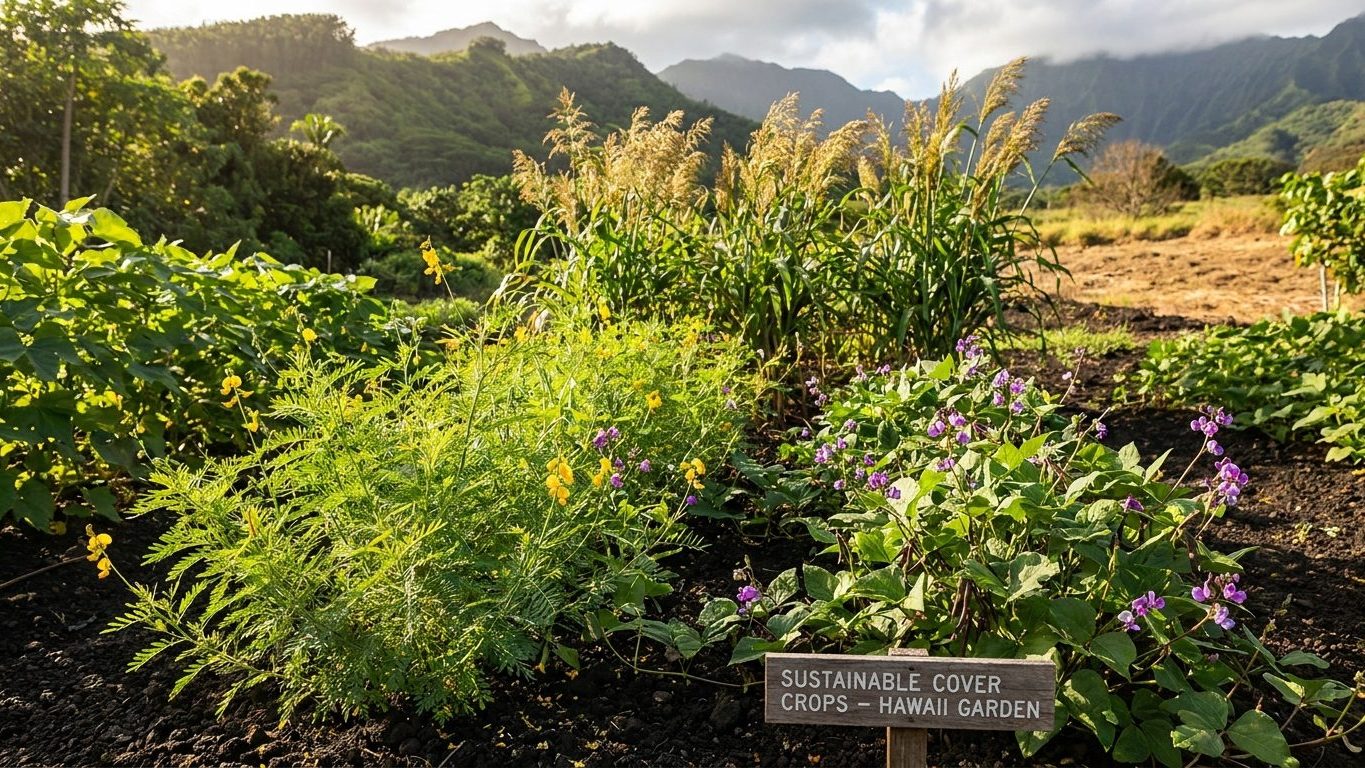

For most of Florida, the strongest cover crop choices split by season rather than by soil type: cool-season legumes such as crimson clover and cereal grains like oats or rye for the panhandle and north Florida winter, and heat-tolerant, humidity-resistant species like sunn hemp, cowpeas, and buckwheat for the long warm stretch that dominates the rest of the state. Which wins depends on where you garden and how mild your winter actually gets.
The short answer for Florida
Florida’s cover crop decision comes down to heat tolerance first, cold tolerance a distant second. The state’s hardiness range runs from 8b to 11b under the USDA system, and the reference station used for this page (Jacksonville) shows a mean minimum of just 42.9°F even in its coldest month. That’s not a cold winter by any national standard, it’s a mild one that happens to dip below freezing on the coldest nights. So the type of cover crop that performs best here is one built for warmth and humidity, with cold tolerance treated as a bonus rather than a requirement.
For gardeners near the Jacksonville reference point, the frost window (last spring frost February 16 to March 7, first fall frost November 26 to December 13) opens a genuine cool-season slot. That’s the window for classic winter legumes and grains: crimson clover, hairy vetch, cereal rye, oats. Plant them after the first frost risk starts dropping in fall, let them grow through the mild winter, and terminate before the last frost date passes and heat returns.
South of that reference point, the calculation flips. Central and south Florida rarely see a freeze worth planning around, so the “cool season” isn’t defined by frost at all, it’s just the drier, less brutal half of the year. There, legumes like sunn hemp and cowpeas, plus quick warm-season grasses like sorghum-sudangrass, carry the load because they tolerate the heat and the humidity load of a Florida summer without collapsing to disease.
Brassica-family covers such as mustard or forage radish sit in a middle tier statewide. They germinate fast and add organic matter quickly, but they’re less reliable through the wettest, most humid stretches, and they don’t offer the nitrogen-fixing benefit that makes legumes the default recommendation for most Florida vegetable beds.
The short version: legumes for nitrogen, grasses and grains for biomass and erosion control, and the calendar you use depends entirely on whether your county still gets a real frost or not.
What will not work here
The biggest mistake gardeners import from northern guides is relying on a hard freeze to kill off a cover crop. That works fine in states with a genuine winter. It does not work reliably in Florida. With a coldest-month average minimum of only 42.9°F, even at the more temperate northern reference station, plants that depend on true winterkill to terminate, like some hairy vetch stands left too long, or forage radish varieties bred for northern zones, may simply keep growing. Instead of dying back on schedule, they turn into a persistent, sprawling patch that needs to be mowed, tilled under, or hit with an herbicide by hand. That’s a maintenance headache, not a soil benefit.
Humidity is the other silent killer. Florida summers deliver near-daily afternoon thunderstorms across most of the state, and that moisture load sitting on dense foliage is exactly what fungal disease needs. Cover crops sown at close, northern-style spacing, thick stands of buckwheat or cowpea meant to shade out weeds fast, are more prone to powdery mildew and rust here than in a drier climate. Wider row spacing and lower seeding rates matter more in Florida than the seed packet’s national average suggests.
Standing water is a related problem that a lot of planting guides simply don’t mention, because it isn’t universal. Florida’s sandy flatwoods soils often sit over a seasonal high water table, and a heavy summer storm can leave a bed waterlogged for a day or two even when the surface looks dry an hour later. Crops that hate wet feet, several clover species among them, are more prone to root rot in these conditions than in a well-drained upland soil elsewhere in the country.
And the reverse mistake matters too: don’t assume you need to irrigate a summer cover crop weekly the way a dry-summer state would. Florida’s issue in the warm months is rarely a lack of water. It’s an excess of it, paired with heat that never really lets up overnight.
What changes across Florida
Florida is not one growing zone, it’s four or five stacked on top of each other, and the hardiness range for the state runs from 8b to 11b. That’s one of the widest internal spreads of any state in the country, and it means a cover crop calendar built around one part of Florida can be almost useless in another.
In the northern tier, near the Jacksonville reference station, three of the past thirty years saw no freeze at all, and the ones that did still landed in a fairly narrow window between late November and early March. That’s enough of a cold season to make classic cool-season legumes and grains worthwhile, and cold enough that summer heat, not winter chill, becomes the real limiting factor for warm-season covers trying to establish too early.
Move south into central Florida and the frost risk thins out fast. By the time you reach the southern end of the state’s range, the growing calendar effectively inverts: winter becomes the main, most productive planting season because it’s the only stretch cool and dry enough for reliable growth, and summer becomes the season to avoid, too hot, too wet, too disease-prone for most cover crop options except the toughest tropical legumes.
What that means practically: a reader in the northern part of the state should think in terms of a fall-planted, frost-tolerant cover crop that grows through winter and gets terminated before spring heat arrives. A reader further south should flip that logic entirely, planting the bulk of a rotation in the cooler months and choosing only heat-hardened species, like sunn hemp or cowpeas, for anything grown during summer. There is no single statewide answer here, only a spread, and the exact point where your county sits on that spread changes which half of this page applies to you. Check the USDA Plant Hardiness Zone Map for your specific location rather than guessing from a nearby city.
Where to check this for your own county
This page gives you the state-level picture, and Florida is too large and too climatically split for a state-level picture to substitute for a county one. The reliable next step is the UF/IFAS Extension office network, which covers every county in Florida with local agents and locally validated recommendations.
Two things are worth pulling up specifically once you’re there. The first is a local planting calendar. UF/IFAS county offices and their affiliated publications break down cover crop and vegetable planting windows by region within the state, which corrects for exactly the frost-window problem described above, since a calendar built for a north Florida county won’t match one built for a county near Tampa or Naples. The second is the list of varieties actually trialled in your area. Extension trials test named cultivars under local soil and disease pressure, which matters more in Florida than almost anywhere else given how much the humidity load and soil drainage shift from the panhandle to the Keys.
A county-level recommendation will always beat a state-level one, because it accounts for the specific microclimate, soil series, and disease pressure of that county rather than an average drawn across the whole state’s range. This page is the state one. It’s a starting point for narrowing down which type of cover crop family fits your situation, legume versus grass versus brassica, and roughly when the frost-free window opens and closes near you. The county office is where that general shape gets turned into a specific seeding date and a specific cultivar name.
Checking this against your own garden
Dates on a page, even a well-sourced one, are averages built from thirty years of data. Your own garden this particular fall or spring can run a week or two ahead of or behind that average, and three simple observations will tell you more than any calendar.
Start with soil warmth by feel. Push a finger a couple of inches into the bed in early morning before the sun has warmed the surface. If the soil feels cool and slightly damp rather than cold, most warm-season legumes are ready to go in; if it still feels chilly to the touch, give it another week regardless of what the calendar says, since a shaded bed or a low spot can lag well behind an open, sunny one even a few yards away.
Watch for the first flush of flowers on whatever you already have growing nearby, whether that’s a lingering winter crop or an early volunteer. Flowering is a strong signal that daylength and temperature have crossed a threshold your local plants respond to, and it’s a better real-time cue than a printed frost date, since your own yard’s exposure to wind and sun shapes that timing more than a regional average can.
Finally, track how fast the first true leaves appear once a cover crop is seeded. A quick, even emergence across the bed tells you the soil temperature and moisture were right at planting. A slow, patchy emergence, especially in low spots that stayed wet after the last storm, is your garden telling you the water table or drainage in that particular bed needs attention before the next round goes in.