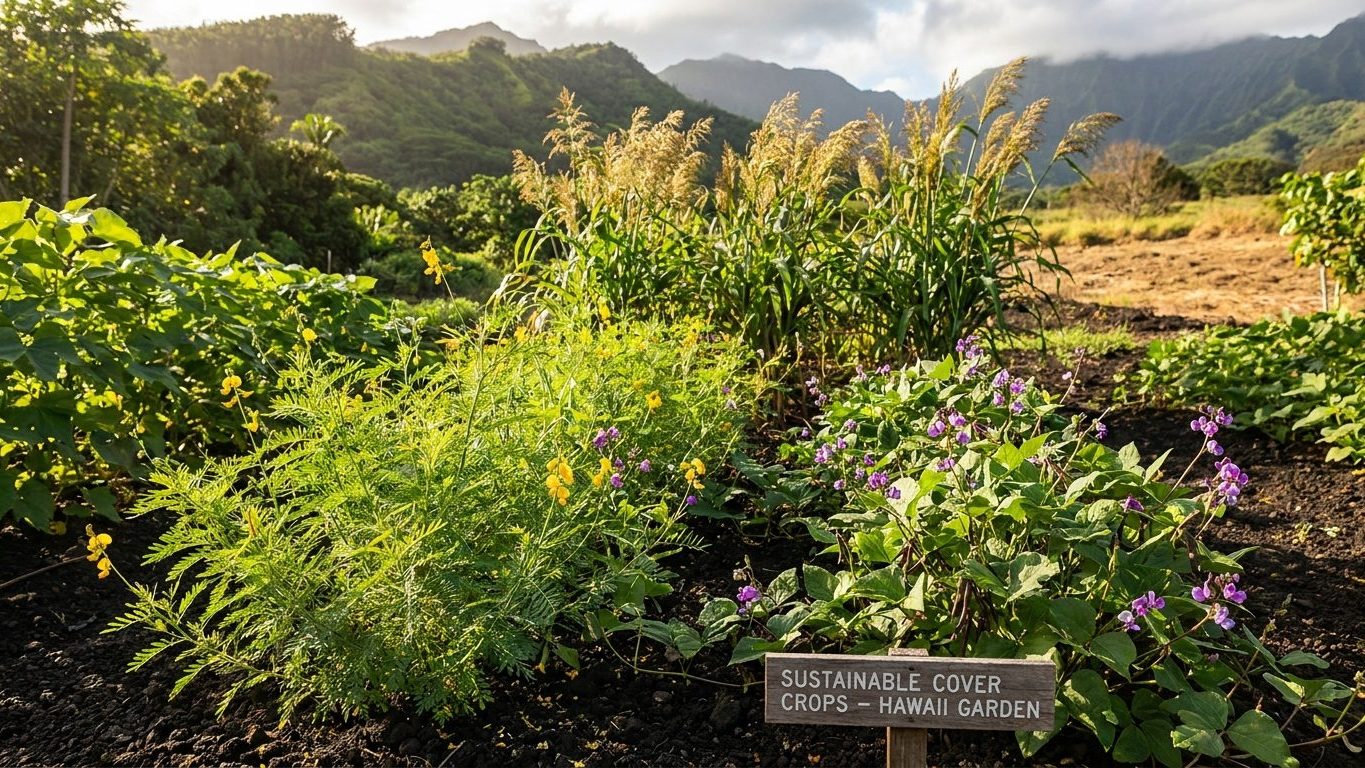

Georgia’s answer splits by season, not by variety. Cool-season legumes and cereals, crimson clover, hairy vetch, cereal rye, oats, cover the fall-to-spring slot across nearly the whole state because winters here rarely bite hard enough to kill them outright. Warm-season options, sunn hemp, cowpeas, buckwheat, fill the summer fallow instead. The split rests on Georgia’s mild winters and a hardiness range that stretches from zone 6a to 9b.
The short answer for Georgia
The mean daily minimum temperature in Georgia’s coldest month sits at 35.6°F, measured at the Atlanta reference station under NOAA’s 1991-2020 climate normals. That single number does more to decide cover crop choice here than any calendar date, because it tells you the cold almost never gets severe enough, on average, to force a winterkill species to actually die. Cereal rye, crimson clover, and hairy vetch don’t just survive a Georgia winter, they often keep growing through it, slowly, on the mild days.
That changes the math for the fall-to-spring slot. In a state where winter reliably kills a cover crop by February, growers plant, let the crop die on its own, and till it in without a second thought. Georgia growers don’t get that convenience across most of the state. Cereal rye and hairy vetch need to be mowed or crimped before they set seed, usually by early spring, because they’ll otherwise keep growing straight into the vegetable planting window. Crimson clover behaves the same way but flowers earlier, which is actually the useful signal for termination.
The frost-free window itself, running from the last freeze band of March 11 to March 29 through the first freeze band of November 13 to December 1 at the Atlanta reference point, gives roughly seven to eight months without frost in the middle of the state. That’s long enough to run two full warm-season cover crop cycles back to back if a garden bed sits fallow that long: a fast one like buckwheat (30 to 45 days) followed by a heat-tolerant one like cowpeas or sunn hemp (50 to 70 days) before fall planting resumes.
Soil type should tip the final decision. Georgia’s Piedmont clay compacts hard and benefits from a deep-rooted brassica like tillage radish worked into the cool season slot to punch drainage channels before spring planting. The sandier coastal plain soils lose nitrogen fast between crops, which favors a legume like crimson clover or hairy vetch that fixes nitrogen in place rather than relying on it being applied later. Neither choice is wrong statewide, but picking the wrong one for the soil in front of you wastes a season.
What will not work here
Oats are the clearest trap. In colder states, oats are planted specifically because they winterkill reliably around 20°F, leaving a dead mulch that needs no termination pass. In much of south Georgia, where winters run milder than the Atlanta reference figure of 35.6°F for the coldest month’s mean minimum, oats frequently don’t die. They limp through winter as a half-alive mat that then has to be mowed or tilled in spring anyway, which erases the labor-saving reason most people plant them in the first place.
Buckwheat fails at the opposite end of the calendar. It has zero frost tolerance, dying at the first light freeze, and growers who lean on the later end of the Atlanta area’s first-frost window (into early December) to squeeze in one more cycle get burned in north Georgia, where the mountains and upper Piedmont freeze weeks earlier than that reference station suggests. A buckwheat planting timed off Atlanta’s calendar in Rabun or Union County can die two or three weeks before it was supposed to.
Dense, high-biomass legumes like hairy vetch planted at northern seeding rates run into a different problem in south Georgia’s summer humidity carryover: thick, wet canopies that don’t dry out between rains breed fungal disease faster than the same planting would in a drier climate. This isn’t a drought state issue, it’s the reverse, moisture that lingers because the air stays humid rather than evaporating it off quickly.
And tillage radish, marketed everywhere as a guaranteed winterkill crop, doesn’t always keep that promise in the far south of the state. Where winters are mild enough that oats survive, radish sometimes does too, bolting to seed in late winter and becoming a weed in the following crop instead of the tidy dead mulch it’s sold as.
What changes across Georgia
Georgia spans hardiness zones 6a through 9b under the USDA Plant Hardiness Zone Map, a system built on one variable: the average annual extreme minimum temperature. A four-zone spread inside one state is wide, and it means there is no single cover crop calendar that fits both ends.
The 6a end sits in the far northern mountains, where the extreme minimum runs much colder and, per the caution attached to the frost data here, freezes arrive weeks earlier in fall and linger later in spring than the Atlanta reference station shows. A grower there planting a cool-season legume off the state-level frost dates is planting too late in fall and terminating too early in spring for their own conditions.
The 9b end sits in the far south, likely near the coastal plain and the Florida line, where winters are mild enough that some warm-season species barely slow down and true winterkill of species like oats becomes unreliable, as covered above.
Atlanta and the Piedmont, where the reference station for the frost and temperature data actually sits, fall somewhere in the middle, and the caution attached to that station matters here too: it’s an urban airport, which runs warmer than the rural land around it. A grower thirty miles outside the city, at a similar elevation, should expect frost a bit earlier in fall and a bit later in spring than the Atlanta numbers state.
None of that can be resolved from a state-level page. The right move is checking the USDA hardiness zone map directly for a specific county or elevation, rather than assuming the Atlanta figures, or any other single point on the map, apply evenly across four zones.
Where to check this for your own county
The University of Georgia Cooperative Extension is the state’s land-grant extension service, and its site, extension.uga.edu, is the right next stop, not because this page is wrong, but because it’s built at the wrong resolution to answer a county-level question.
Two things are worth pulling up there specifically. The first is a county-level planting calendar. Extension offices build these from local trial data and local frost records rather than a single airport station, which means they account for the elevation and microclimate differences this page can only describe in general terms. The second is variety trial results for cover crops actually grown and tested in that county, since a cereal rye or crimson clover cultivar that performs well on UGA’s research farms in the Piedmont isn’t automatically the best pick for a sandy field near the coast or a cold pocket in the mountains.
A county extension agent, or the county-specific pages on the UGA Extension site, will also know things this page can’t: what disease pressure local growers have actually seen on a given cover crop, whether a particular seed source performs poorly in local soil pH, and what neighboring farms have already learned by trial and error that season.
That’s the honest hierarchy here. A state-level page like this one can explain the mechanism, the frost windows, the hardiness zone spread, and the general reasoning behind picking cool-season versus warm-season species. A county recommendation, built on local data and local observation, will always beat it on the specifics. Use this page to understand why the choice works the way it does, then use the county resource to pin down the actual dates and varieties for the land in question.
Checking this against your own garden
Every date and zone number on this page describes an average. The soil in front of a grower on any given morning doesn’t always agree with the average, and three simple checks, none requiring anything beyond hands and eyes, will say more about that specific plot than any calendar.
Soil warmth by feel is the first. Warm-season cover crop seed like cowpea or buckwheat germinates poorly in cold soil regardless of what the frost-free window says. Pushing a hand a few inches into the bed on a sunny afternoon and feeling for actual warmth, not just air temperature, catches the cold, slow-draining spots (often clay, often shaded) that lag behind the rest of a property by a week or two.
The speed of first true leaves on an already-planted cover crop is the second. A crimson clover or cereal rye planting that pushes past its cotyledon stage to true leaves noticeably faster than a neighbor’s, or than it did the previous year in the same bed, is a sign that particular spot runs warmer or better drained than the county average, information worth remembering for every future planting there.
The first flush of flowers on a legume cover crop is the third, and the most useful for timing termination. Crimson clover and hairy vetch both need to be cut or crimped before they set seed, and the exact week that happens shifts year to year with the weather, not with the calendar. Watching for that first bloom, rather than counting days from planting, catches the real moment to terminate before nitrogen gets diverted into seed instead of staying in the biomass headed back into the soil.