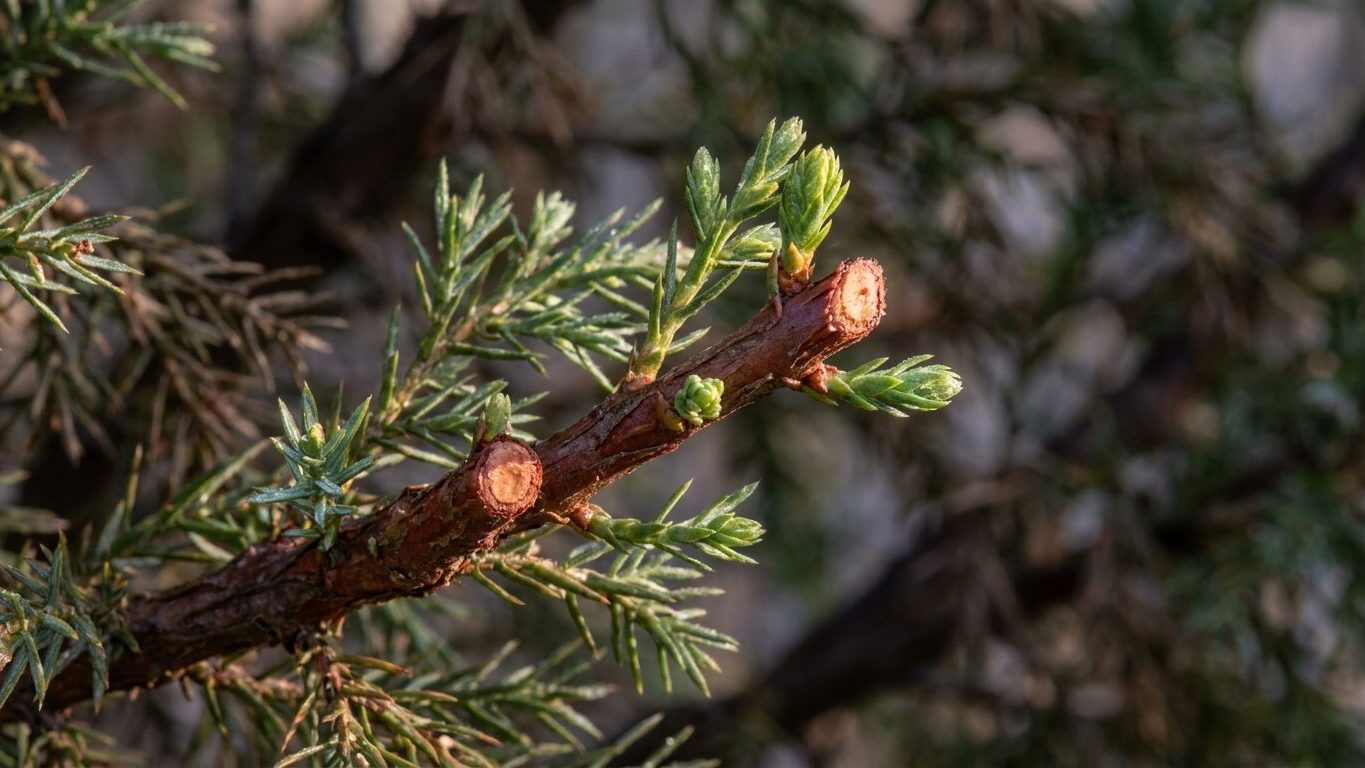

Eastern red cedar takes its cue from the plant, not the calendar. The right time is late winter, right before the buds swell and the year’s new growth starts to push. Cut then, and the flush that follows covers the wound within weeks. Cut in fall, and that same cut sits open and bare all winter.
When to prune eastern red cedar
The signal to watch for is dormancy breaking. Eastern red cedar (Juniperus virginiana) sits quiet through the cold months, then swells its buds and pushes new foliage as days lengthen. A cut made in that narrow stretch, just before the push starts, gets folded into the season’s growth almost immediately. The plant is already mobilizing energy toward new tissue, and a fresh cut becomes part of that story instead of an open wound waiting on repair.
That’s why late winter beats fall or early winter for this species. A cut made in October or November sits exposed through months of freezing and thawing, with no active growth to seal it and no foliage forming to hide it. By the time spring arrives, that wound has had a full season to dry out, crack, or invite decay organisms that a healthy cedar would otherwise keep out. Timing here isn’t cosmetic. It’s the difference between a wound the plant covers on its own and one that lingers as a weak point in the wood.
Why the window shifts by region
“Late winter” doesn’t land on the same week nationwide. Eastern red cedar grows across USDA zones 3 to 9, a range that stretches from Minnesota to the Gulf Coast, and dormancy breaks on very different schedules across that spread. A gardener in coastal South Carolina is watching for bud swell weeks before someone in Iowa sees the same signal. The plant itself sets the date, not a page on the internet, and the local university extension office is the most reliable place to confirm when that window is opening in a given county.
Growth rate matters here too. This species adds 12 to 24 inches a year under decent conditions, which is fast enough that a hedge left unpruned for even one season can outgrow its intended footprint. That pace is also why timing the cut matters: a plant growing this quickly recovers fast from a well-timed wound, but shows every mistake from a poorly timed one just as fast.
How far back you can cut, and what happens if you go past it
Eastern red cedar does not regrow from bare brown wood. There are no dormant buds hiding under that older bark, waiting for a chance to sprout the way they do on many broadleaf shrubs. Cut back into that zone and nothing comes forward to replace what was removed. The result is a hole in the plant’s outline that stays there, season after season, because the tissue that could have filled it simply isn’t equipped to regenerate.
The one rule that matters in practice: cut into the green, never through it. Every cut needs to land on wood that’s still carrying live foliage. Go past that line, even by a few inches, and the plant has no mechanism to close the gap. This isn’t a matter of stress or recovery time. It’s a structural fact about how the species is built, and it holds true whether the cut was accidental or deliberate.
What that means for an overgrown hedge
This is the part that trips people up. A cedar hedge that’s grown too wide or too tall over several neglected seasons cannot be renovated the way a boxwood or privet hedge can. Those species tolerate a hard cut back to old wood and rebuild from buds along the trunk. Eastern red cedar has no such reserve. Whacking it back to fix years of overgrowth doesn’t produce a smaller, denser hedge. It produces a permanently bare, hollowed-out shape with brown patches that never fill back in.
The honest options for a hedge that’s already past its green wood are limited:
- Live with the current size and prune lightly each year going forward, staying inside the green
- Accept the bare patches as permanent and treat the hedge as a screen rather than a tight formal shape
- Remove the overgrown sections and replace them with new plants sized to the space
None of those is a quick fix, but the alternative, a drastic cut hoping for regrowth, guarantees a worse outcome than doing nothing at all.
The shape that keeps the bottom alive
A hedge with straight vertical sides, or sides that lean inward toward the top, shades its own lower branches. Over a few seasons those shaded branches thin out and eventually go bare, which is the most common reason a cedar hedge looks full up top and skeletal at the base. Once that lower foliage is gone, it’s gone for the reasons already covered: no regrowth from old wood means no filling back in.
The fix is in the cut, not after the fact. Shape the hedge so it’s noticeably wider at the base than at the top, tapering in as it rises, roughly a slope that lets full sun reach the lower branches instead of glancing off the wider top. That taper is the whole trick. Light reaching the bottom keeps those lower branches producing foliage year after year, while a flat-sided or top-heavy hedge starves them by degrees.
How much to take off at once
Even inside the green, restraint matters. A widely used guideline among horticulturists is to remove no more than one-third of a plant’s foliage in a single pruning session. Eastern red cedar responds to this the same way most conifers do: exceed that fraction and the plant redirects energy into recovering rather than into the steady, even growth that keeps a hedge dense from top to bottom. Repeated over-cutting compounds the problem, thinning the plant from the inside even when the outer silhouette still looks intact.
Combined with the taper, the one-third limit is the whole maintenance strategy. Light, regular cuts that respect both rules keep a cedar hedge full at eye level for years. Skip either one and the bottom goes first, exactly where a screen or privacy hedge needs coverage most.
What actually kills eastern red cedar
This species has a reputation for toughness, and most of that reputation is earned. It tolerates poor soil, drought, and wind that would thin out less rugged conifers. The real vulnerability isn’t the weather. It’s cedar-apple rust, a fungal disease that needs both an eastern red cedar and an apple or crabapple tree nearby to complete its life cycle. Where orchards or ornamental crabapples are common, that two-host relationship gives the disease everywhere it needs to spread.
Pruning changes the odds here more than most people expect. A crowded, unthinned cedar holds moisture inside its canopy after rain or dew, and that damp, still air is exactly the environment fungal spores need to establish. An open, properly spaced hedge dries out faster and gives the disease less to work with. This is one of the few cases where routine pruning does double duty: it maintains the shape, and it reduces the conditions that let the tree’s main disease threat take hold.
Cedar-apple rust is enough of a problem in orchard regions that some state extension services have scaled back recommending eastern red cedar for planting near commercial or backyard apple production. That’s a call worth checking locally rather than assuming, since the risk depends heavily on how close the nearest apple trees are. Anyone deciding whether to plant, keep, or remove a cedar near fruit trees should check with their state extension service for current guidance, since recommendations vary by region and by how serious local rust pressure has become.
Common questions
Can eastern red cedar be cut back hard to control its size?
No. Because it doesn’t regrow from bare wood, a hard cut back to old growth leaves permanent bare patches rather than a smaller, denser plant. Size control has to come from light, regular pruning that stays inside the green foliage, not from an occasional drastic cut.
What happens if I prune in fall instead of late winter?
The cut sits exposed through the cold months with no active growth to help seal it, increasing the chance of dieback or dried-out wood by spring. Late winter, right before the plant breaks dormancy, lets new growth cover the cut almost immediately.
How do I know if my hedge has already been cut too far back?
Look for bare, gray-brown sections with no green foliage at all. If a branch shows no live growth anywhere along its length, that section will not recover, and the bare patch is permanent regardless of how the hedge is treated afterward.
Does thinning a cedar hedge really reduce disease risk?
Yes, in a meaningful way. Dense, unthinned foliage traps moisture, which favors the fungal spores behind cedar-apple rust. Opening up the canopy through regular light pruning lets air move through and the foliage dry faster after rain, lowering the conditions that disease needs to spread.