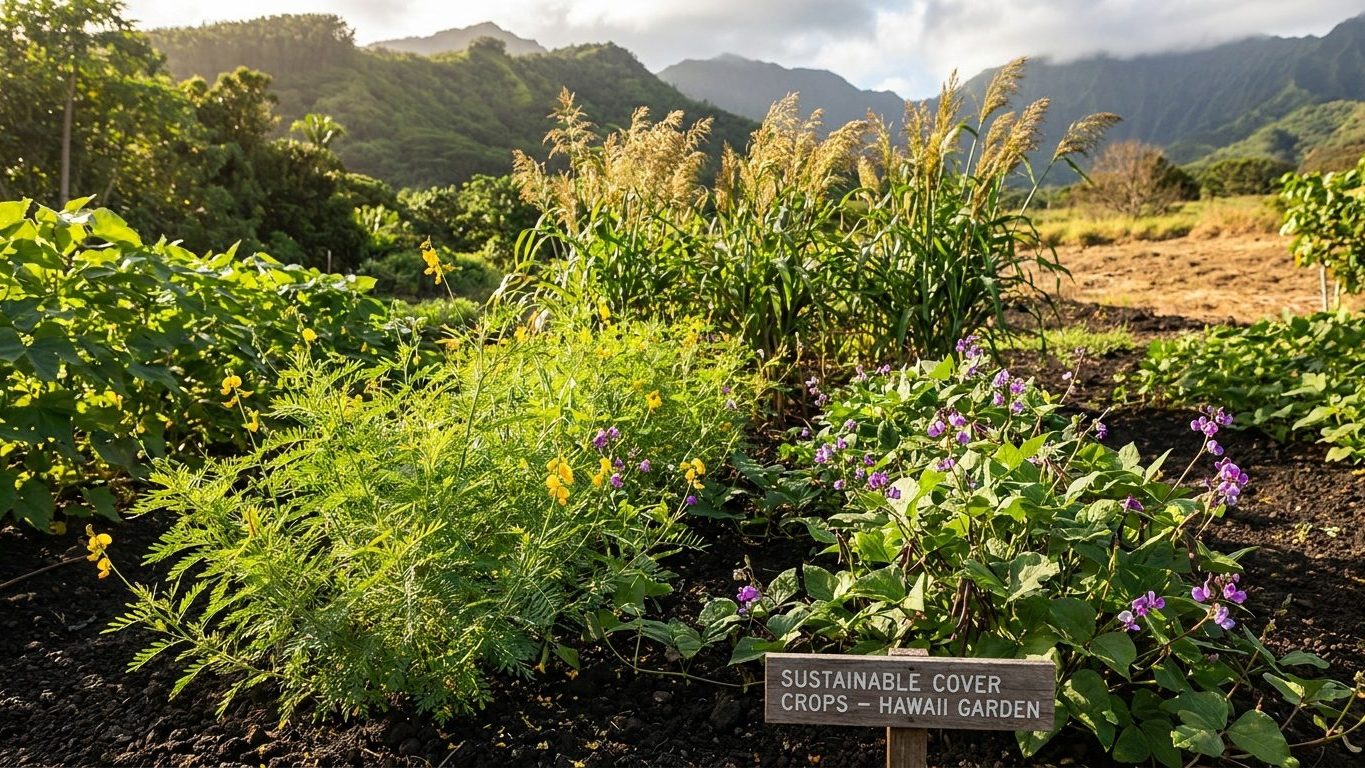

For most Idaho gardens and fields, the safest cover crop choices are cool-season types: winter cereal rye, oats, field peas, and hairy vetch in the milder valleys. The right pick depends less on the calendar date and more on how much cold and how short a season your specific spot deals with each year.
The short answer for Idaho
Idaho’s frost-free window, measured at the Boise reference station, runs from a last spring frost between April 23 and May 7 to a first fall frost between October 7 and October 21. That gives the valley floor around Boise something like 155 to 180 days without a killing freeze in a typical year. That’s the number that decides which cover crop TYPE actually fits, because a cover crop that needs a long season to bloom, fix nitrogen, or set a deep root system simply runs out of daylight before the first frost shuts it down.
The other number that matters is the mean daily minimum of the coldest month, which sits at 25.4°F at Boise. This is not the record low and not the average temperature, it’s the number that tells you whether a cover crop meant to overwinter actually survives here, or dies back to nothing by February. Idaho’s statewide hardiness range runs from 3b to 7b on the USDA map, and that spread is the reason there’s no single crop that works everywhere in the state. Boise sits toward the warm end of that range; a lot of Idaho does not.
Given those two numbers, the decision comes down to type rather than variety name. Winter cereal rye is the closest thing to a universal answer here: it germinates in cool soil, tolerates freezing well below Boise’s 25.4°F coldest-month minimum, and doesn’t need a long season to be useful as a soil cover. Field peas and oats work as a fast, frost-tolerant option for a short shoulder-season window, though a hard freeze will kill them outright rather than just slowing them down, so timing against that October frost date matters. Hairy vetch is a strong nitrogen-fixer but needs real season length to establish before winter, which makes it a reasonable bet in Boise’s 155-to-180-day window and a riskier one anywhere colder or higher. Crimson clover leans toward the warmer end of the state’s zone range and struggles where winters get harsh.
None of this replaces a local check. But if you’re choosing blind, cereal rye is the crop that fails least often across Idaho’s range, and everything else is a bet you place against your own local winter.
What will not work here
Warm-season cover crops are the most common mistake. Buckwheat, cowpeas, and sorghum-sudangrass all need a long stretch of warm soil and no frost risk to be worth planting, and Idaho’s frost dates don’t give a generous margin for error. With a last spring frost that can run as late as May 7 and a first fall frost that can arrive as early as October 7, the realistic warm window at Boise itself can shrink to well under 150 days in a cooler-than-average year. Plant a warm-season cover crop on the early side and a late frost kills the seedlings before they’ve done anything useful. Plant late to dodge that risk and the crop gets caught by an early fall frost before it’s built any real biomass.
Long-season legumes fail for a related reason. Anything that needs 90-plus days of active growth to flower and fix meaningful nitrogen is gambling against a season that, in the higher and colder parts of Idaho, may not offer that much frost-free time at all. The 3b-7b hardiness spread means a crop rated hardy only to zone 6 can be a fine bet in a warm Snake River Plain valley and a total loss in a mountain valley or the northern Panhandle, where winter lows regularly beat Boise’s already-cold 25.4°F coldest-month average by a wide margin.
Cover crops bred for mild, wet winters are the other trap. Some clover varieties rated for zone 6 or warmer will winterkill hard anywhere the state’s colder zones apply, and that’s a large share of Idaho’s land area, not a fringe case. On the flip side, this is dry country in summer, not humid country, so the failure mode isn’t fungal disease from tight spacing, it’s desiccation. A cover crop that needs weekly watering to establish through a hot, dry Idaho summer is a poor match for dryland acreage or a garden that isn’t set up for regular irrigation. Match the crop to the water you’re actually willing to give it, not to a planting guide written for a wetter state.
What changes across Idaho
Idaho is not one growing region wearing a single label. A hardiness range of 3b to 7b is one of the widest spreads you’ll find listed for any single state, and that gap is mostly about elevation, not latitude. A high mountain valley in central Idaho can sit at 3b or 4b even though it’s no farther north than a 6b or 7b valley floor a few dozen miles away. Elevation, more than how far south or north a spot sits on the map, is what pushes a location toward the colder end of that range.
What that means in practice: a grower in a low, warm valley like the Boise area or the Snake River Plain has room to try hairy vetch, crimson clover, or other cover crops that need a fuller season and a milder winter to pull through. A grower in a high mountain valley or in much of the northern Panhandle is working closer to the 3b-4b end of the range, where the safer bet is the hardiest, fastest options: winter cereal rye, oats terminated ahead of hard winter, or spring-seeded peas timed to a much shorter frost-free window than Boise’s.
There’s no way to give a single statewide planting date or a single “best” cover crop and have it hold true from the Panhandle to the southeastern high desert. If your land sits at meaningfully higher elevation than a valley floor, or farther north where winters run harder, treat every date and every crop recommendation on this page as the milder-end case, not your case. Idaho’s own hardiness zone map is the tool for placing your specific location inside that 3b-7b spread; this page can’t do that for you from here.
Where to check this for your own county
The next step is the University of Idaho Extension, the state’s land-grant extension service. This is where a statewide answer turns into a county-specific one, and that difference matters more in Idaho than in most states given how much elevation swings the numbers.
Look specifically for two things once you’re there. First, any local or regional planting calendar that reflects your county’s actual frost dates rather than Boise’s, since a county at higher elevation or farther north will have a shorter, colder window than the one used in this article. Second, look for variety trial results or extension bulletins covering cover crops actually tested in your part of the state. Idaho’s extension system runs field trials and county-level programs precisely because a crop that performs well on the Snake River Plain can behave very differently in the Panhandle or in a high mountain county, and trial data from your own region beats a general recommendation every time.
This page has given you the state-level picture built on Boise’s frost data and Idaho’s full hardiness range. That’s useful for narrowing down which types of cover crop are worth considering at all, but it isn’t a substitute for a county recommendation. If your county extension office publishes something more specific, that number should overrule anything general stated here, because it’s built on local frost records and local field trials rather than a single reference station standing in for a state this varied.
Checking this against your own garden
Every date and zone number in this article is a probability, not a promise, and your own plot will tell you more than any of them. Three things are worth watching directly.
Soil warmth by feel is the first. Dig down a few inches and grab a handful. Cool, damp soil that hasn’t shed its winter chill yet is a sign that cool-season cover crop seed will sit and wait rather than germinate quickly, no matter what the calendar says. Warmer, looser soil that crumbles easily is the better signal that germination will move fast.
The second is how quickly true leaves show up on your stand once seeded. A cover crop that pushes past its first true leaves quickly, in days rather than weeks, tells you the season is running warmer or your microclimate is more sheltered than the regional average. A slow, dragging start suggests your spot runs colder than the reference numbers used here, which matters most for anyone near the edge of Idaho’s colder zones.
The third is the first bloom on a legume cover crop like vetch or clover. Flowering is the signal that the plant is moving toward setting seed, and it’s your cue to terminate the stand before it does, since a cover crop that reseeds itself can turn into next year’s weed problem. Watch these three signs on your own ground for even one season, and you’ll have a better read on your microclimate than any station-based average can give you.