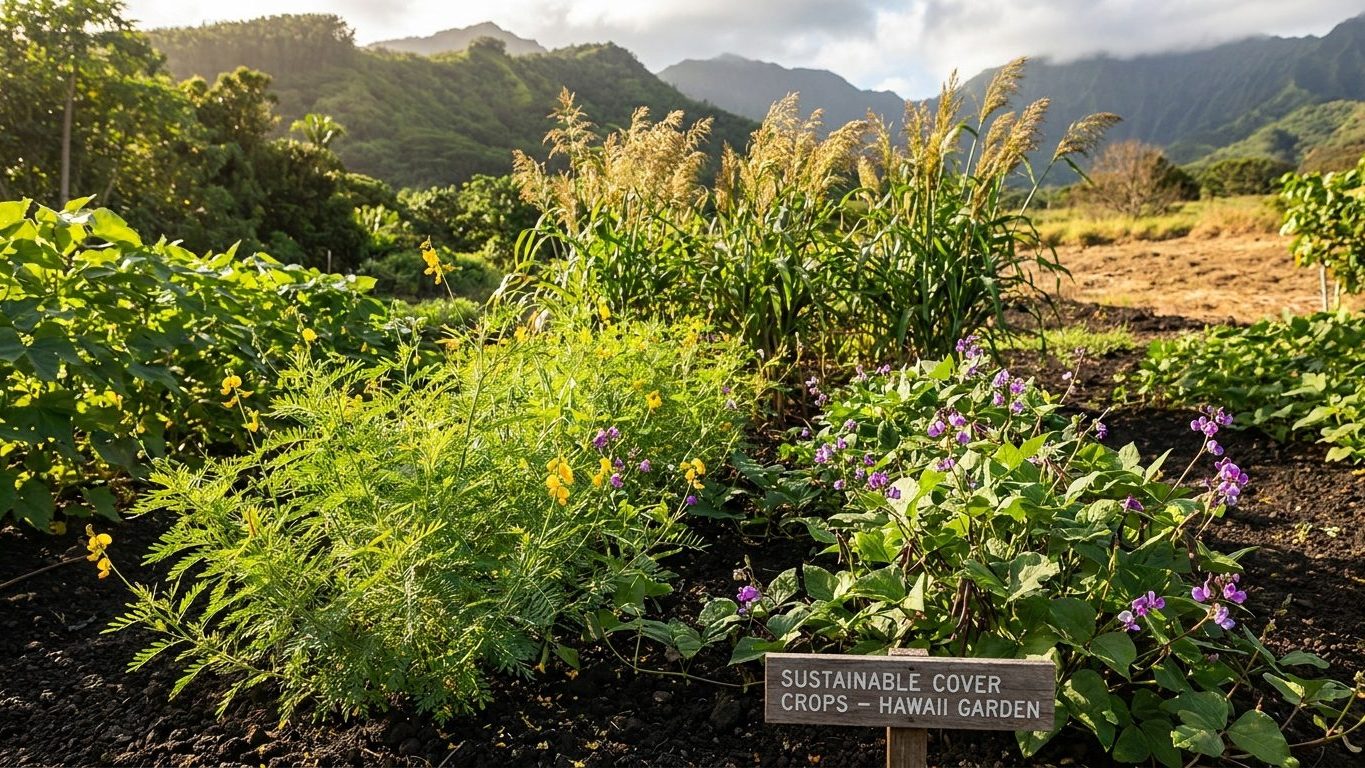

Cereal rye tops the list for most of Illinois because it survives the state’s coldest winter nights and still gives you a thick mat of green before spring planting. Oats and radish work well too, but only as a fall-only cover that dies on its own. Clover and vetch fit a narrower band of the state, and that band depends on exactly where you garden.
The short answer for Illinois
Illinois runs a growing season bounded by a last spring frost of April 11 to April 22 and a first fall frost of October 24 to November 3, both measured at the reference weather station. That’s a window of roughly six months at the warmest pocket of the state, tighter almost everywhere else. The number that actually decides which cover crop survives winter, though, isn’t the frost dates. It’s the coldest month’s mean daily minimum: 18.8°F. That’s not a record low, it’s the average low night in the harshest month, and it’s the figure a seed catalog means when it prints “hardy to zone 5” or “zone 6 only.”
Combine that with a hardiness zone spread of 5a to 7b across the state, and the picture by type looks like this. Cereal rye tolerates cold well below 18.8°F once established, which is why it’s the default recommendation almost anywhere in Illinois: seed it after a fall harvest, let it grow a few inches before frost, and it’ll green up again in March regardless of which end of the state you’re in. Oats and forage radish take the opposite strategy. Neither survives a hard freeze, so they’re planted deliberately to winterkill, leaving a dead mulch on the surface by the time the ground freezes solid. That makes them a low-maintenance choice for anyone who doesn’t want to terminate a living cover crop in spring.
Legumes split the state. Hairy vetch handles the cold reliably across most of Illinois and is the standard nitrogen-fixing choice from central counties north. Crimson clover is pickier: it’s rated for milder winters and performs best in the southern third of the state, where the zone climbs toward 7a-7b. Farther north, where winter lows sit closer to zone 5a territory, crimson clover often doesn’t make it through to spring.
| Cover crop | Winter behavior | Best fit in Illinois |
|---|---|---|
| Cereal rye | Overwinters, regrows in spring | Statewide, most reliable option |
| Oats | Winterkills reliably | Statewide, low-maintenance fall cover |
| Forage radish | Winterkills, breaks up compaction | Statewide, paired with oats |
| Hairy vetch | Overwinters in most zones | Central and northern counties |
| Crimson clover | Marginal in colder zones | Southern counties only |
What will not work here
Warm-season cover crops built for a long, hot growing window are the first to fail. Sunn hemp and cowpeas need heat and a frost-free stretch well beyond what’s available once you count backward from an October frost. Plant either one in August expecting a full cycle before the first fall frost lands sometime between October 24 and November 3, and you’re asking a plant that wants 90-plus frost-free days to squeeze into 60 or fewer. It won’t flower, and in the case of sunn hemp, it won’t build the biomass that makes it worth planting at all.
Buckwheat has the same problem in reverse. It’s fast and it’s cheap, but it’s also one of the most frost-tender cover crops available, killed outright by the first light freeze. Sown too late in the season, say after Labor Day in the northern half of the state, it never reaches the flowering stage that makes it useful for pollinators or weed suppression before that first frost cuts it down. It becomes an expensive way to grow a few inches of green and nothing else.
Crimson clover planted in the northern tier of Illinois runs into the same wall the frost dates describe. The coldest month’s mean minimum of 18.8°F is measured at a single reference station, and northern counties, especially away from the moderating effect of Lake Michigan, regularly see colder nights than that. Crimson clover’s cold tolerance tops out lower than cereal rye’s or even hairy vetch’s, so a stand that looks fine in November can be dead by February in a zone 5a pocket, while the same seed thrives two hundred miles south.
Dense, tight-spaced legume plantings also run into trouble in the humid stretch of a typical Illinois summer or a wet fall. Clover and vetch sown too thick trap moisture at the soil line, and in a wet year that turns into fungal disease before the stand ever gets tall enough to do its job. The fix isn’t a different species, it’s wider rows and lower seeding rates, but skip that step and the failure looks the same as a cold-kill even though the cause is completely different.
What changes across Illinois
A hardiness zone range of 5a to 7b is not a rounding error, it’s close to three full zones of difference packed into one state. There is no single cover crop answer for “Illinois.” A grower near the Wisconsin border is working with a shorter frost-free season and colder winter lows than a grower near the Ohio River, and that gap shows up directly in which legumes survive winter and how early a fall cover crop needs to go in the ground to establish before frost.
In practice, that spread means the same planting date can produce very different results depending on where in the state you are. A cereal rye stand seeded in mid-September will likely have several extra weeks of fall growth in the southern counties compared to counties near Chicago, simply because the first fall frost arrives later there. Hairy vetch, which needs a decent root system going into winter to survive, benefits from that extra growing time in the south, while a northern planting on the same calendar date might go into winter under-developed and more vulnerable to a hard freeze.
None of this is something to guess at from a state map. The USDA Plant Hardiness Zone Map, built on the average annual extreme minimum temperature, is the tool that shows exactly where a given zone line runs, down to the county and often the neighborhood. This page describes the state’s range; it does not, and can’t, tell an individual reader which zone their own yard sits in. That’s a question for the map itself, not for a state-level article.
Where to check this for your own county
Illinois Extension, run through the state’s land-grant university system, is the resource built for exactly this gap between a statewide range and a single garden. Its site, extension.illinois.edu, publishes county-level guidance that a state page like this one simply can’t replicate, because a county office works with local trial data instead of a single reference weather station.
Two things are worth looking for once there. First, a local planting calendar for cover crops, if the county office has published one: these typically translate the general “before first frost” guidance into an actual date range based on local conditions rather than the airport-station numbers used for statewide averages. Second, variety trial results specific to the region. Illinois Extension offices have tested cover crop varieties, including cereal rye lines and clover cultivars, under regional conditions, and that data reflects local soil, rainfall, and winter severity in a way a state-wide recommendation never can.
A county recommendation beats a state recommendation every time there’s a conflict between the two. This page exists to describe patterns across Illinois as a whole, using the best statewide climate data available. It is not a substitute for what a local extension educator knows about the specific soils and microclimates in a given county, and it shouldn’t be treated as the final word once that more precise information is available.
Checking this against your own garden
Every date on this page is a probability built from decades of averages at one weather station. Your own soil and your own plants will tell you something more current and more local, and that observation should win when it disagrees with a calendar.
Start with soil warmth by feel. Cover crop seed germinates on soil temperature, not the calendar date, and a handful of soil that still feels cold and damp in mid-April, even after the reference station’s frost window has passed, is telling you that your particular spot is running behind the regional average.
Watch for the first flush of flowers on whatever legume is already growing nearby, whether that’s clover in a lawn or vetch in a neighboring field. That first bloom is a solid sign that the local season has turned the corner into steady warmth, and it tends to track more closely with your own microclimate than a printed date does.
Finally, look at the first true leaves on any fast-germinating cover crop you’ve already seeded, like oats or radish. Slow, stunted true-leaf growth after germination usually points to soil that’s still too cool or too wet, a sign to hold off on the next planting rather than push ahead on schedule.