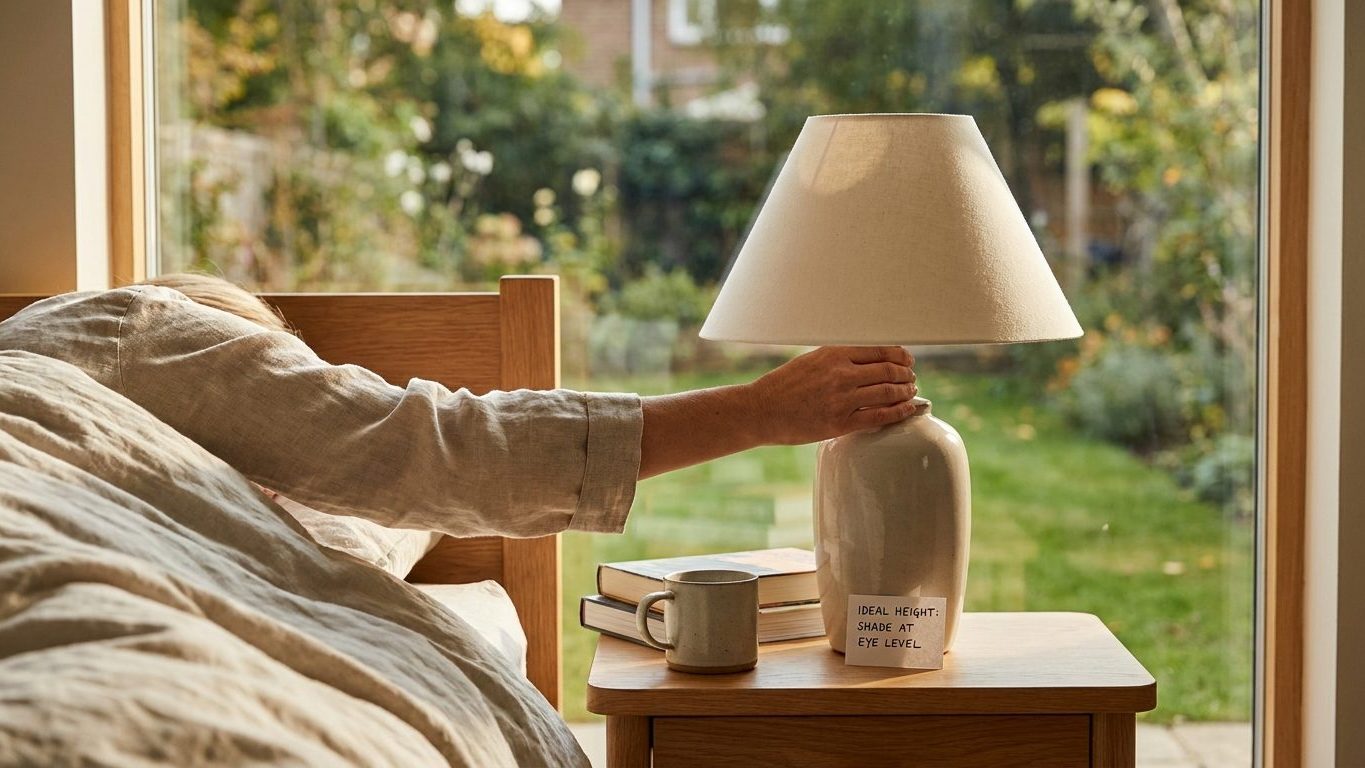

The shade’s bottom edge is what decides this, not the lamp’s total height. That edge, and the top of the whole fixture beneath it, wants to land at 58 to 64 inches off the floor, table included, because that’s roughly eye level for someone sitting up against the pillows. Measure your nightstand’s height, subtract it from that range, and buy a lamp that fills the gap.
The height that puts the shade where it belongs

Lighting-design convention puts the working range at 58 to 64 inches, measured from the finished floor to the top of the lamp with the table underneath it already counted in. This is a trade convention, not a building code number. No inspector checks it, no permit references it, and nobody will cite a section number if your lamp lands an inch outside it. It’s a figure lighting designers settled on by testing what actually reads comfortably at bedtime, not a legal threshold.
The measurement runs from the floor up to the highest point of the fixture, which on most bedside lamps is the rim of the shade rather than the finial or the switch above it. That distinction matters because two lamps with the same listed “height” on the box can put the shade in different places if one has a taller harp or a shallower shade. When you’re comparing lamps, check where the shade itself sits, not just the number printed on the tag.
It also means the lamp’s own height is only half the calculation. A 26-inch lamp on a 24-inch nightstand puts the shade around 50 inches up, well under the range. The same lamp on a 30-inch table clears 56 inches, still short. Get the table’s height first, because the lamp you need is whatever closes the remaining distance up to that 58 to 64 inch band.
Eye level sitting up, not standing
The reason the range sits where it does is posture, not decoration. Someone reading in bed is propped against pillows with their head roughly a foot or so above the mattress surface, not standing at the nightstand. A lamp sized for a standing adult’s eye level will sit far too high once that same person is lying down and reaching to switch it on, and the light it throws will miss the page entirely.
What goes wrong below the range and above it
Below 58 inches, the bulb itself sits close to eye height, so instead of reading by the light it throws onto a page or a phone screen, you’re looking straight into the glare. That’s the harsher failure of the two, because a bright bulb at eye level is uncomfortable within seconds, not just inconvenient over an evening.
Above 64 inches, the failure is quieter but just as real: the light falls behind your shoulder instead of onto what you’re reading. You end up tilting a book toward the lamp, or turning your head at an angle that gets tiring fast. Neither failure is dangerous. Both make the lamp annoying enough that people stop using it and switch on the overhead light instead, which defeats the reason for having a bedside lamp at all.
None of this is written into any code because none of it touches safety or egress. It’s a comfort range, arrived at by lighting designers watching what people actually do with a book and a lamp, and it’s worth treating as a target rather than a rule you could be cited for missing.
The table decides half the answer
There’s no code section governing any of this, so there’s no local adoption question the way there is with something like the minimum ceiling height in a bedroom, which does come out of an adopted building code and varies by jurisdiction. A bedside lamp’s height is pure furniture-planning convention, and the convention only holds because of one assumption: that the nightstand is roughly level with the top of the mattress.
That assumption breaks more often than people expect. A low platform bed with a tall nightstand, or a high pillow-top mattress next to a low vintage side table, both throw the relationship off. In either case the 58 to 64 inch range still describes where the shade should end up, but the table no longer does the work the convention assumes it does, and the lamp has to make up a bigger or smaller gap than it would on a matched set.
This is why lamp shopping by table height alone, without checking mattress height too, gets people into trouble. A tall table next to a low mattress can put even a modest lamp’s shade above eye level for someone lying down, even though the same lamp would sit correctly next to a higher bed. Since none of this is enforced anywhere, there’s no authority to check your combination against. It’s a fit you work out yourself, table against mattress against lamp, and adjust by eye once the pieces are actually in the room together.
Measuring from the mattress, not the floor

The gesture that actually settles this is simple, and it’s also the one people skip. Sit on the bed the way you would to read, and have someone hold a tape measure from the mattress surface up to your eye level. That number, not a floor measurement, is the real target the shade needs to land near.
The steps in order
- Measure from the top of the mattress to eye height while sitting up against pillows, the way you’d actually read.
- Measure the nightstand’s height from the floor to its top surface.
- Subtract the nightstand height from the 58 to 64 inch range to find the lamp height that fills the gap.
- Check the shade’s actual bottom rim against that number, not the lamp’s total listed height.
The common mistake is measuring the nightstand from the floor and stopping there, treating that as the whole answer. Measure from the mattress top, not the floor, because the mattress is where the eye level that matters actually starts. A nightstand that’s the “right” height on paper can still put the lamp wrong if the mattress next to it is unusually thick or thin.
If you’re also dealing with light leaking in around the edges of the window treatments, it’s worth sorting that separately. Uneven daylight changes how bright a lamp needs to feel at the shade, and chasing lamp height won’t fix a room that’s already fighting glare from gaps described in why blackout curtains still leak light.
The lamp that lights the wall behind you
Get the height wrong and nothing fails an inspection, because nothing here is inspected. What actually happens is smaller and more annoying: you read for ten minutes, notice you’re squinting or leaning, and give up in favor of the overhead light. Over time, the lamp stops getting used for its one job and just sits there as a night-light, which is a waste of a fixture bought specifically for reading in bed.
The other common outcome is a running fix rather than a one-time one. People prop the shade at an angle, add a riser under the base, or keep meaning to swap the lamp for a taller one and never get around to it. None of that is dangerous, but it’s the kind of small daily friction that’s easy to solve once, correctly, and easy to keep tolerating instead.
One piece of this is worth fixing at the same time as the height: how you turn the lamp on. A fixture with a wall-mounted or plug-mounted switch spares you the reach behind a hot shade to find a tiny inline switch in the dark, according to the Illuminating Engineering Society’s RP-1 recommended practice. If you’re rewiring a lamp or adding a wall switch near the bed to solve that, that’s an electrical job worth handing to a licensed electrician rather than improvising with an extension cord and a plug-in switch you’re not sure is rated for the load.
Common questions
Does the lamp height rule change for a bunk bed or a loft bed?
The 58 to 64 inch range assumes someone sitting up on a standard mattress near the floor, so it doesn’t translate directly to an elevated bed. For a bunk or loft, measure sitting eye level on that specific mattress the same way described above, since the convention is about eye level, not a fixed floor measurement.
What if my nightstand is much taller than my mattress?
Then a shorter lamp than you’d expect will still land the shade in the right place, because the table is already doing more of the height work. Measure the table first and subtract it from the 58 to 64 inch range before shopping, rather than assuming a “standard” lamp height will fit.
Is there an actual code for bedside lamp height?
No. This is a lighting-design and furniture-planning convention, not a building code requirement, so there’s nothing an inspector checks and nothing you’d need a permit for. Treat the range as a comfort target, not a legal minimum.
Can I just go by the lamp’s total height listed online?
Not reliably. Two lamps with the same listed height can put the shade’s bottom edge in different places depending on harp length and shade depth, so check the shade position specifically, not just the overall number on the product page.