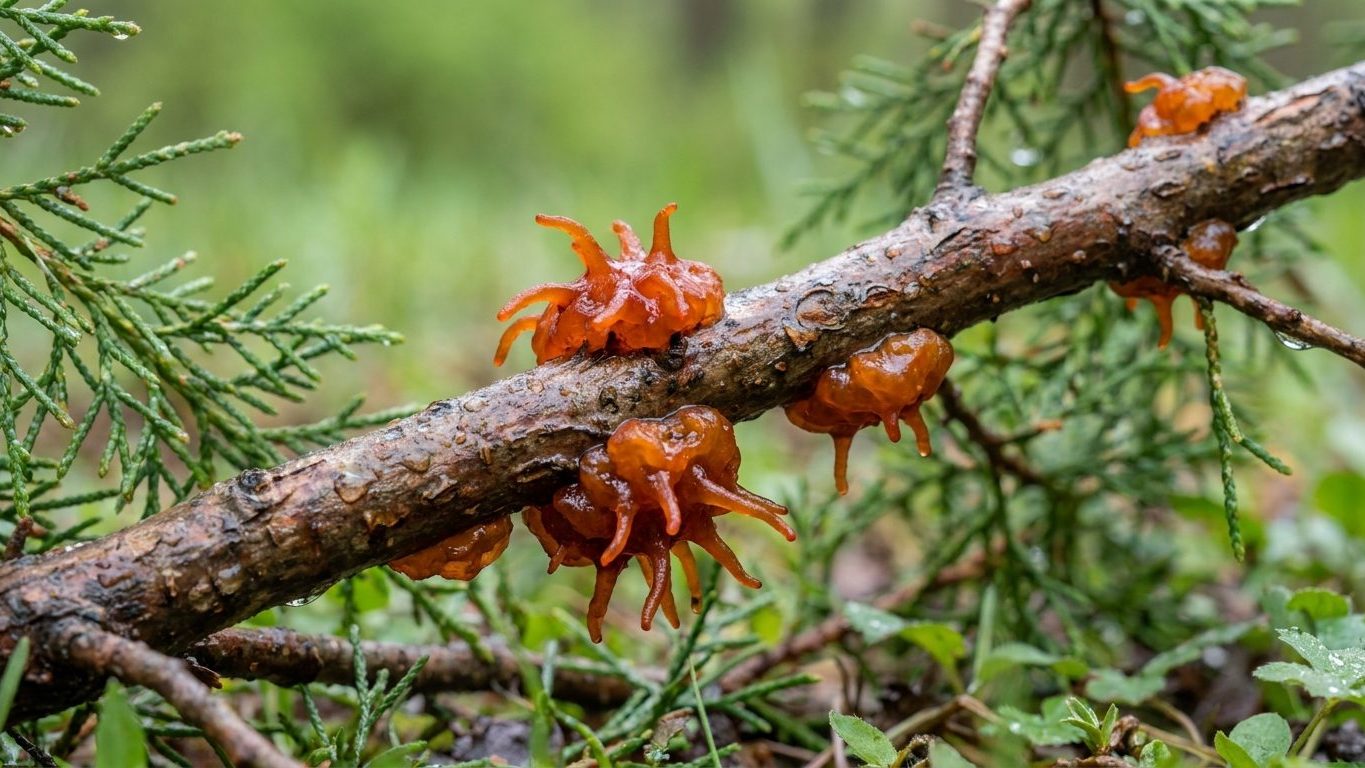

Those lumpy brown growths on eastern red cedar that swell into slimy orange tentacles after a spring rain are cedar-apple rust galls, caused by a fungus that needs both a cedar and an apple or crabapple tree to complete its life cycle. The galls rarely kill the cedar outright, but they mark a disease cycle that repeats every year an alternate host stands nearby, and any branch that has already browned from it will not fill back in.
Telling apart what makes eastern red cedar rust galls
Location, season, and pattern
Start with where the growth sits, not what it looks like once it’s swollen. Cedar-apple rust galls form on twigs and small branches, almost never on the main trunk and rarely deep in the interior where light doesn’t reach. They appear as hard, round brown knots that show up in late summer or fall and sit there through winter looking like nothing much, easy to mistake for a woody bud or an old cone. The tell comes in spring: after a soaking rain, the same gall swells and pushes out bright orange, gelatinous horns that can look almost like a sea creature stuck to the branch. Dry the gall out and the horns shrink back down within a day or two, ready to swell again at the next rain.
The diagnostic test costs nothing and takes a day. Soak a suspect gall in a cup of water overnight; if it swells and sprouts those gelatinous orange horns by morning, that confirms cedar-apple rust rather than an insect gall or a twig blight. Nothing else on eastern red cedar behaves that way.
Ruling out look-alikes
Cedar carries several problems that get confused with rust because they all show up as brown, damaged-looking tissue at some point in the year. The table below separates them by where the damage sits on the plant and when it shows up, which matters more for identification than color or shape alone.
| Culprit | Where it shows | When it shows | What it looks like |
|---|---|---|---|
| Cedar-apple rust | Twigs and small branches | Galls form fall, horns erupt spring | Brown knot, then orange gelatinous horns after rain |
| Bagworms | Scattered across foliage, tip-heavy | Bags visible summer through winter | Spindle-shaped bags of silk and cedar bits |
| Spider mites | Interior foliage first | Hot, dry summer stretches | Fine stippling, faint webbing, dusty look |
| Winter bronzing | Uniform across the plant | Cold months, especially exposed sides | Overall bronze or purple tint, not localized |
| Twig blight (Phomopsis/Kabatina) | Branch tips, scattered | New growth, spring flush | Tips brown and die back, no orange horns |
Only cedar-apple rust produces that gelatinous orange stage. If the plant is browning uniformly or the damage sits at scattered branch tips with no horns after rain, look elsewhere before assuming rust.
Will it come back?
For any branch that has already browned out from cedar-apple rust, from a pruning cut into bare wood, or from drought, no, it will not fill back in. Eastern red cedar carries no dormant buds under its bark, so once tissue turns brown past the last live green growth, that gap on the plant is permanent, not a phase the plant grows out of.
Why the tissue can’t refill
Plenty of shrubs and hedge species keep a reserve of dormant buds tucked under the bark, ready to break and push new shoots when older wood dies back or gets cut hard. That’s how a boxwood or a privet can be renovated almost to the ground and still leaf out again in a season or two. Eastern red cedar doesn’t work that way. Its regrowth comes only from live green tissue at the tips, so a cut, a dieback, or a gall-killed section past that point leaves bare wood that stays bare for the rest of the plant’s life. This is a species trait, not something specific to rust, which is why it applies just as much to a branch damaged by a bad string trimmer hit or a hard freeze as it does to one carrying a gall.
The disease side of the question has its own answer, separate from the tissue question. Cedar-apple rust comes back on the same tree year after year as long as an apple or crabapple stands close enough for spores to travel between the two hosts each spring. The fungus doesn’t need to reinfect from scratch every season if an alternate host keeps the cycle running nearby. That’s the mechanism worth carrying to any other cedar on the property: check what fruit trees are within range before assuming a single tree’s problem is isolated.
Stopping the cause
What actually moves the needle
Sanitation is the one practice with a real, measurable effect: hand-picking and destroying the brown galls during winter, before spring rain triggers spore release, cuts that season’s spore production before it starts. Reducing how long twigs stay wet after rain or irrigation matters too, since prolonged moisture is what lets the gall swell and the spores germinate on a nearby apple leaf. That means watering the ground, not the foliage, and giving the plant enough room that air moves through it and dries the twigs faster after a storm. Distance from any apple or crabapple in the surrounding landscape, not just the plant next door, also lowers the odds of new infections starting, even though it won’t do anything for galls already on the tree.
The pruning cut itself carries a rule that overrides the others. Cut only into the green, never into brown wood, and do it during the late-winter window with light cuts only. Because of the no-regrowth trait covered above, removing a gall-bearing branch means cutting back to the nearest live green tissue, even if that sacrifices more of the branch than the gall alone would suggest.
Getting a positive identification
General plant vigor, fertilizing, or improving soil doesn’t reduce rust incidence, since this isn’t a nutrient-deficiency problem and won’t respond to feeding. Before deciding on any treatment, contact a state extension service for a positive identification and current guidance, rather than guessing from a photo. University horticulture programs like NC State Extension keep plant identification and disease resources specific to regional conditions and orchard proximity, which matters more for this disease than for most.
What to do with what is left
Weighing the four options
Living with it costs the least in dollars and the most in patience: hand-remove galls each winter, accept the occasional orange horn after a spring storm, and understand the cedar tolerates the disease better than any nearby apple tree does. Renovating a badly infected section isn’t really on the table here, since the no-regrowth trait means there’s nothing to rejuvenate once a run of branches has browned past the green.
- Live with it: annual hand removal of galls in winter, ongoing, lowest cost
- Renovate: not viable past brown wood; limited to light shaping of remaining green growth
- Interplant: fill bare gaps with new cedar or another screening species while the original plant holds its remaining green
- Replace: realistic once losses are widespread or an orchard nearby guarantees reinfection
Interplanting buys time but not speed. Eastern red cedar grows 12 to 24 inches a year, so a seedling filling a gap or a full replacement reaching screening height of 8 to 20 feet is a multi-year project, not a season’s fix. Where a hedge or screen has lost more than a scattered branch here and there, and where an apple orchard sits close enough to keep reinfecting it, replacement with a different species is the honest answer rather than a slower repeat of the same cycle.
Common questions
Do cedar-apple rust galls hurt the cedar tree?
Mostly cosmetic on the cedar itself. The bigger damage happens on the apple or crabapple side of the cycle, where the same fungus causes leaf spots and fruit lesions that affect yield.
How far apart should cedars and apple trees be?
There’s no universal safe distance given here, and spore travel varies by site and weather. A state extension service can give current, region-specific guidance on realistic separation for a given property.
Can I remove the orange horns without hurting the tree?
Yes, picking off galls by hand in winter, before they swell, doesn’t harm the cedar and reduces spore load for that season, as long as any cut needed to remove a branch stays in green wood.
Is cedar-apple rust the same fungus on junipers and hawthorns?
Related rust fungi in the same family cause similar gall-and-horn cycles on other junipers and on hawthorn, each needing its own specific alternate host. A state extension service can confirm which species is involved on a given plant.