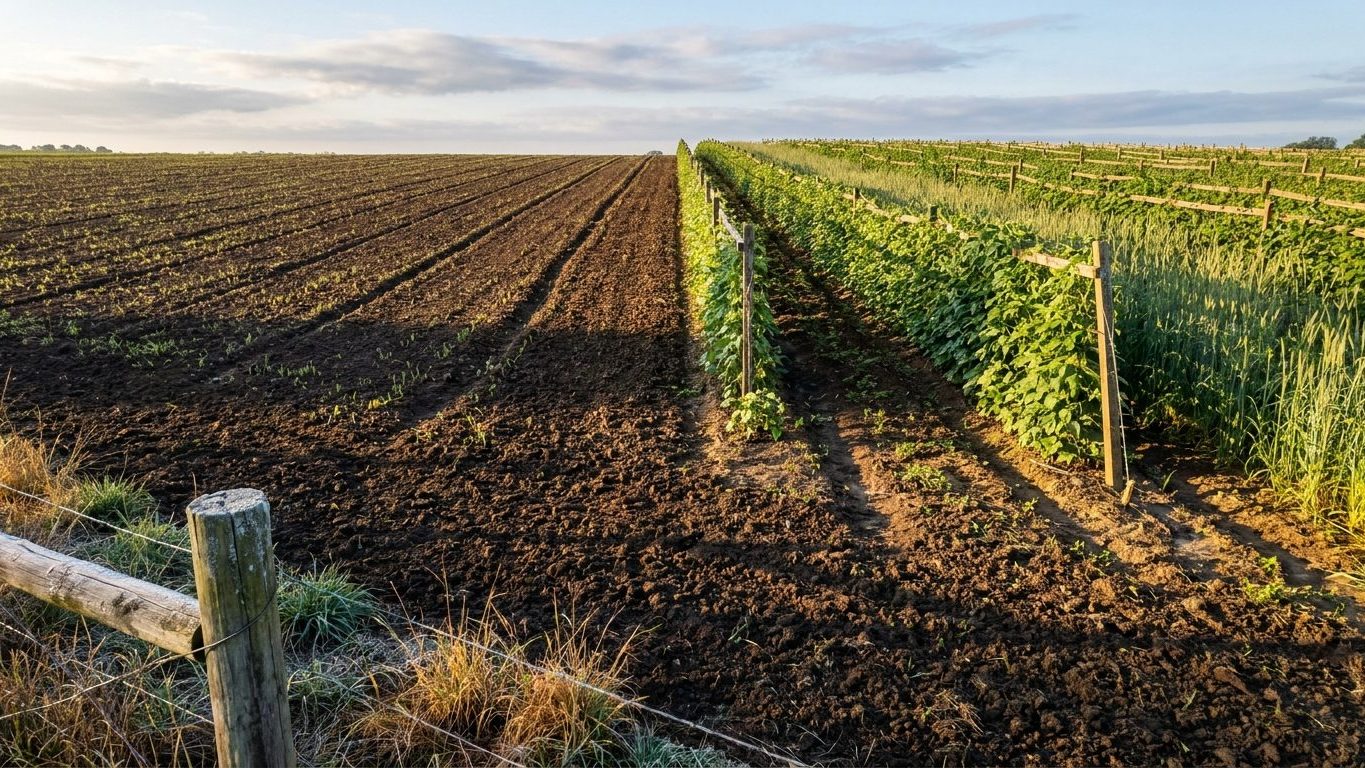

The safe sowing window for cool-season cover crops in New York runs from the last spring frost through late summer, with a second entry point in early fall before the ground freezes. In New York City, that means after March 23-April 3 for spring seeding, or before November 14-27 for a fall-planted cover. Upstate, both dates shift by weeks.
The short answer for New York
Those frost dates aren’t a guess. They come from NOAA’s 1991-2020 Climate Normals, and they mark the window where a 32F freeze has between a 30% and 70% chance of happening on any given day. That’s the probability band climatologists use to call a date “typical” rather than “extreme.” So when a seed packet says “sow after last frost,” it’s really asking you to clear that 30-70% risk zone, not to gamble on a single calendar square.
For a spring-sown cover like buckwheat or field peas, the practical start in the New York City reference area is early April, once the March 23-April 3 window has passed. Buckwheat germinates fast and can go in as soon as soil has warmed past that point, then gets terminated before frost returns in fall. Oats work the same way but tolerate a slightly cooler soil, so an early-April sowing is low-risk even on the early side of that window.
Fall sowing is where New York’s cover crop calendar gets interesting. Winter rye and crimson clover are typically drilled six to eight weeks before the first fall freeze, which in the New York City reference station falls between November 14 and 27. That puts the target sowing window at roughly late September through early October for winter rye, since it needs enough top growth before dormancy to hold soil over winter. Clover wants slightly warmer soil at planting, so an earlier September date is safer if you’re relying on it for nitrogen fixation rather than just erosion control.
None of this is a statewide number, and that distinction matters more here than almost anywhere else in the country. The frost dates above come from Central Park’s climate station, a dense urban site that runs noticeably warmer than the rest of the state. Upstate New York and the Adirondacks freeze earlier in fall and thaw later in spring, sometimes by a month or more. Treat the dates above as the New York City figure, not the New York figure, and read the next two sections before you set a date for your own county.
What will not work here
The coldest month in the New York City reference area averages a daily minimum of 27.9F. That’s not the record low, and it’s not an average for the whole month, it’s the typical overnight low across the coldest weeks of winter. It’s the number that decides whether a cover crop actually survives the season here, and it rules out a lot of what garden centers sell as “winter cover.”
Tender legumes bred for Zone 7-8 conditions, things like certain field pea varieties marketed for southern winter cover, are gambling against that 27.9F floor every single night for weeks at a time. In the city itself they might squeak through most winters. Move upstate, where winter lows run colder and longer, and the same seed is a coin flip at best. Winter-kill isn’t a failure of technique in that case, it’s a mismatch between the plant’s genetics and the actual overnight floor of the region.
The reverse problem shows up with slow-maturing summer covers. A cover crop that needs 100-plus frost-free days to build enough biomass to matter, some of the longer-season sorghum-sudangrass hybrids, for instance, is working against a season that in New York’s colder pockets simply doesn’t offer that many days between frost-free windows. Even where the growing season stretches longest, from early April to mid-November in the city itself, that’s a ceiling of roughly 225 to 250 days, and a lot of that gets eaten by cool soil at both ends when germination stalls.
Timing errors compound each other here more than in milder states. Sow winter rye too late relative to that November frost window and it never puts on enough fall growth to survive winter as a functioning cover, it just sits as thin, vulnerable seedlings. Sow a summer annual too early, before soil has cleared that March 23-April 3 frost risk, and cold soil rots seed before it germinates. New York’s frost swing between its earliest and latest recorded normal dates is wide enough that a calendar reminder set for “mid-April” statewide is really a New York City instruction wearing a state-sized label.
What changes across New York
New York spans USDA Hardiness Zones 3b through 7b, one of the widest ranges of any state in the Northeast. That’s not a rounding spread, it’s the difference between the average annual extreme minimum temperature running deep below zero in the highest Adirondack elevations and staying comfortably above zero near the coast and in the city. A cover crop rated hardy to Zone 6 is a safe bet in one corner of the state and a routine loss in another.
That zone spread is built on one variable only, the average annual extreme minimum temperature, so it doesn’t capture growing season length, snow cover, or how early the ground freezes in fall, all of which matter just as much for cover crop success. Two spots in the same hardiness zone can still have very different frost calendars depending on elevation and distance from large bodies of water like Lake Erie, Lake Ontario, or the Atlantic.
What that means practically: a reader in the Hudson Valley or the Southern Tier should expect a shorter frost-free window than New York City’s numbers suggest, and should push fall cover crop seeding earlier rather than later. A reader near the Adirondacks or in the higher elevations of the Catskills is working with a season closer to Zone 3b-4 behavior, where winter rye needs to go in well before New York City’s late-September mark and where tender summer covers may not have time to mature at all in a typical year.
There’s no single sowing date that covers all of that. The honest answer is a spread, not a point, and the only way to know which end of it applies to a specific address is to check the zone directly rather than guess from a regional label. The USDA’s interactive Plant Hardiness Zone Map lets you enter a ZIP code and get the zone for that exact spot, which is a more useful five minutes than reading another paragraph of statewide averages.
Where to check this for your own county
This page gives the state-level picture, and a state-level picture is exactly the wrong resolution for actually deciding a sowing date. Cornell Cooperative Extension runs county-based offices across New York, and that’s the resource that turns these statewide numbers into a number that applies to your soil, your elevation, and your local frost record. Find it at cals.cornell.edu/cornell-cooperative-extension.
Once there, look for two things specifically. First, the local planting or cover crop calendar for your county, which will typically account for microclimate factors this page can’t, things like proximity to a Great Lake, elevation above 1,500 feet, or a valley that traps cold air and frosts earlier than surrounding areas. Second, look for variety trial results. Cornell’s extension network runs field trials on cover crop varieties across different regions of the state, and those trials tell you which winter rye, clover, or vetch varieties actually performed in soil and weather conditions like yours, not just which ones survived at a single test station downstate.
A county-level recommendation beats a state-level one every time, and that’s not a knock on this page, it’s just how climate data works. Statewide figures average out real variation that matters to a single garden. A Cornell county office can also answer questions this page structurally can’t, like how local soil drainage interacts with a wet fall, or whether a particular winter has been running colder than normal and it’s worth delaying a sowing date by a week or two. That kind of real-time, local adjustment is exactly what an extension office is built to provide.
Checking this against your own garden
Every frost date on this page is a normal, built from thirty years of averages. Your actual yard this particular season might run a week ahead or behind that normal, and the most reliable way to know is to read the ground itself rather than the calendar.
Soil warmth by feel is the first check. Push a bare hand a couple of inches into the bed where you plan to sow. If it feels cold and damp rather than merely cool, most cover crop seed will sit there without germinating, no matter what the calendar says. Wait until the soil feels closer to room temperature at that depth before committing spring-sown seed like buckwheat or oats.
Second, watch for the first flush of volunteer weeds or early wildflowers breaking ground nearby. Weeds respond to the same soil temperature triggers many cover crops need, so a burst of chickweed or early dandelion growth is a reasonably reliable local signal that soil has cleared its coldest phase, often a more current read than a fixed date.
Third, once seed is in, watch for the first true leaves rather than just the first sprout. A cover crop that germinates but stalls at the cotyledon stage for more than a week is telling you the soil or air is still marginal for that species, and it’s worth holding off on any second planting until growth clearly picks up. Taken together, these three signals adjust the calendar dates on this page to whatever your particular yard is actually doing this year, which is the only thing that ultimately decides whether a cover crop takes.