
The confirmed record behind this page does not include a species-by-species pest list for carrots grown in Maine. What is verified is narrower and more useful: the soil the state is built on, the days a carrot root needs underground, and the storage rules that decide whether a harvest lasts two weeks or three months. Pair that with a call to a county extension office, and a gardener gets a real answer instead of a guess.
Which pests attack carrot in Maine
No species list for carrot-feeding insects in Maine appears in the verified sourcing used for this page. That gap matters, because naming an insect without a documented source is how misdiagnosis spreads from one garden blog to the next. Rather than guess at a name, it is worth working from what is actually confirmed: the ground itself, and how it behaves under a carrot row.
Maine’s official state soil is the Chesuncook series, a Spodosol, sandy and acid, with a surface pH around 5.1, running roughly 35 percent sand, 12 percent clay, and 53 percent silt, and classed as moderately well drained. That is not a description of any one backyard, since a state holds hundreds of mapped soil series and river bottoms, hill ground, and graded lots will differ completely. But it does tell you what the region’s ground tends toward: acid, sandy, and prone to draining fast in some spots while sitting wet in others.
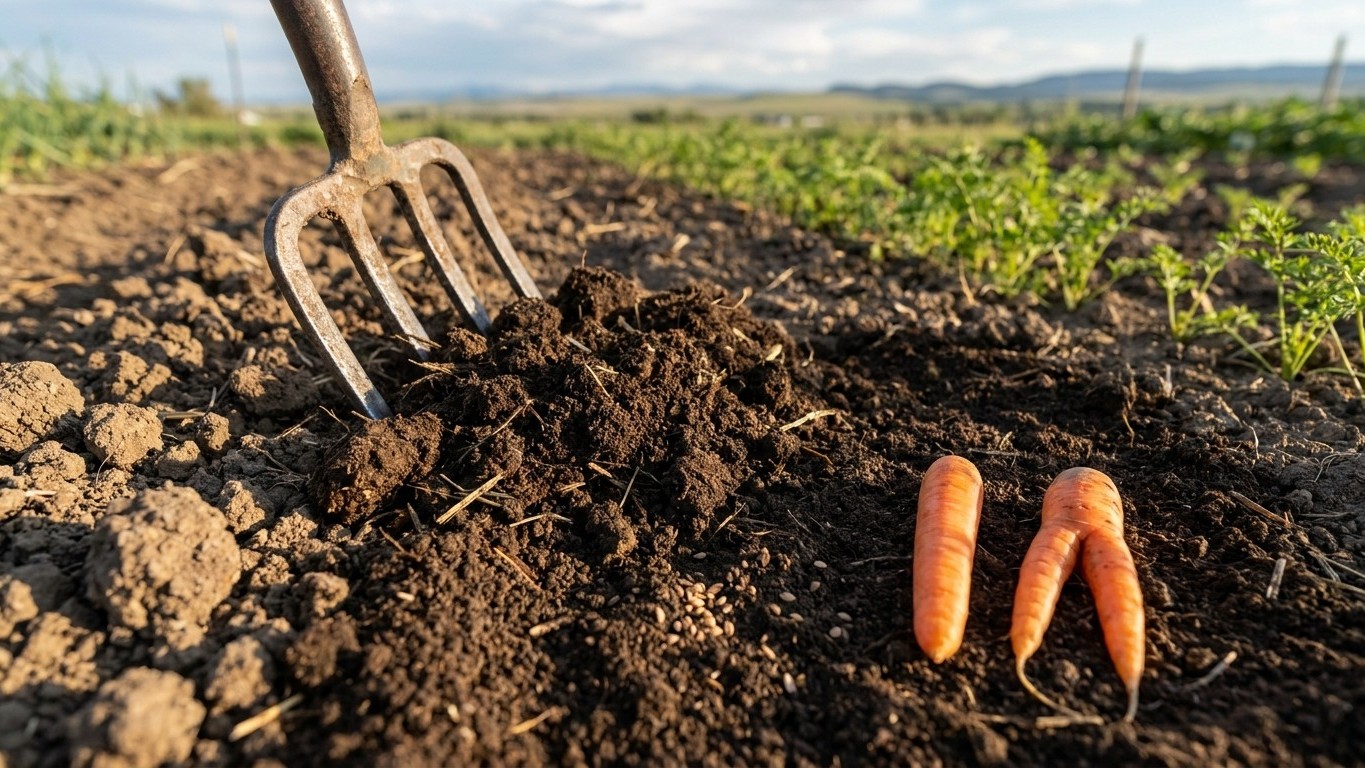
That texture matters for carrots because of what Utah State University Extension documents about the crop: carrots want deep, sandy, well-drained soil rich in organic matter, and heavy or rocky soil makes the root fork. Forking is not insect feeding. It is a mechanical response to compaction or stones in the root’s path, and on a soil profile that leans toward the Chesuncook pattern, that risk is real in any bed that has not been loosened or amended.
So the honest first move is not to name a bug. It is to rule out the soil doing what heavy or rocky soil does to a taproot, and then to bring an actual specimen, or a clear photo of the damage, to a county extension office for identification. A gardener who skips that step and reaches for a general-purpose treatment on a hunch is treating a soil problem as a pest problem, which fixes nothing and wastes a season.
When each one shows up, and what it does first
Without a confirmed species list, there is no verified calendar of insect emergence to publish here, and inventing one would be worse than leaving it blank. What the record does support is the crop’s own timeline, since carrots are sown directly in place and never transplanted. Clemson Cooperative Extension lists harvest at about 65 to 75 days after planting, counted from the seed going into the ground. That window is the frame a gardener should use for watching the row, because problems that show up early in that span look different from problems that show up near the end of it.
In the first weeks after seeding, the visible risk is almost always germination failure or seedling loss, thin stands, gaps in the row, or seedlings that topple, which can come from soil crusting, damping-off, or feeding pressure a home gardener cannot tell apart without a close look. By midseason, once foliage is established, the signs to watch shift to the tops: chewed or ragged leaf margins, stippled or bronzed foliage, or leaves that wilt despite the bed having enough water. Because none of those symptoms are tied to a documented species here, they should be read as prompts to inspect closely, not as confirmation of any one cause.
Near the 65 to 75 day mark, the root itself becomes the thing to check. Pulling a test carrot or two before the full harvest is the simplest way to catch tunneling, forking, or cracking while there is still time to decide whether to harvest early rather than lose the whole row. A root that looks fine at 60 days and forked or damaged at 75 tells you something changed in that window, which narrows down what to ask an extension agent when you call.
Telling the damage apart from everything else
A forked, cracked, or stunted carrot root gets blamed on insects more often than it deserves. The soil requirement documented by Utah State University Extension is explicit that heavy or rocky ground forks the root on its own, no feeding involved, and that the fix is organic matter and double digging, not a spray. A soil that resists a finger pushed six inches down is telling you the same thing a forked root will tell you three months later.
Wilting foliage is another common false alarm. It can mean insect feeding at the root, but it can just as easily mean inconsistent watering on a sandy, fast-draining profile like the one Maine’s Chesuncook soil represents, where moisture moves through quickly between waterings.
| Symptom | Common non-pest cause | What distinguishes it |
|---|---|---|
| Forked or split root | Compacted, rocky, or heavy soil | Root shape splits around an obstruction rather than showing chew marks or tunnels |
| Wilting despite watering | Uneven soil moisture on fast-draining, sandy ground | Wilting eases within a day of a deep, even watering |
| Soft or shriveled roots after storage | Storage above 33°F, or tops left attached | Softening progresses in storage, not in the ground, and worsens with tops still on |
| Stunted, pale foliage | Low organic matter or nutrient deficiency | Affects the whole row evenly rather than isolated plants |
None of this is a diagnosis. It is a way to separate ordinary causes from ones that need a closer look, and the point is knowing what to bring, or ask about, when you call a county extension office rather than guess at a name.
What actually works here, and what is a waste of time
On a soil profile that tends acid, sandy, and unevenly drained, the highest-value move has nothing to do with insects at all: work compost into the bed before seeding, and double dig if the ground resists more than a few inches down. Utah State University Extension is specific that this is the fix for heavy or rocky soil forking a root, and it costs nothing but labor, done once, before the row goes in.
A physical barrier placed over the row at seeding, before any feeding has started, generally outperforms a reactive treatment applied after damage is already visible, because by the time chewed foliage or a tunneled root shows up, the damage that mattered has already happened. Timing that barrier to the seeding date rather than to a calendar month matters more on a short season, since a week lost waiting to see if a problem develops is a week the root doesn’t get back.
Treating a bed for an unidentified pest, without a confirmed species, is close to a coin flip and often a wasted trip to the store. No product name, active ingredient, or rate belongs on this page, because what is legal to use in Maine is a question for the state’s extension service, not a garden blog.
After harvest, the single biggest preventable loss has nothing to do with insects either. Clemson Cooperative Extension is direct that carrots should be stored at 33°F and high humidity, and that bunched carrots, meaning roots with the tops still on, keep only about 10 to 14 days because the leaves keep pulling moisture out of the root. Cutting the tops off before storage, and holding the roots close to that 33°F mark rather than at a cellar temperature closer to 50°F, is a low-effort step that prevents a harvest from softening or sprouting in a fraction of the time it should have lasted.
Where to check this for your own county
The University of Maine Cooperative Extension, through its county offices, is the right place to bring an actual carrot, an actual leaf, or a clear photo of root damage for identification. Nothing published at the state level, including the soil data behind this page, tells you what is present in one specific garden, because pest presence and pressure vary from one county to another, and often from one side of a town to the other depending on what was grown there the year before.
The Chesuncook soil profile represents the state on paper. It does not represent the raised bed behind a specific house, the community garden plot down the road, or the field a neighbor has worked for years. A home soil test, run through the county extension office, is what turns that state-level pH and texture into a number that applies to one actual bed. The same logic applies to pests: a documented state list, where one exists, is a starting point for what to ask about, not a confirmation of what is in any single row.
The next step, if a carrot bed is showing damage this season, is a call or a visit to that county office with the plant, the root, or the photo in hand. That single step replaces a guess with an answer, and it is the only way this page’s honest gap, no confirmed pest list for Maine carrots, gets closed for one specific garden rather than left open for every reader.
Common questions
Is it normal for a carrot root to fork even with no pests present?
Yes. Utah State University Extension documents forking as a response to heavy or rocky soil, not to insect feeding, and the fix is working in organic matter and double digging the bed rather than treating for a pest.
How long can I count on stored carrots lasting?
Clemson Cooperative Extension states that carrots stored at 33°F with high humidity keep well, while bunched carrots with the tops still attached last only about 10 to 14 days, since the leaves continue drawing moisture from the root.
When should I count the 65 to 75 day harvest window from?
From the seeding date. Carrots are sown directly in the bed and never transplanted, so there is no separate transplant date to count from on this crop.
Does Maine’s state soil tell me what my own garden’s pH is?
No. The Chesuncook series, with a surface pH near 5.1, represents mapped values for the state’s official soil, not a measurement of any individual yard. A home soil test through a county extension office is what gives an actual reading for a specific bed.