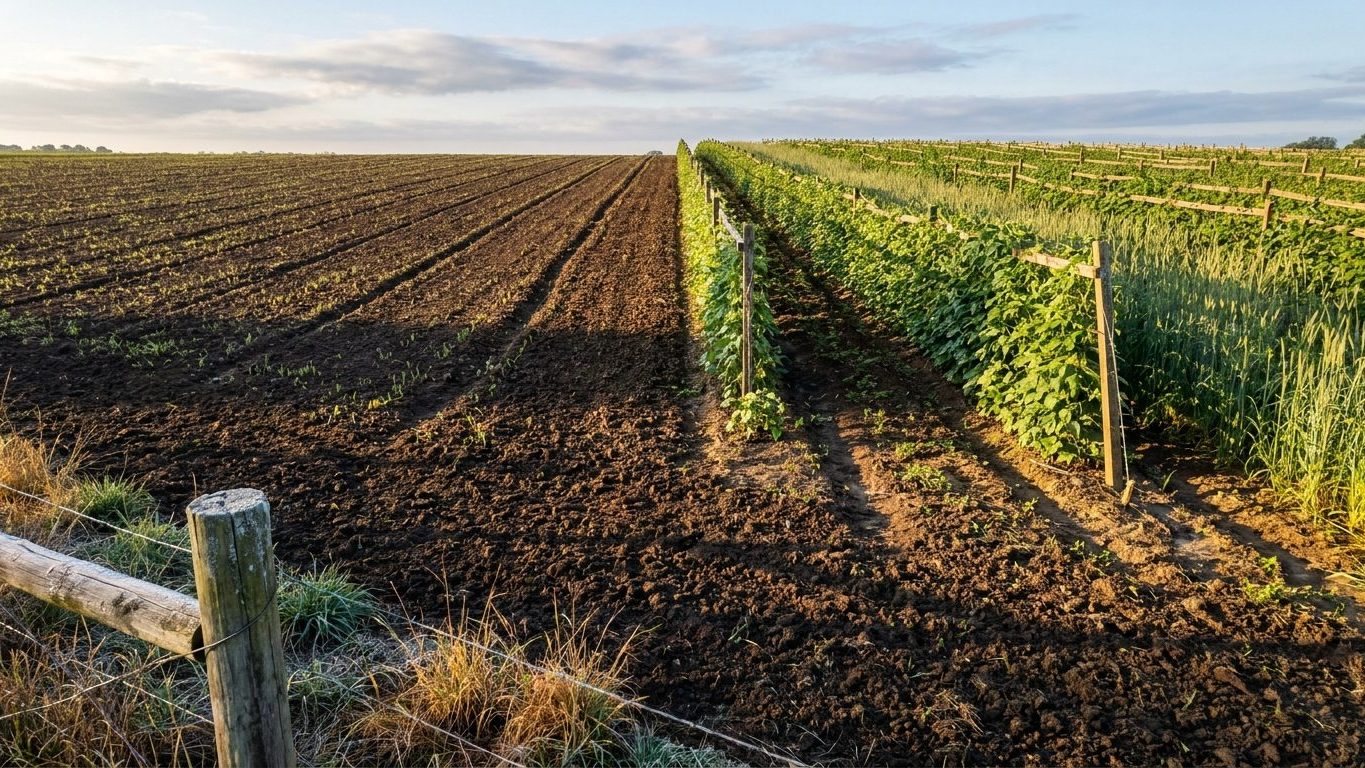

Sow winterkill covers like oats, field peas, or forage radish in late July through mid-August, and fall-established covers like winter rye by early September, so they root before the mean first frost on October 18. Spring-sown legumes and grasses go in after the mean last frost on May 7, but that date is a coin flip, not a guarantee, half the years around Halifax see frost land later.
The short answer for Nova Scotia
Everything here runs off two numbers from Environment and Climate Change Canada’s normals for the Halifax Stanfield station: a mean last spring frost of May 7 and a mean first fall frost of October 18. Those are averages pulled from 1981-2010 records, which means in roughly half the years on record, frost showed up after May 7 in spring and before October 18 in fall. Treat both dates as the middle of a window, not a line you can plant right up against.
That gives a frost-free stretch of about 164 days between the two mean dates. It sounds generous next to a lot of northern gardens, but it’s short by the standard of cover crops bred for longer, hotter seasons further south. Anything that needs 90-plus warm days to bulk up and set seed is working against the calendar here before it even germinates.
Inside that window, the sowing calendar splits into three practical slots. Spring-sown legumes and oats go in from mid-May onward, once soil has shaken off the worst of the cold and the mean frost date has passed, with the caveat that a late frost can still nip young seedlings. Summer smother crops like buckwheat get sown in June or July for a fast six-to-eight week cycle, timed to finish and get turned under well before the October frost kills it anyway. Fall-established covers, winter rye chief among them, need to go in by the first week or two of September so they’ve got roots down and some top growth before the mean first frost arrives.
| Cover crop type | Sowing window | Frost relationship |
|---|---|---|
| Spring legumes/oats | Mid-May onward | After mean last frost (May 7), risk of a late frost still exists |
| Summer smother crop (buckwheat) | June-July | Killed by first frost; timed to finish beforehand |
| Fall-established winter rye | Early-mid September | Needs weeks of growth before mean first frost (Oct 18) |
The mean coldest-month minimum for the reference station sits at 13.3°F. That figure matters as much as the frost dates: it’s the number that decides whether whatever you plant in fall actually survives to spring, not just whether it germinates in time.
What will not work here
The 164-day frost-free window rules out warm-season cover crops that need a long run of real heat to do their job. Sorghum-sudangrass, cowpeas, and sunn hemp are staples in cover crop guides written for the Mid-Atlantic and the South, but they’re built around 90-to-120-day maturity cycles in hot soil. Sown here in late May or June, they germinate slowly in cool ground, then run out of season before they’ve produced the biomass or nitrogen fixation they’re known for. You end up tilling in a half-grown crop that cost seed money and gave little back.
Buckwheat sown too early runs into the opposite problem. It’s frost-tender at both ends, so a planting that goes in before the ground has properly warmed, or that lingers past its six-to-eight week cycle hoping for more growth, risks getting caught by an early autumn cold snap. Given that the October 18 date is a mean and not a safe cutoff, a buckwheat crop pushed into late September is gambling against a frost that arrives early in plenty of years.
Overwintering legumes are the trickiest call, and this is where the 13.3°F coldest-month minimum does the real work. Hairy vetch and crimson clover are marketed as reliable overwintering covers in warmer zones, but they’re marginal at best where the coldest month averages a daily minimum that low, especially on a field without consistent snow cover to insulate the crown. A crop that survives fine in a milder pocket of the province can winterkill outright a short drive inland, and there’s no way to know which side of that line a given field sits on without watching it through at least one winter.
Close spacing is its own quiet failure point. Cover crop guides written for drier regions often recommend tight seeding rates to maximize ground cover, but Nova Scotia’s humid Atlantic climate means dense stands hold moisture at the soil surface longer after rain. That’s a setup for fungal disease in a crop like clover or vetch, particularly in a wet fall when the crop can’t dry out between rain events. Wider spacing, or a lower seeding rate than the bag recommends, tends to hold up better here than the maximum rate printed on the label.
What changes across Nova Scotia
The hardiness zone figure available for this page, 6b under the Canadian system, is tied specifically to the reference station near Halifax, not to the province as a whole. That distinction matters more here than it would in a smaller territory, because Nova Scotia isn’t one climate. The Canadian zone system is built from seven climate variables, not the single minimum-temperature reading the USDA system uses, so it can’t be lined up against USDA zones used elsewhere on this site, and it can’t be assumed to hold steady from the coast to the interior of the same province.
Coastal areas near Halifax and along the Atlantic shore get a moderating effect from the ocean: winters run milder, springs arrive a touch earlier, and the growing season stretches a bit past what an inland reading would suggest. Move away from the coast, into the interior valleys or up onto higher ground, and both the frost dates and the winter minimum shift the other direction, later springs, earlier falls, colder winter lows. A cover crop that overwinters reliably in a sheltered coastal garden can winterkill on an exposed inland field the same year, even though both sit within provincial borders.
None of the figures on this page can tell an individual reader which side of that divide their own garden falls on. The reference station data is a starting point, not a verdict for every county. Readers who want the actual zone for their own location should check Natural Resources Canada’s Plant Hardiness Site, which maps zones by municipality using the same 1991-2020 normals rather than the single-station figure used here.
Where to check this for your own county
This page works from one station’s data, and Nova Scotia’s growing conditions vary enough across the province that a provincial figure is a starting point, not a final answer. The provincial resource for local, county-level guidance is the Nova Scotia Department of Agriculture, and it’s worth checking directly rather than relying on the averages here for anything beyond a first planning pass.
What to look for once there: any local planting calendar the department or its extension staff publish for cover crops or field crops generally, since those are built from observed conditions across the province’s agricultural districts rather than a single airport station. Also worth checking for any list of cover crop varieties that have actually been trialled in Nova Scotia conditions, since seed catalogs written for a national market don’t always flag which varieties have a track record of surviving the province’s specific combination of coastal humidity and inland cold snaps.
A county-level or district-level recommendation, grounded in trials or observed results from farms and gardens in that specific area, will always beat a provincial average built from one weather station’s frost dates and one reference city’s hardiness zone. That’s exactly what this page is: a provincial starting point. It gives the general shape of the sowing calendar and flags what tends to fail, but it can’t replace local knowledge of how a particular valley, ridge, or shoreline behaves in a given year. Treat the dates here as the frame you plan around, then adjust based on what the provincial agriculture department and your own observation tell you about the specific ground you’re working.
Checking this against your own garden
Every date on this page is an average pulled from decades of records at one station. Your own garden, on a given year, either agrees with that average or it doesn’t, and there’s no way to know in advance which. Three things to watch will tell you more than any calendar date.
Soil warmth by feel is the first check. Push a hand a few inches into the bed in spring; if it still feels cold and damp rather than just cool, germination for most cover crop seed will be slow and uneven no matter what the mean frost date says. Wait for that cold edge to soften before sowing spring legumes or oats, even if the calendar date has technically passed.
The first flush of flowering on whatever’s already growing nearby, buckwheat especially, tells you how far along the season actually is compared to the average. Early flowering suggests a warm run that might let you push a fall sowing a little later than September; late flowering is a signal the season is running behind, and a fall cover crop should go in on the early side of the window rather than the late side.
First true leaves on a spring-sown crop, as opposed to the initial seed leaves, mark the point where the seedling has actually established a root system able to handle a stray cold snap. A crop still sitting at seed-leaf stage when a late frost hits is far more vulnerable than one that’s pushed a set of true leaves, which is one more reason the mean last frost date is a starting point for sowing, not a finish line for worrying about the young crop’s safety.