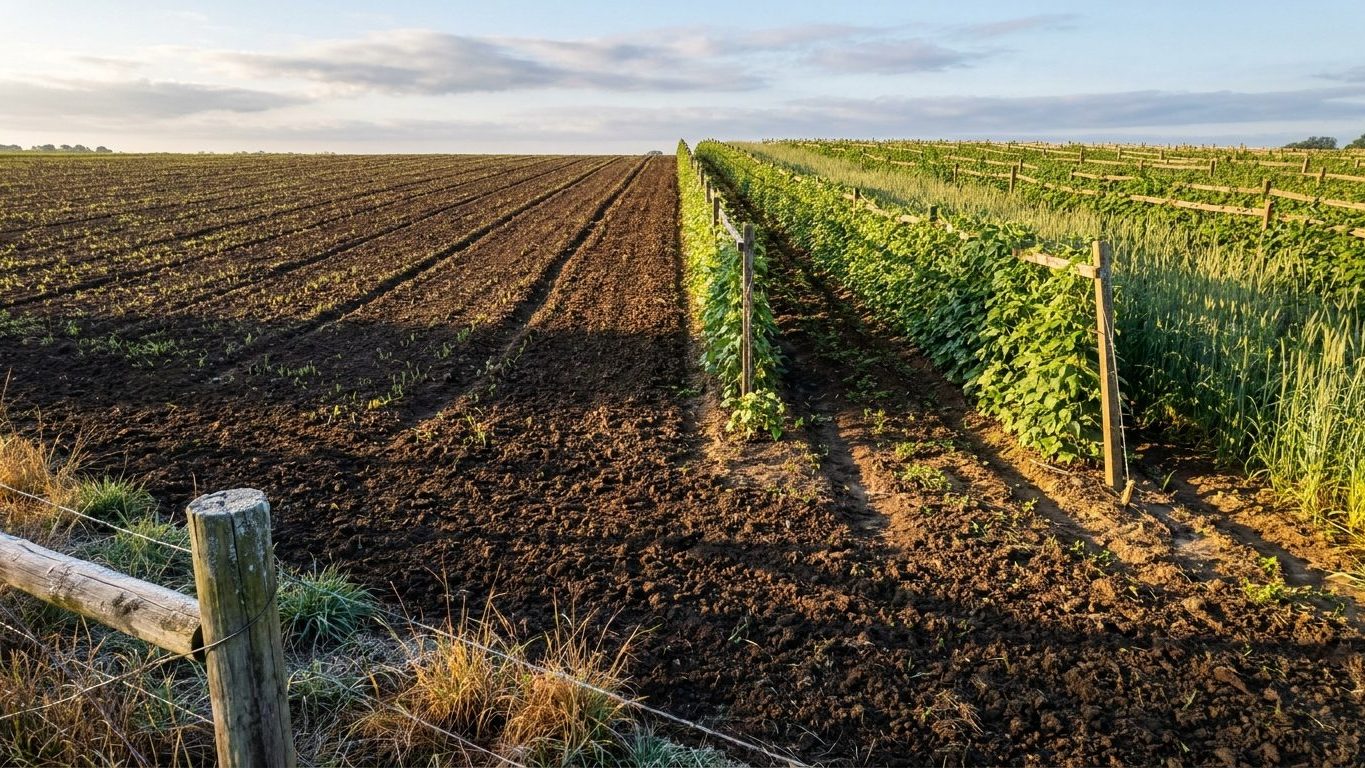

Ohio’s cover crop calendar splits into two windows, not one. The larger window runs from late summer through the first fall frost, October 5 to October 15 in zone 6a. A smaller spring window opens after the last spring frost, May 5 to May 15. Which one applies depends on what’s leaving the field, what’s replacing it, and how much cold the seedling can take before the ground locks up for winter.
The short answer for Ohio
Fall is when most Ohio gardeners and growers Sow Cover Crops, and the window closes with the first fall frost, October 5 to October 15 in zone 6a, according to Ohio State University Extension’s Ohio Gardening Calendar. That date is not a hard stop carved in stone. It is a probability window built from decades of weather records, meaning frost has historically shown up somewhere inside those ten days in roughly half the years tracked, with some years running earlier and some later.
Inside that fall window, timing still splits by what you’re planting. Winter-hardy species, cereal rye and hairy vetch among them, are seeded early enough to put down roots and build some top growth before the ground goes dormant, so gardeners typically aim for the front half of the window rather than the back. Winter-killed species, oats and forage radish being the common picks, can go in a bit closer to the frost date itself since the plan is for them to die back on their own once the hard freeze lands, leaving residue on the surface rather than a living plant to manage in spring.
The spring window works off the opposite frost date. Warm-season covers like buckwheat and sudangrass need soil that has actually warmed, so sowing waits until after the last spring frost, May 5 to May 15 in zone 6a. Sow too early and the seed sits in cold soil doing nothing, or the seedling comes up straight into a late frost that kills it. This window matters most for gardeners rotating a bed between an early spring harvest and a summer planting, where a fast-growing cover crop fills the gap for a matter of weeks rather than months.
Both windows come from the same source, the Ohio Gardening Calendar published by Ohio State University Extension, and both are built for zone 6a specifically. That is the key detail missing from most general cover crop advice: a date without a zone attached is not really a date, it’s a guess.
What will not work here
Species rated for winter survival in warmer zones run into trouble here. The coldest month in the Columbus reference area has an average daily minimum of 22.0°F, per NOAA’s 1991-2020 Climate Normals. That figure, not the record low and not the monthly average, is what decides whether a cover crop’s roots and crown make it through winter intact. A legume or grass bred to hold on in a milder zone, one where the coldest month’s typical low sits well above freezing, is simply not built for a stretch of nights averaging 22°F. Crimson clover is the classic example: reliable further south, marginal to unreliable across much of Ohio, and gardeners who plant it expecting a full stand come spring are often disappointed.
Sowing too late in the fall window creates a related failure. A winter-hardy cover crop seeded right up against the first fall frost date, rather than earlier in the window, hasn’t had time to establish a root system deep enough to survive the freeze-thaw cycles that follow. The plant looks fine going into winter and is gone by March, having never built the reserves it needed. This is a timing failure, not a hardiness failure, and it’s the one gardeners repeat most often because the calendar says “before first frost” without saying how long before matters.
Spring sowing has its own trap. Buckwheat and other fast, warm-season covers are sometimes seeded right at the average last frost date rather than after it, on the assumption that an average is safe. But an average frost date splits the record roughly down the middle, which means sowing on that exact date still carries meaningful odds of a frost event afterward. A cover crop that’s a legitimate warm-season grower, not a cold-tolerant one, doesn’t shrug that off the way an established perennial might.
Slow-establishing cover crops sown into the tail end of either window are the third pattern that consistently underperforms. A species that needs a long run of frost-free days to bulk up simply doesn’t get enough of them squeezed into the back half of a window measured in single weeks, and the result is thin, patchy growth rather than the dense stand a cover crop is supposed to provide.
What changes across Ohio
Ohio is not one climate, and cover crop timing shifts with it. The state spans USDA hardiness zone 5b to 6b, a range built on average annual extreme minimum temperature, which means the coldest parts of the state and the mildest parts are separated by a full zone and more. That’s not a rounding error. It’s the difference between a cover crop that reliably overwinters and one that’s a gamble.
| Tendency | Typical hardiness zone | Practical shift |
|---|---|---|
| Colder areas of the state | Toward 5b | Fall sowing pushed earlier in the window; winter-hardy species favored over marginal ones |
| Milder areas of the state | Toward 6b | Fall window stretches later; spring window may open slightly sooner |
The frost dates and cold-month figure cited above are anchored to the Columbus reference station and zone 6a, which sits roughly in the middle of that 5b-6b spread. A reader gardening in a colder pocket of the state should expect the last spring frost to arrive somewhat later than May 5-15, and the first fall frost to arrive somewhat earlier than October 5-15, simply because that’s what a lower zone number implies about the local cold. A reader in a milder pocket should expect the opposite shift, more room on both ends of the growing season.
None of this tells an individual gardener which zone their own yard falls into. Elevation, proximity to Lake Erie, and even which side of a valley a property sits on can move the practical zone up or down from what a regional map suggests. The only reliable way to place a specific address on that 5b-6b spread is the USDA Plant Hardiness Zone Map itself, and that’s the tool to check rather than guessing from a state average.
Where to check this for your own county
Everything above is a state-level answer, and Ohio is large enough that a state-level answer is a starting point, not a final one. The next step is Ohio State University Extension, at extension.osu.edu, which maintains the Ohio Gardening Calendar cited throughout this page along with county-level offices across the state.
Two things are worth looking for once there. The first is any planting calendar or fact sheet specific to a county or region rather than the statewide version, since local extension staff often adjust sowing windows based on years of on-the-ground observation that a statewide average can’t capture. The second is any list of cover crop varieties that have actually been trialled in that county, which matters more than it sounds. A cereal rye variety that performs well in a university trial plot in one part of the state doesn’t automatically perform the same way sixty miles north with different soil drainage and a shorter frost-free stretch.
A county-level recommendation will always beat a state-level one, for the simple reason that it’s built on narrower, more specific data. This page draws on statewide frost dates, a single reference station’s cold-month figure, and a hardiness zone range that spans much of Ohio’s north-south length. That’s useful for understanding the mechanics of the calendar and why the windows fall where they do. It is not a substitute for what a county extension office knows about the specific soils and microclimates it serves.
Ohio State University Extension offices also field direct questions from home gardeners and small-scale growers, and that conversation often surfaces details, a frost pocket in a particular township, a variety that’s underperformed locally despite good statewide numbers, that never make it into a published calendar at all.
Checking this against your own garden
Every date on this page is a historical average, and a garden doesn’t read calendars. Three direct observations tell a gardener more about their own plot than any published frost date can.
Soil warmth by feel is the first and most useful for spring sowing. Warm-season covers like buckwheat germinate poorly in soil that’s still cold from winter, even if the calendar date has technically passed. Pushing a hand a few inches into the bed and feeling for genuine warmth, not just thawed ground, is a better test than the date on the wall.
The first flush of male flowers on standing corn, the tasseling stage, is the second signal, and it’s a real one used in practice: interseeding a cover crop into standing row crops is commonly timed to that stage, since the canopy is closing in but there’s still enough light reaching the ground for a young cover crop to establish before harvest.
First true leaves on the cover crop itself, appearing within the normal window after sowing, confirm that germination is on track. A stand that’s slow to push past its seed leaves, well past when it should, is telling a gardener something about that specific bed’s soil temperature or moisture that the regional calendar simply can’t account for.