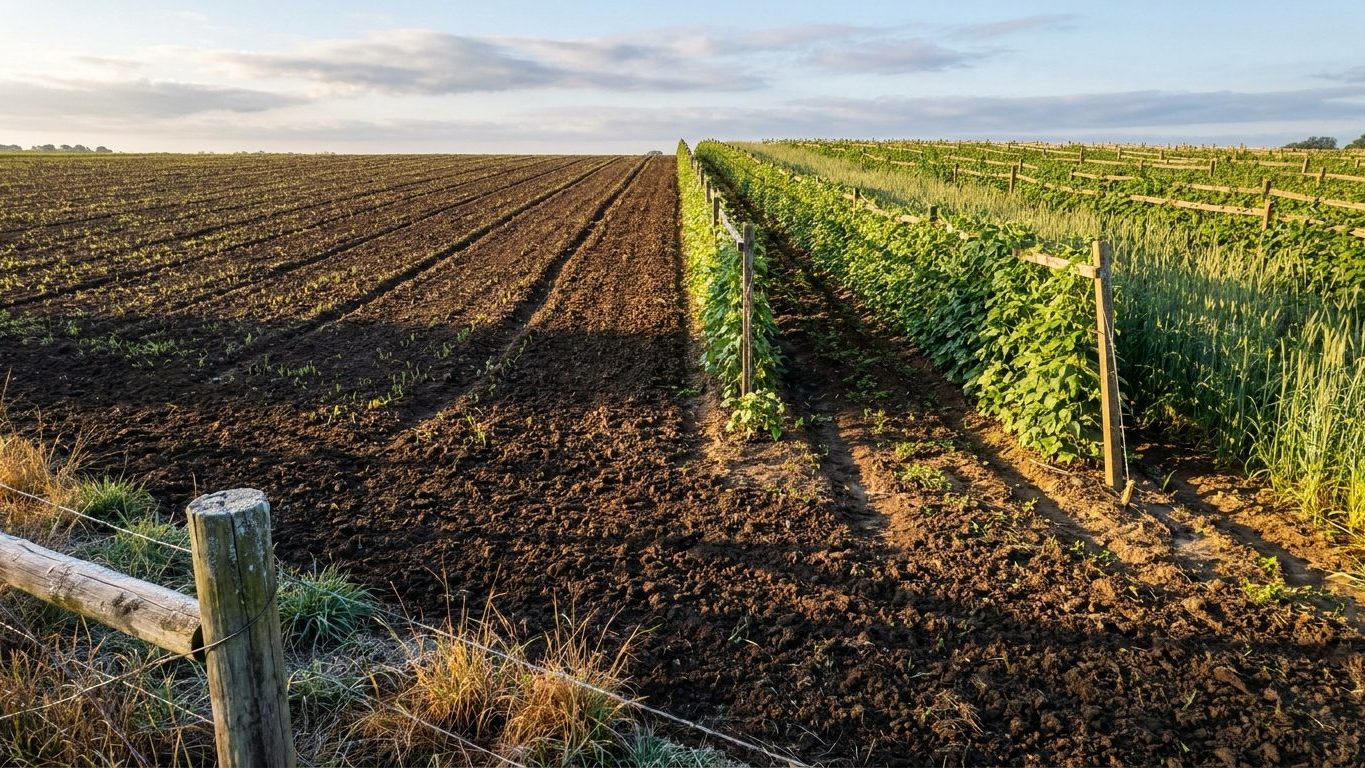

Tennessee’s cover-crop calendar splits in two: warm-season species like buckwheat, cowpeas, and sorghum-sudangrass go in after the last spring frost (March 31 to April 12), while cool-season covers like cereal rye, crimson clover, and hairy vetch go in before the first fall frost (October 28 to November 8). Those dates mark the 30-70% probability band for a 32°F freeze at the reference Nashville station, not a guarantee.
The short answer for Tennessee
Two windows, two families of plants, and one number that decides which family survives the winter. For warm-season cover crops, wait until the freeze risk has dropped into that March 31 to April 12 band before seeding buckwheat, cowpeas, or sorghum-sudangrass. For cool-season covers meant to hold soil through winter, get cereal rye, crimson clover, oats, or hairy vetch into the ground with enough weeks left before the October 28 to November 8 frost window that seedlings can establish before growth slows.
That frost band is not a single date circled on a calendar. NOAA’s 1991-2020 Climate Normals, drawn from station USW00013897, define it as the range in which a 32°F freeze has between a 30% and 70% chance of occurring. Sow a tender warm-season crop on March 25 in Nashville and you are betting against odds that still favor a frost. Wait until April 15 and the odds have flipped in your favor, though never to zero.
The other number that shapes the answer is the mean daily minimum temperature of the coldest month: 30.1°F at the Nashville reference station. That is not a record low, and it is not an average day. It is what a typical cold-month night looks like, and it tells you whether a cover crop’s stated winter-kill threshold will actually trigger here. A species rated to winter-kill at 20°F will very likely survive a Tennessee winter, because most nights never get that cold, even though a handful of individual nights might.
USDA hardiness zones for the state run from 5b to 8a, a wide enough spread that Nashville’s frost dates cannot be treated as a Tennessee-wide truth. They describe the reference station only. A reader gardening in the Cumberland Plateau or the high country of East Tennessee needs a colder, later-starting version of this same calendar, which the next section addresses directly rather than papering over.
What will not work here
Sunn hemp and other tropical, heat-loving cover crops planted at the edge of the spring frost window are a common and costly mistake. These species have essentially zero cold tolerance, and a March 31 seeding date sits at the very start of the probability band, where a freeze is still a coin flip. A grower who plants on that early edge is not being efficient. They are gambling with seed cost and a lost month of soil coverage.
On the fall side, the mistake runs the other direction. A cover crop that needs 90 to 120 days to reach a useful stand, sown in late August or early September with the idea of “getting ahead,” can still run into trouble if the first fall frost lands on the early side of the October 28 to November 8 window. Slow-establishing legumes in particular need every one of those days; sow them too late and they enter winter as thin, shallow-rooted seedlings instead of an established stand.
Heat, humidity, and the winter-kill assumption
Cool-season legumes seeded during Tennessee’s hot, humid mid-summer stretch face a different problem: soil temperatures too high for reliable germination, followed by fungal pressure on any seedlings that do emerge, especially where seed is drilled at close spacing. Humidity here is not an occasional visitor. It sits on the region most of the growing season, and a spacing chart written for a drier climate will produce more disease than yield.
The winter-kill assumption trips up more gardeners than any other single factor. A grower who chooses oats specifically because a seed catalog lists them as “winter-killing” is often working from a colder climate’s numbers. With a coldest-month mean minimum of only 30.1°F, many Tennessee winters simply do not deliver the sustained hard freeze that oats need to fully terminate. The residue can persist into spring, tying up the bed exactly when a warm-season crop needs it clear.
What changes across Tennessee
A hardiness range of 5b to 8a is not a rounding error. It is the difference between a garden that can push a warm-season cover crop into early April and one that should still be waiting in late April, and between a fall cover crop that has six comfortable weeks to establish and one working with barely four. There is no single Tennessee sowing date, only a state-wide range anchored to one reference point.
The Nashville station, USW00013897, sits closer to the milder, longer-season end of that range. East Tennessee and the Cumberland Plateau run measurably cooler and later in spring, which means both frost windows shift: a later last spring frost pushes the warm-season start date back, and an earlier first fall frost trims the cool-season establishment period. A reader gardening at elevation in the eastern part of the state should treat the dates in this article as an earliest-possible start in spring and a latest-safe start in fall, not as the actual target.
West Tennessee, down toward the Mississippi River, tends toward the milder end near zone 8a, with a longer frost-free stretch than the statewide dates suggest. That extra margin can matter for a slower-establishing legume that needs every available week before frost.
None of this tells an individual reader which zone applies to their own yard, and this article will not guess. The USDA Plant Hardiness Zone Map lets anyone check their own location by zip code, and it is the right next stop before locking in a date from a state-wide range this wide.
Where to check this for your own county
Everything above describes Tennessee at the state level, built from one reference weather station. A county-level recommendation will always beat a state-level one, because it accounts for local elevation, local soil, and local frost behavior that a single Nashville-based dataset cannot capture.
The University of Tennessee Institute of Agriculture runs the state’s Cooperative Extension Service. Every county in the state has an office attached to that system, and each one publishes or can point to planting guidance calibrated to local conditions rather than the statewide probability band used in this article.
Two things are worth asking the local office for specifically. The first is the county’s own planting calendar for cover crops, which will typically narrow the wide spring and fall windows described here into dates that reflect actual local frost history rather than a single reference station two counties or two mountains away. The second is a list of varieties that extension agents have trialled in that specific county, since performance under Cumberland Plateau conditions and performance under West Tennessee bottomland conditions can diverge even within cover crops of the same species.
This page is the state-wide version of that answer, useful for understanding the mechanism and the outer bounds of the calendar. It is not a substitute for the county-specific version, and treating it as one is the most common way a Tennessee gardener ends up planting three weeks too early or three weeks too late.
Checking this against your own garden
Frost-date probabilities and hardiness zones describe averages built from decades of weather records. They cannot describe the specific patch of ground a reader is about to plant into, which is why direct observation of that ground outranks every date on this page.
Soil warmth by feel is the simplest check available. Push a hand into the top few inches of soil in the planting bed on a morning before frost risk has fully passed. Soil that still feels cold and damp, even under warm afternoon air, has not yet reached the temperature warm-season cover crop seed needs to germinate reliably, regardless of what the calendar date says.
The first flush of male flowers on any cucurbit-family plant already growing nearby, whether a volunteer squash or a neighbor’s planted pumpkin vine, signals that soil and air temperatures in that specific yard have crossed a warm-season threshold. It is a living thermometer calibrated to the exact microclimate the reader is standing in, rather than to a weather station miles away.
First true leaves on any seedling already up, cover crop or otherwise, tell a different story: how fast that particular bed is moving through its growing conditions this year compared to a typical year. A bed that reaches true leaves noticeably faster or slower than in past seasons is signaling a warmer or cooler spring than the averages this article is built on, and that signal should carry real weight when deciding whether to plant on the early or late side of the windows described above.