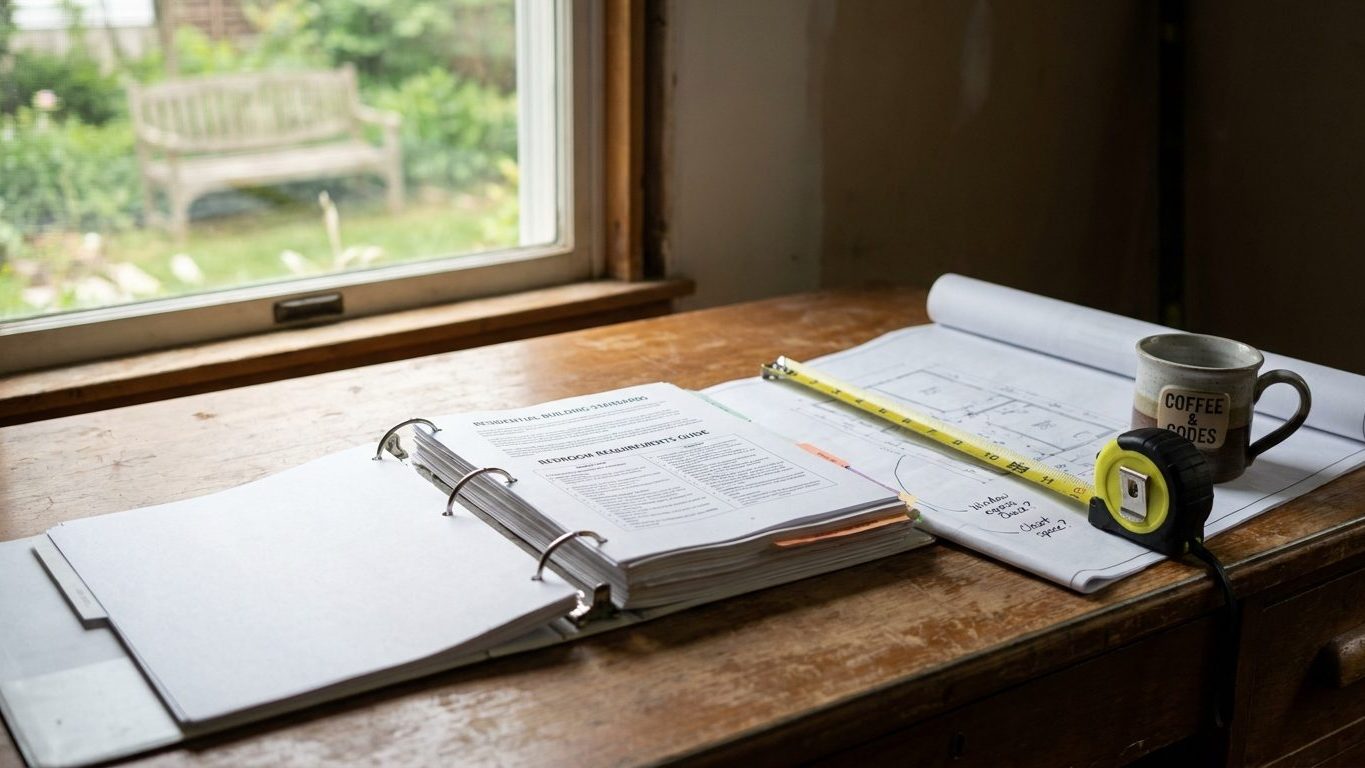

Put a bed in a room and code stops asking what the blueprint calls it. The room now has to meet the same two requirements as any bedroom: an emergency escape and rescue opening, and a smoke alarm inside the room itself. That test runs on use, not on the label a real estate listing or a floor plan puts on the door. Before a spare room becomes a guest room, check both of those against the room you actually have, not the one the plans say you have.
What decides: the use, not the name on the plan

One test, not two labels
The 2021 International Residential Code, section R310.1, runs on a single test: is the room used for sleeping. Not what the floor plan calls it, not what the listing calls it, not what everyone in the house calls it after a holiday visit. The code requires that any room, however it’s labeled on the drawings, meet the same egress and alarm requirements as a bedroom the moment it’s used for sleeping.
That test measures use, not name, and it doesn’t care about intent either. A den with a pull-out couch that a guest sleeps on three times a year is, for the length of that stay, a room used for sleeping. An office with a daybed a teenager naps on most afternoons crosses the same line, more or less permanently, and the 2021 IRC does not carve out a lighter version of R310.1 for a room that’s called something other than “bedroom” on a permit set.
This is where a lot of confusion starts for homeowners finishing a basement or converting a den into overflow sleeping space. Calling the room a flex room or a media room on the plans does not exempt it from the egress and alarm requirements that apply to a fourth or fifth bedroom, because the requirement attaches to the bed, not the label on the door. A room also has to clear a separate floor-area test before it counts as a bedroom at all for square-footage purposes, a threshold covered on its own at Minimum Bedroom Size: 70 Square Feet, and 7 Feet in Any Direction, but the egress and alarm test discussed here runs independently of that one and kicks in the moment the room is used for sleeping, sized correctly or not.
The two requirements that follow a bed into a room
What each requirement answers
Both requirements trace back to what happens if the room catches fire while someone is asleep in it. A person who has just woken up to smoke or heat is not at their sharpest, and if the only way out runs through a hallway that’s already filling with smoke, a second way out of the room itself is what actually gets them to open air. That’s the reasoning behind the emergency escape and rescue opening: the 2021 IRC, section R310.1, requires a sleeping room to have one, separate from the door into the hallway.
The smoke alarm requirement answers the other half of the same problem. An alarm mounted somewhere else in the house can be too far away, or too muffled by a closed door, to wake someone actually asleep in the room it’s protecting. The 2021 IRC, section R314.3, requires a smoke alarm inside each sleeping room itself, not just in the hallway outside it or at the top of the stairs.
Put together, the two requirements cover the two ways a sleeping room can fail someone in a fire. An alarm addresses not waking up in time, and an escape opening addresses waking up and being unable to get out. A room actually used for sleeping needs both, regardless of what the floor plan or the listing calls it.
None of this is about comfort or resale value. It’s a room-specific answer to a scenario where minutes and a door matter, which is also why the requirement follows the bed rather than the label on it. A guest room used twice a year carries the same risk, for those two nights, as a bedroom used every night. The code does not prorate the requirement by frequency of use, only by whether the room is used for sleeping at all, a distinction the next section covers in more detail.
Occasional use, permanent use, and where the line sits
Where construction code stops and occupancy code starts
The 2021 IRC’s egress and alarm requirements attach at the point a room is built or renovated to be used for sleeping, which is a construction question decided when plans go in for permit. A local jurisdiction’s property maintenance code is a separate, occupancy-focused question, looking at how a room is actually being used today, sometimes years after the original permit closed. The International Property Maintenance Code is the model most jurisdictions that address occupancy issues start from, but it is not adopted everywhere the IRC is, and a homeowner has to check with their own building or code enforcement department to know which model, if either, applies locally.
That gap between construction code and occupancy code is exactly where a guest room sits. A room built and permitted as a den, with no egress opening and no in-room smoke alarm, does not automatically get reclassified the day a bed moves into it under the IRC’s construction provisions. What happens next, whether local code enforcement treats an occasionally-used guest bed differently from a permanent one, is a local occupancy question the 2021 IRC itself does not answer. No blanket exception for occasional use appears in the facts this article rests on, and none should be assumed for a specific room.
A furniture or trade convention, a rule of thumb some contractor or stager repeats about how many nights a year makes a guest bed “count,” is not a code provision and is not enforceable by anyone. Only a locally adopted code section, whether IRC or an IPMC amendment, decides that question, and it decides it differently from one county to the next. The honest answer for a specific guest room is a call to the local building or code enforcement department, not a rule of thumb passed along by a contractor or a real estate agent.
Checking a spare room before putting a bed in it

What to check, in order
Checking a spare room starts with the window, not the door. Measure an escape opening with the sash open, not the closed pane in front of you, because that’s the mistake that trips people up most often. A window that looks plenty big enough closed can be blocked down to a narrow gap once the sash is raised, by a stop, a security bar, or a screen frame that doesn’t come out. The 2021 IRC, section R310.1, only cares about the opening a person can actually climb through while the window is open, not the glass area visible from across the room.
A short list of what to look at before a mattress goes in:
- Whether the window opens at all, and how far, without a tool or a key kept somewhere else
- Whether a security bar, storm window, or aftermarket lock blocks the opening even with the sash raised
- Whether there’s already a smoke alarm mounted inside the room itself, not just in the hallway outside it
- Whether the alarm is hardwired or battery-only, and whether it’s been tested recently
- Whether the room has a second way out at all if the door were blocked by smoke
None of this tells you on its own whether the room meets the 2021 IRC’s egress and alarm requirements, because the specific dimensions a code official checks against are a question for that official, not something to guess at from a tape measure and a hunch. What a homeowner can rule out without professional help are the obvious failures: a window painted shut, a bar with no quick-release, a smoke alarm that isn’t there at all. If the room is also tight enough that the bed crowds out the closet, deciding How Deep Does a Wardrobe Need to Be? 24 Inches, Because of the Hanger becomes its own separate question worth working through before furniture goes in. Anything closer than the obvious failures is worth a call to a local building department or a licensed contractor before the bed goes in, not after.
The listing that describes a room it should not
What breaks first
Calling a room a bedroom in a real estate listing, or on an insurance application, when it doesn’t meet the egress and alarm requirements above, is a separate problem from the building code question this article has been answering. The 2021 IRC, chapter 3, sets construction and use requirements for the room itself. What a listing agent, appraiser, or insurance form calls that room afterward is a contract and disclosure question, not a code compliance question, and the two get resolved by different people entirely.
At a home inspection or an appraisal, a room without an egress opening or an in-room smoke alarm that’s marketed as a bedroom is the kind of thing that gets flagged, and can knock a bedroom count, and the value tied to it, back down before closing. The buyer’s inspector doesn’t have to agree with the listing, and often won’t. At claim time, an insurer that priced a policy around a stated number of bedrooms can raise questions about a room that doesn’t meet the definition it was priced against, though what that means for a specific policy is a question for the insurer or an insurance professional, not something a building code article can settle.
None of that is a reason to guess at an answer. If a guest room’s status, as a bedroom for a listing, an appraisal, or a policy, is actually in question, the next call is to the people who decide it: a local zoning or building department for the code question, a real estate professional or attorney for the disclosure question, and an insurance agent for the policy question. A code article can say what the 2021 IRC requires of the room. It can’t say what to write on a listing sheet or an insurance form, and it shouldn’t try to.
Common questions
Does a guest room need a closet to count as a bedroom?
That’s not one of the requirements covered here. The egress opening and the in-room smoke alarm come from the 2021 IRC sections named above and apply based on sleeping use. A closet requirement, where one exists, tends to be a local zoning or appraisal convention rather than a life-safety code provision, so check with the local building department for how that particular question gets answered in your jurisdiction.
Can I put a window air conditioner in the guest room’s escape window?
Only if it doesn’t block the opening the window is required to provide. An AC bracket or unit left in place can reduce or eliminate the usable escape opening even when the window itself is fine, which is one of the most common reasons an otherwise adequate window fails to work as an emergency exit. Remove anything mounted in or over the window before assuming it still functions as required.
Does a sofa bed or daybed count the same as a regular bed?
Yes. The 2021 IRC’s test in section R310.1 is based on whether the room is used for sleeping, not on what kind of furniture is providing the sleeping surface. A pull-out couch, a daybed, or an air mattress on the floor all put the room on the same side of that test as a bed frame and a mattress would.
What about a guest room in a converted garage or finished basement?
The same egress and smoke alarm test applies to any room used for sleeping, regardless of where in the house it sits. Garage conversions and basement finishes often carry additional local requirements beyond what’s covered in this article, so a call to the local building department before finishing the space is worth more than assuming the same rules that apply upstairs cover a below-grade or converted room without any changes.