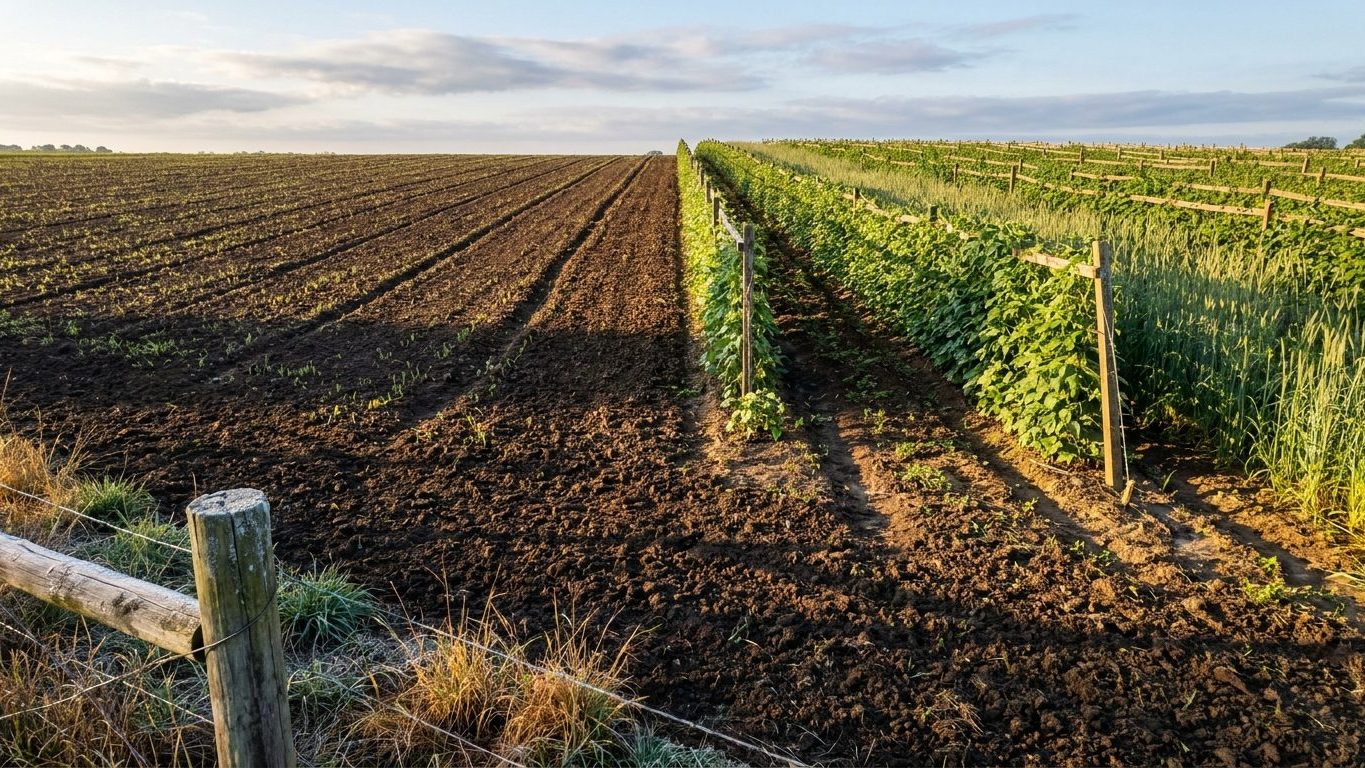

Cover crops in western Washington go in the ground between late August and mid-October for fall-sown species, timed to establish before the first fall frost, November 13 to November 30. Spring-sown covers wait far longer than the frost date suggests, because cold, saturated soil keeps growth stalled into April even after the last freeze has passed.
The short answer for Washington
Western Washington’s frost data comes from a single mild, maritime station, and it tells a specific story: winters rarely dip hard, but soil stays cold and wet long after the calendar says spring has started. The last spring frost here falls somewhere between February 27 and March 18, and the first fall frost lands between November 13 and November 30. Those are 30-70% probability windows, not guarantees, drawn from 1991-2020 NOAA normals at the Seattle-area station. Half the years in that dataset, frost shows up outside that band entirely.
For a fall cover crop, work backward from the November window. Cereal rye, crimson clover, and hairy vetch need roughly six to eight weeks of top growth before frost slows them down, which puts the practical sowing target at late August through the first half of October for most of the lowland Puget Sound corridor. Wait past mid-October and you’re asking a cover crop to establish roots in shortening daylight and cooling soil, a combination that produces thin, patchy stands rather than the thick mat you want holding soil through winter rain.
Spring sowing is where this territory diverges from what a frost-date chart implies. The last-frost window closing in early-to-mid March does not mean soil is ready. Western Washington’s clay-heavy, poorly-drained lowland soils sit at 40°F or colder well into April in a wet year, and spring-sown covers like oats or field peas planted into that cold mud germinate unevenly at best, rot at worst. Growers who watch actual soil conditions rather than the frost date typically hold spring sowing until mid-to-late April, sometimes into early May at higher, wetter sites.
The coldest month here runs a mean daily minimum of 37.1°F, which is mild by national standards. That number matters less for killing plants than for what it implies about the whole season: temperatures rarely crash hard, but they also rarely warm up fast. A cover crop chosen for this territory needs to tolerate slow, cool starts in both directions of the calendar, not survive deep freezes.
What will not work here
Warm-season, fast-germinating covers are the first casualty of this climate. Buckwheat and cowpea are popular cover crops precisely because they establish in days under warm soil, but western Washington rarely delivers the soil temperatures they need until late spring at the earliest. Sow buckwheat in April here on the strength of the last-frost date and you’ll get spotty germination, slow growth, and a crop that never builds the canopy it’s known for. These species belong later in the season, once soil has actually warmed, not once the frost risk has technically passed.
The opposite failure shows up in fall. Legumes like crimson clover need real establishment time before growth slows, and sowing them in late October, chasing the tail end of that first-frost window, sets them up to enter winter as seedlings rather than as an established stand. An underdeveloped legume cover doesn’t fix meaningful nitrogen and doesn’t survive a wet winter as well as a fuller stand would. The fix isn’t a hardier variety; it’s respecting the six-to-eight-week establishment window before frost risk climbs, which means sowing in September, not waiting for a fall frost date that only tells you when growth stops, not when you should have started.
Wet-season rot is the third and most territory-specific failure. A coldest-month minimum of 37.1°F means the ground rarely freezes hard enough to slow fungal activity, and the Puget Sound lowlands see sustained rain from November through March. Cover crops with dense, low-lying growth habits or those planted at tight spacing in heavy soil are prone to gray mold and root rot through that stretch. This isn’t a heat-and-drought failure mode like you’d see east of the Cascades or in the interior West; it’s a cool, wet, low-light failure mode, and the species list that works in a dry continental climate is not the species list that survives a Puget Sound winter.
Finally, treating this frost data as statewide is its own failure. These numbers come from one maritime station. East of the Cascades, Washington turns into high desert with a dramatically shorter, hotter, drier growing season, and a cover crop calendar built on Seattle’s numbers would be actively wrong there.
What changes across Washington
Washington spans USDA hardiness zones 4a to 9a, a five-zone range within one state’s borders, built on average annual extreme minimum temperature. That spread is enormous. Zone 9a, found in the mildest parts of the west side, allows some cover crop species to overwinter with minimal dieback. Zone 4a, found in the coldest interior and mountain areas, sees winter extremes cold enough to kill the same species outright, regardless of what a fall sowing calendar built on Seattle data would suggest.
This is not a state with one growing season. The maritime lowlands west of the Cascades, where the frost data above was collected, behave nothing like the Columbia Basin’s high desert or the mountain valleys of the northeast corner. A reader gardening in Spokane or Yakima is working with a shorter, more extreme-temperature season than the Puget Sound numbers describe, even though both places share a state name and this page’s title.
Elevation compounds the zone spread inside even a single region. Two gardens forty miles apart in western Washington, one at sea level near the Sound and one a thousand feet up in the foothills, can differ by a full hardiness zone. The higher garden sees frost earlier in fall, later in spring, and colder lows through winter, which shortens the practical fall-sowing window and pushes spring sowing even later than the mid-to-late April target that works in the lowlands.
None of this means a reader should guess. The right move is checking the USDA Plant Hardiness Zone Map for the specific address in question, not estimating from a regional reputation. A five-zone range packed into one state means “Washington” alone answers almost nothing about frost risk at a particular property; the map narrows it down, this page cannot.
Where to check this for your own county
This page describes western Washington’s maritime lowlands using data from one reference station. It does not, and cannot, describe conditions in every county, and it says so plainly: a county-level recommendation from a land-grant extension office will always beat a state-level frost-date summary like this one.
Washington State University’s extension service is the right next stop. Look specifically for two things once there: a county-level planting calendar, which will reflect local frost data rather than a single statewide station, and any cover crop variety trials run in that county, which tell you what’s actually performed well in local soil rather than what performs well in theory.
County extension offices tend to publish or link to trial results for cover crop species suited to specific soil types, drainage conditions, and microclimates, information this page has no way to capture at a territory-wide level. If a county office lists a cereal rye variety or a clover cultivar that’s done well in regional trials, that recommendation carries more weight than a general species suggestion, because it’s been tested against the same rainfall pattern and soil chemistry a local reader is actually working with.
Extension offices also track pest and disease pressure specific to a county, which matters more in a wet maritime climate than in most parts of the country. A cover crop that resists gray mold in one county’s trial conditions might behave differently in a neighboring county with heavier clay or higher rainfall totals. That level of granularity is exactly what a statewide page cannot provide and a county office can.
Checking this against your own garden
Every date on this page is a probability drawn from decades of averaged weather data. A reader’s own soil, checked by hand, will always be a more current and more local source of truth than any calendar.
Soil temperature by feel is the first and most useful check. Cold, clammy soil that sticks to a trowel in a heavy clump signals it’s still too cold for spring-sown covers to germinate evenly, regardless of what the last-frost window suggests. Soil that crumbles and feels merely cool, not cold, is a better sign that spring sowing will actually take.
Weed germination is the second signal, and it’s free information most gardeners already have. Once common cool-season weeds start pushing up on their own in a bed, it’s a rough proxy for soil having warmed enough for a spring cover crop to compete rather than sit dormant while weeds get ahead of it.
Fall cover crop timing has its own tell: watch how quickly a seeded patch shows the first true leaves rather than just the initial cotyledons. A fast move to true leaves within a week or two of sowing means the season still has enough warmth and light left for real establishment before frost. A slow, stalled seedling stage is a sign the sowing window has effectively already closed for that fall, even if the calendar date hasn’t arrived yet.