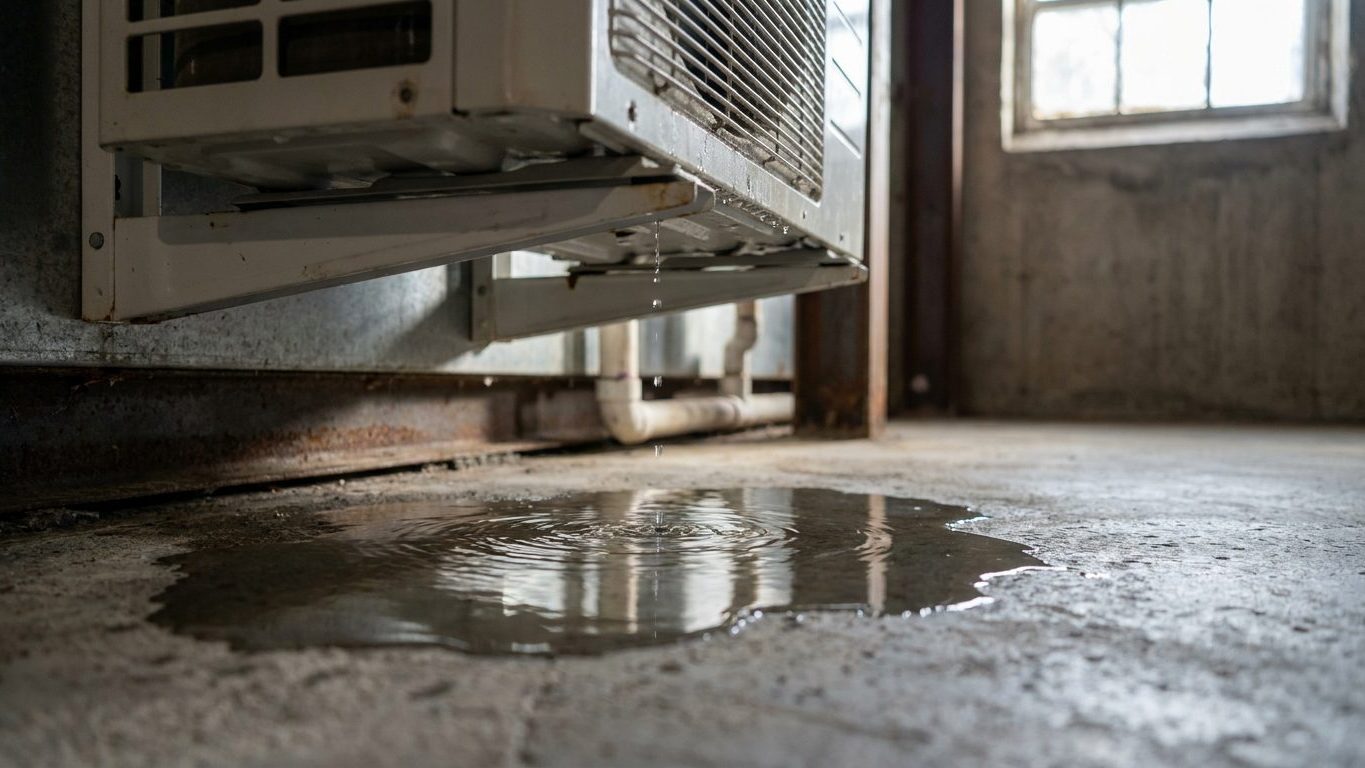

Water pooling near the indoor unit, or a system that just shut itself off, almost always traces back to one part: the condensate drain. When it clogs, the pan fills, the float switch trips (or should), and the air conditioner stops cooling rather than let that water go anywhere it shouldn’t. Clearing the blockage, not the symptom, is the fix.
The water is supposed to be there

A central air conditioner pulls moisture out of your house the same way a cold glass of iced tea sweats on a humid afternoon. On a sticky July day, a typical residential system can condense several gallons off the coil without anyone noticing, because all of that water is supposed to leave the house quietly through a dedicated path. The problem is never that water shows up. The problem is that it stopped leaving by the route built for it.
That route has a short list of parts, and knowing them makes the rest of this easier to picture. Warm, humid air moves across the cold Evaporator coil inside the indoor unit. The moisture that condenses out drips into a shallow drain pan sitting underneath the coil. From there it runs into a trap (a small U-shaped bend that holds a bit of water to block air from being pulled backward through the line), then down a length of PVC or similar tubing. In most setups gravity carries it outside to a drain, a stack pipe, or simply daylight at an exterior wall. When gravity isn’t available, a small condensate pump lifts the water up and over to wherever it needs to go.
Every piece in that chain is passive except the pump. There’s no filter, no screen, nothing designed to be serviced on a schedule the way an air filter is. That’s exactly why it’s easy to forget about until the day it backs up.
Once you can see that path in your head, coil to pan to trap to line to drain, the whole troubleshooting exercise is really just walking that path looking for the one point where the water stopped moving.
Why it blocks, and why in July
The condensate itself is the raw material for the blockage. It’s dark, it’s damp for weeks at a stretch, and it carries a little organic dust and debris off the coil every time the system runs. That combination, moisture plus nutrients plus darkness, is close to ideal for biological growth, and a thin film building up along the inside of a drain line behaves the way a shower drain does: it doesn’t stop water on day one, it narrows the opening a little more each week until one day it doesn’t.
That’s the mechanic behind the seasonal pattern homeowners notice. Systems rarely clog in the first cool week of the season. They clog in the thick of summer, after the air conditioner has been running for hours a day for a month or more, because that’s how long it takes for a thin coating to grow into an actual plug. A system that gets light, occasional use in spring might sail through June without trouble and then back up the first week it’s asked to run all day, every day.
The second cause: a dry or missing trap
Growth inside the line isn’t the only failure mode. The trap near the drain pan is supposed to hold a small standing column of water at all times, and that column is what keeps the blower’s air pressure from pulling outside air backward through the drain. If a system sits idle for a while, that water can evaporate out of the trap. Once it’s dry, the blower can pull air through the line instead of letting water drain by gravity, and condensate backs up into the pan rather than flowing out.
Some installations skip the trap entirely, which causes the same problem from day one rather than after a dry spell. Either way, the fix isn’t chemical, it’s mechanical: restore the trap’s function so the line behaves the way it was designed to.
Knowing which of these two you’re dealing with matters less than it might seem, because the first steps for clearing a drain are the same regardless of the cause.
Clearing it
Before touching anything, switch the system off at the thermostat and, if you’re comfortable doing so, at the disconnect near the Outdoor Unit. Don’t open The Outdoor Unit‘s electrical panel to poke around inside it. A capacitor in there holds an electrical charge even after the power is off, and there’s no safe shortcut, tool, or trick worth using to check it yourself. Leave that part alone and stay outside the cabinet.
- Find the access point. Most drain lines have a T-shaped fitting with a removable cap somewhere along the run, often near where the line exits the indoor unit or passes through a wall. That’s your entry point.
- Clear standing water from the pan first. If the drain pan under the indoor unit is holding water, remove what you can with a wet-dry vacuum or a turkey baster before going further, so you’re working with a clean starting point.
- Apply gentle suction at the outdoor end. A wet-dry vacuum fitted snugly over the end of the line where it exits the house can pull a clog toward the outside, where it belongs.
- Flush the line through the access opening. Once suction has loosened things, water poured in through the access tee, moving in the same direction the condensate normally flows, helps clear whatever’s left and confirms the line is running freely again.
The direction matters more than the method. Pressure applied from the wrong end, blowing air or water back toward the coil, can push a clog further into the line instead of out of it, and it tends to return sooner and worse than before. Gentle, outward-directed suction is the safer default; if you’re not sure which end is which, trace the line visually before doing anything.
If the system has a float switch (a small safety device that shuts the unit down when the pan holds too much water), and it has tripped, resist the urge to bypass, tape over, or wire around it. Clear the actual blockage first, let the water level in the pan drop on its own, and the switch will reset itself once conditions are normal again. That switch exists for one reason: to stop a slow drain problem from turning into a ruined ceiling below the unit. Overriding it removes the one thing standing between a clogged line and real water damage.
One more note on cause and effect: if you’ve cleared the drain and the system still isn’t cooling well, that’s a different problem, not a drain problem. Refrigerant isn’t a consumable that gets “used up” over time. If a system is genuinely low on it, that means there’s a leak somewhere in the sealed system, and that’s a job for a technician, not something to chase down with drain-clearing tools.
Keeping it clear
The cheapest fix for a clogged condensate drain is never letting it get bad enough to notice. That means treating the drain the same way you treat the filter: on a schedule, not when something goes wrong.
A quick check at the start of each cooling season costs a few minutes and catches most problems before they start. Confirm the trap has water in it, that the drain line isn’t dripping somewhere it shouldn’t, and that the outdoor end of the line isn’t blocked by grass, mulch, or debris that built up over winter. That single seasonal look handles the “dry trap” failure mode almost entirely.
The pan deserves a glance every time you’re already at the unit for something else, most naturally when you change the filter. If you see standing water, a film of growth, or debris sitting in the pan, that’s the early warning sign of a slow clog, and it’s far easier to clear at that stage than after it’s shut the system down.
The filter itself is the upstream half of this. A filter that’s clogged or torn lets dust bypass it and land directly on the wet evaporator coil, where it mixes with condensate and feeds exactly the kind of buildup that clogs a drain line. ENERGY STAR’s guidance is direct on how often to check: “Inspect, clean, or change air filters once a month in your central air conditioner, furnace, and/or heat pump.” That’s a monthly check across all three types of equipment, not a seasonal one, and it’s one of the few maintenance habits that pays off in both drain health and cooling performance at the same time.
If your system relies on a condensate pump because gravity drainage isn’t available, treat it as a wear item worth keeping an eye on. It’s a small motor, and small motors fail eventually, often without much warning, and usually while sitting close to electrical connections. A pump that’s gone silent or is running constantly without moving water is worth investigating promptly rather than waiting to see if it sorts itself out.
Common questions
Can I use bleach or vinegar to clear a condensate drain?
Many homeowners pour something down the line periodically, but the safest general approach is mechanical: clearing standing water, applying gentle suction from the outdoor end, and flushing the line. Whatever you choose to use, avoid anything that could damage PVC fittings or metal components, and never force liquid or air back toward the coil.
Why does my AC only leak water in the summer?
Because the blockage builds gradually. Growth inside a drain line takes weeks of steady, humid runtime to narrow the passage enough to stop water. A system barely used in spring often clogs only after it’s been running long, hot days for a while, which is why midsummer is when most drain problems surface.
Is it safe to bypass a tripped float switch to keep the AC running?
No. The float switch shuts the system down specifically to prevent an overflowing pan from damaging the ceiling or floor beneath the indoor unit. Clear the blockage causing the water buildup and let the switch reset on its own once the pan drains; don’t tape, wedge, or wire around it.
My drain is clear but the AC still isn’t cooling well. What’s going on?
That points away from the condensate system entirely. A properly draining unit that still underperforms may be dealing with an airflow issue, a dirty coil, or a refrigerant leak, since refrigerant doesn’t get used up over time; if a system is low, something is leaking. That diagnosis calls for a technician rather than more drain maintenance.