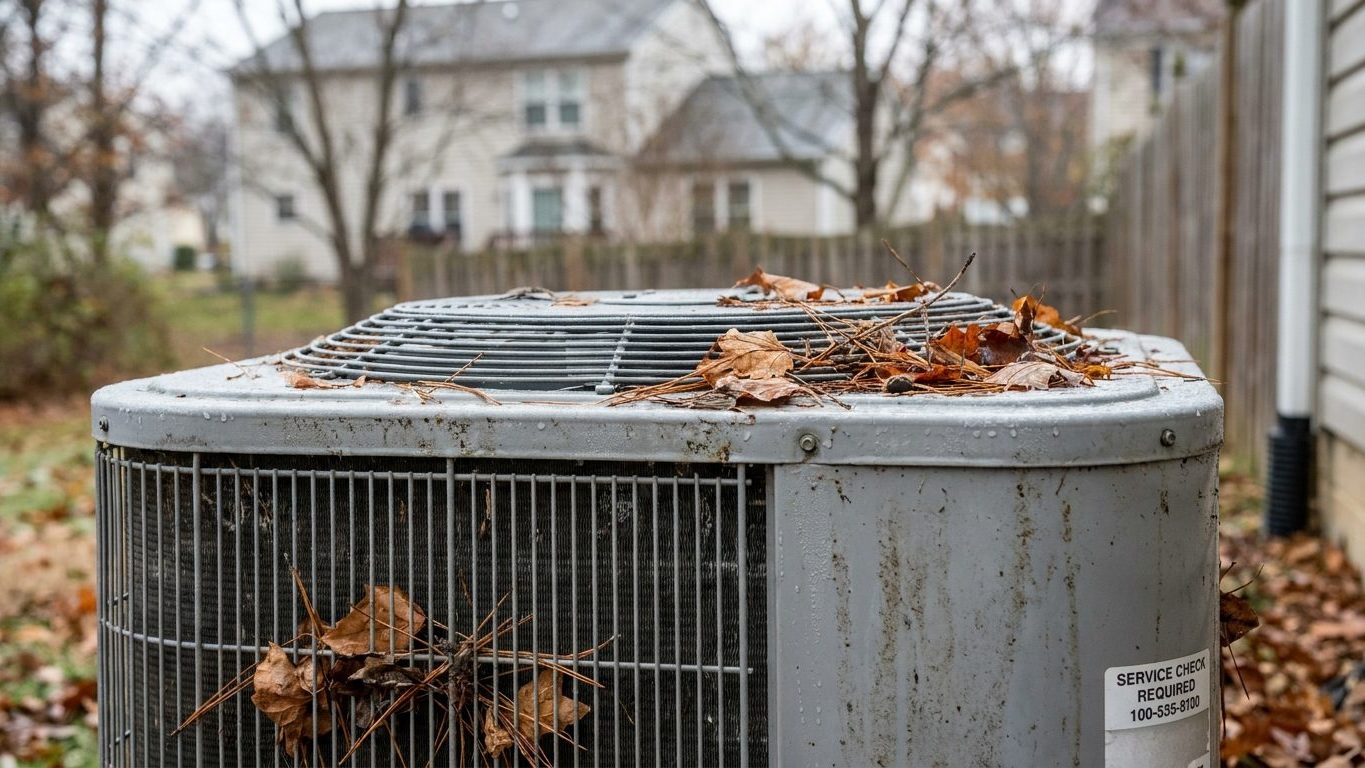

An outdoor condenser is designed to sit outside, exposed to rain, snow, and freezing temperatures, for its entire working life. It does not need a winter cover to survive the cold, and a tight waterproof wrap can actually cause more trouble than the weather ever would. The only real job worth doing in autumn is keeping debris out of the top grille, and knowing whether the unit is a heat pump before you touch anything.
Does it need covering at all
The honest answer is no, not for protection from the elements. The cabinet, the coil, and the compressor inside it are built and tested to sit outdoors through every season a given climate throws at them. Manufacturers do not design these units with the expectation that someone will wrap them each October. Cold air, rain, frost, even a foot of snow sitting on top of the cabinet during a storm, none of that threatens the equipment the way a full-coverage tarp marketed as a “winter cover” can.
Where a cover earns its keep is much narrower than the marketing suggests. Leaves, seed pods, pine needles, and the occasional tennis ball from next door all want to settle into the top of the cabinet over autumn and winter. Once they’re in there, they hold moisture against the coil fins and can block the airflow path the unit needs on the first warm day of spring. That’s a legitimate, if modest, problem. It’s also the entire case for covering anything at all.
What a cover is actually being sold to prevent
Most retail covers are marketed on cold and rain protection, the two things the unit needs least protection from. The debris problem, the one thing a cover can genuinely help with, is usually mentioned as an afterthought if it’s mentioned at all. That mismatch between the marketing claim and the actual risk is worth sitting with for a second, because it’s also what leads people toward the wrong kind of cover.
A homeowner who believes the unit needs shielding from winter weather reaches for the same kind of full, fitted, waterproof wrap you’d use on a grill or a boat. That instinct is understandable. It’s also the choice that causes the damage described next.
The cover that does damage
A full, close-fitting waterproof cover, the kind that wraps the entire cabinet down to the base pad, creates two problems that a bare unit never has. Neither one shows up in October. Both show up months later, when they’re harder to trace back to the cover.
The first is corrosion. Outdoor units are designed to dry out after rain, snow melt, or morning dew, because air moves freely around the cabinet. Wrap that cabinet in plastic or vinyl and any moisture that gets underneath, from condensation, a gap in the seal, or humidity trapped at installation, has nowhere to go. It sits against bare or lightly coated metal for weeks at a time. That’s a slower process than a flood, but it’s a steadier one, and it’s happening on parts you can’t see until the cover comes off.
The second problem is worse: shelter. A dry, dark, enclosed cabinet that nothing disturbs for four or five months is an excellent place for a mouse or a small rodent to spend the winter. Outdoor units are full of insulated wiring, control boards, and low-voltage connections, all of which look a lot like food to something that needs to gnaw to keep its teeth in check. Homeowners who pull a full cover off in April often find chewed wiring, nesting material packed into the cabinet, or both. That’s a repair bill that traces directly back to a cover that was supposed to help.
What avoids both problems
A top-only cover, one that shields just the grille and the coil from falling debris while leaving the sides and base open to air, avoids the moisture trap entirely. So does a simple flat board, plywood or similar, laid across the top and weighted down so wind can’t shift it. Both let air keep moving through the cabinet the way the manufacturer designed it to. Neither gives anything a dry, enclosed space to nest in.
| Type of cover | What it prevents | What it causes |
|---|---|---|
| Full waterproof wrap, base to top | Nothing the unit needed protection from | Trapped moisture, corrosion risk, rodent shelter |
| Top-only cover or flat board | Leaves, seeds, and debris in the grille | None, if it doesn’t block the sides |
| No cover at all | Nothing extra | Occasional debris in the top over winter |
If it is a heat pump, cover nothing
Everything above applies to a straightforward cooling-only condenser, the kind that sits idle from the last cool day of fall until the first hot day of the following year. A heat pump is a different machine wearing the same box, and it changes the answer completely. A heat pump runs in winter. It’s pulling heat out of outdoor air, even cold outdoor air, and moving it inside, which means the outdoor unit is cycling on and off through the coldest months, not sitting dormant.
Covering a running heat pump, or building a wooden enclosure around it for “protection,” blocks the airflow it needs to operate and interferes directly with its defrost cycle. That cycle periodically melts frost off the outdoor coil so the unit keeps working efficiently; anything that restricts airflow around the cabinet makes that cycle less effective and forces the system to work harder for less output. This is precisely the mistake a cover encourages, because the cover looks like it’s protecting the equipment while it’s actually starving it.
Telling the two apart from the yard
The cabinets are often identical from the outside, same size, same shape, same fan grille on top, which is exactly why this gets its own section. The way to tell them apart takes one observation, not a manual: go outside when the heat is running indoors on a cold day. If the outdoor unit’s fan is turning and the cabinet is warm to the touch or has visible steam rising off it during a defrost, it’s a heat pump, and it needs to stay uncovered and unobstructed all winter. If the outdoor unit sits completely silent all winter and only runs when the air conditioning is on in summer, it’s a cooling-only condenser, and the debris-only cover approach above applies. For more detail on how these systems behave through a heating season, the heat pump guides elsewhere on this site cover defrost cycles and winter operation in depth.
The autumn pass that actually helps
Skip the cover debate for cooling-only equipment and do this instead, once in early fall.
- Cut power at the outdoor disconnect, if the unit is a cooling-only condenser that won’t run again until spring.
- Clear leaves, needles, and seed pods from around the cabinet and out of the top grille by hand or with a soft brush, not a pressure washer.
- Trim back anything that grew into the unit’s clearance over summer, vines, shrubs, tall grass, so air can move freely around all sides.
- Check that the pad underneath hasn’t settled or tilted, since a unit sitting at an angle sheds water unevenly and stresses the connections over time.
- Cover the top only, with a fitted top piece or a weighted board, if the location genuinely drops debris onto the unit each fall.
The electrical compartment stays closed the entire time, for one plain reason: a run capacitor inside holds an electrical charge even after power is cut, and that’s not something to test, probe, or work around as a DIY step. Leave that compartment to a licensed technician.
Come spring, restore power at the disconnect several hours before the first time you plan to run the system, not the same morning. Many outdoor units have a crankcase heater that needs that lead time to warm the compressor oil properly before the compressor starts. Skipping that wait is a common way people accidentally strain a compressor on the season’s first hot day.
One more distinction worth carrying into next season: refrigerant is not a consumable that runs low with normal use. If a technician ever tells you the system is “a little low” and tops it off, that’s a system with a leak somewhere in the line, and refilling without finding that leak means paying for the same fix again later.
Common questions
Should I cover my central AC unit for the winter?
Only if debris regularly falls onto it, and only with a top-only cover or a weighted flat board. A full wraparound cover traps moisture and gives rodents a place to nest, which causes more damage than leaving the unit uncovered.
Can covering the unit damage it?
Yes, a full waterproof cover that seals the cabinet can trap moisture against the metal and create a dry, sheltered space that attracts rodents looking to nest near the wiring inside.
Is it different for a heat pump?
Very different. A heat pump runs through the winter to heat the home, so covering it or boxing it in blocks the airflow it needs and disrupts its defrost cycle. Heat pumps should stay fully uncovered and unobstructed all winter.
Do I need to turn off power to the outdoor unit for winter?
For a cooling-only condenser that won’t run again until spring, cutting power at the outdoor disconnect is a reasonable step. A heat pump should stay powered, since it continues operating through the heating season.