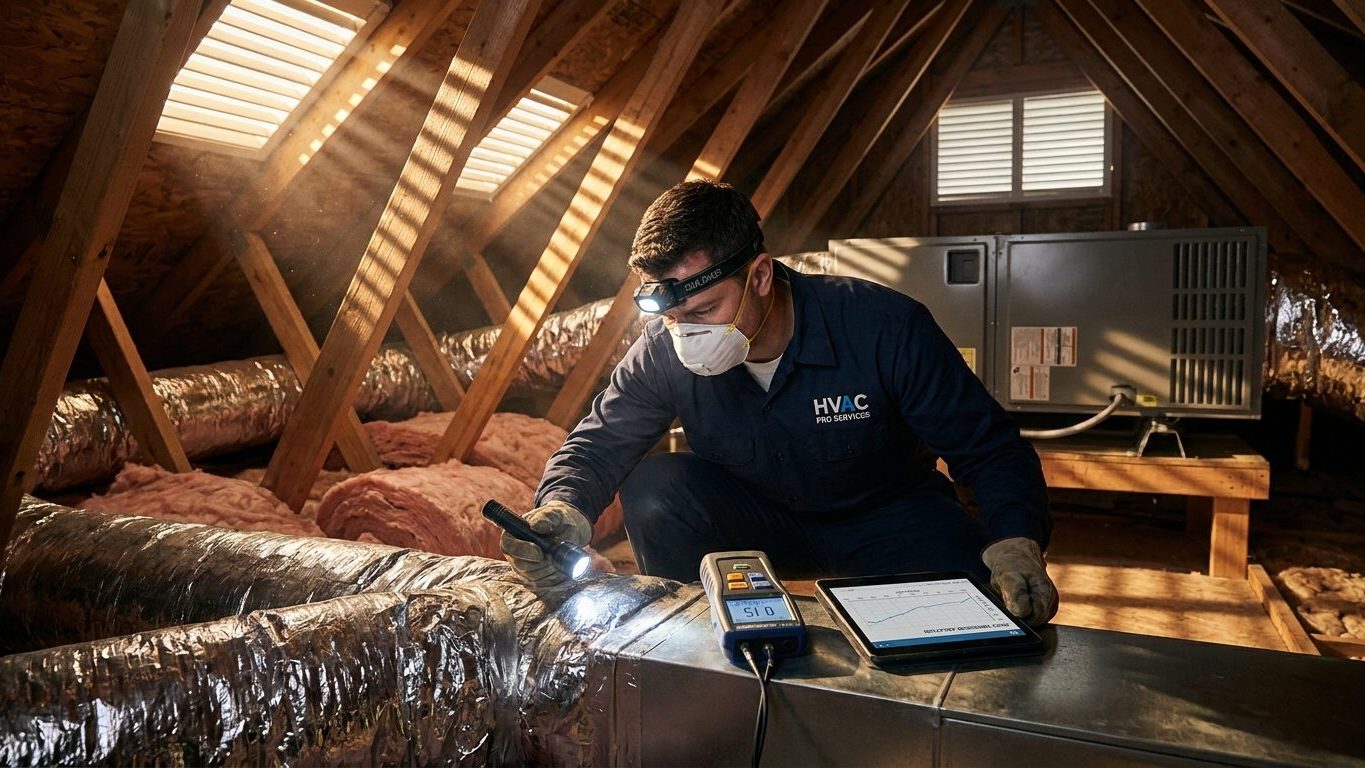

SEER2 measures how much cooling a system delivers per unit of electricity, under a standardized lab test that accounts for the resistance of real ductwork. It does not measure heating output, humidity control, installation quality, or how the system performs once it’s sitting in your attic instead of a test rig. Those gaps are where most comfort complaints start.
What SEER2 Measures, and What It Does Not
The SEER2 rating comes from a controlled test that runs a system through a cooling season simulation while measuring the electricity it consumes against the cooling it produces, expressed as a ratio. The “2” version of the test, which replaced the older SEER standard, added external static pressure to the setup, meaning the lab now accounts for the effort a system spends pushing air through ducts rather than testing the equipment in a frictionless vacuum. That’s a meaningful correction, because a compressor and blower don’t work in isolation, they work against whatever resistance the ductwork puts up.
What the number does not capture is just as important. SEER2 says nothing about heating performance, that’s a separate metric called HSPF2, and the two are not interchangeable. A reader comparing two heat pumps needs to line up the same letter: cooling efficiency against cooling efficiency, heating efficiency against heating efficiency. Mixing them produces a comparison that looks informed but isn’t.
The test also can’t know anything about your specific ducts, your attic temperature, your home’s air sealing, or whether the system was sized correctly for the square footage it serves. The rating is a laboratory measurement of the equipment, not a forecast of your utility bill.
Where the ENERGY STAR minimums reveal the mechanism
U.S. ENERGY STAR sets different minimums depending on how a heat pump is configured, and the differences tell you something concrete about how ductwork affects the outcome:
| Configuration | Minimum HSPF2 | Minimum SEER2 |
|---|---|---|
| Split system, non-ducted | 8.5 | 15.2 |
| Split system, ducted | 8.1 | 15.2 |
| Single-package equipment | 8.1 | 15.2 |
Notice that the non-ducted system has to hit a higher heating number (8.5 versus 8.1) to earn the same label. A ductless system skips duct losses entirely, so it starts with a structural advantage, and ENERGY STAR asks it to do more with that advantage rather than letting it coast to the badge on a technicality. It’s a small detail in a spec sheet, but it’s a direct admission from the standard itself: ducts cost efficiency, and the rating system was built around that fact (source: U.S. ENERGY STAR, Air-Source Heat Pumps Key Product Criteria).
How to tell, in your own house
A rating on a spec sheet doesn’t tell you whether your system is actually delivering anything close to that number today. The checks below go from things that cost nothing to things that require a licensed technician, and the order matters: do the free ones first, because they catch the most common problems before you pay anyone to look for something more obscure.
- Check the filter. A clogged filter restricts airflow at the source, which forces the blower to work harder and can make even a high-rated system perform like a cheap one. This takes two minutes and costs nothing.
- Walk the outdoor unit. Look for grass, leaves, mulch, or shrubs crowding the coil. Airflow blocked on the condenser side drags down performance the same way a blocked filter does indoors.
- Check every supply and return vent. Furniture pushed against a return, or a supply register closed to “save energy” in an unused room, changes the pressure balance the whole system was designed around.
- Look at accessible ductwork. In an attic, basement, or crawlspace, scan visible duct runs for disconnected joints, crushed flex duct, or insulation that’s fallen away from the metal. This is a visual check, not a repair.
- Track your utility bills against outdoor temperature. A system that used to hold steady and now spikes on similar weather is telling you something changed, even if you can’t see it.
- Call a professional for a static pressure or duct leakage test. This is the point where homeowner work ends. Measuring actual airflow and duct leakage requires a manometer, a duct blaster, and training to interpret the readings correctly. It’s also where you’ll find out if the ducts themselves are undersized or leaking in ways no visual inspection would catch.
The boundary is specific: anything involving refrigerant charge, opening sealed refrigerant lines, or calibrated duct testing equipment is off-limits for DIY, both because it requires EPA-certified handling and because the readings only mean something when taken with equipment that’s been calibrated and interpreted by someone trained to do it. Checking a filter is homeowner work. Measuring static pressure is not.
What it costs you to ignore it
None of this shows up instantly. A system fighting restricted airflow, whether from a dirty filter, blocked vents, or leaky ducts, doesn’t stop working, it just works longer and harder to reach the same setpoint. That extra runtime is the whole mechanism of the cost: more electricity consumed per degree of comfort delivered, more hours the compressor spends cycling, more mechanical wear accumulated over a season than the equipment was designed to absorb.
Comfort degrades in a specific way, too. Airflow restrictions tend to show up first as uneven temperatures between rooms and poor humidity control, since a system straining against high static pressure often can’t run its full dehumidification cycle even while it’s technically cooling the air. That’s why a house can feel “cool but clammy” long before anyone notices the utility bill creeping up.
Ignored long enough, restricted airflow also shortens the life of the equipment itself. Components rated to run under specific pressure conditions age faster when they’re consistently pushed outside those conditions, the same way a car engine wears faster running at high RPM than idling in traffic. The rating on the spec sheet described a lab test. What actually happens in the house depends on whether the system ever gets the chance to run the way that test assumed it would.