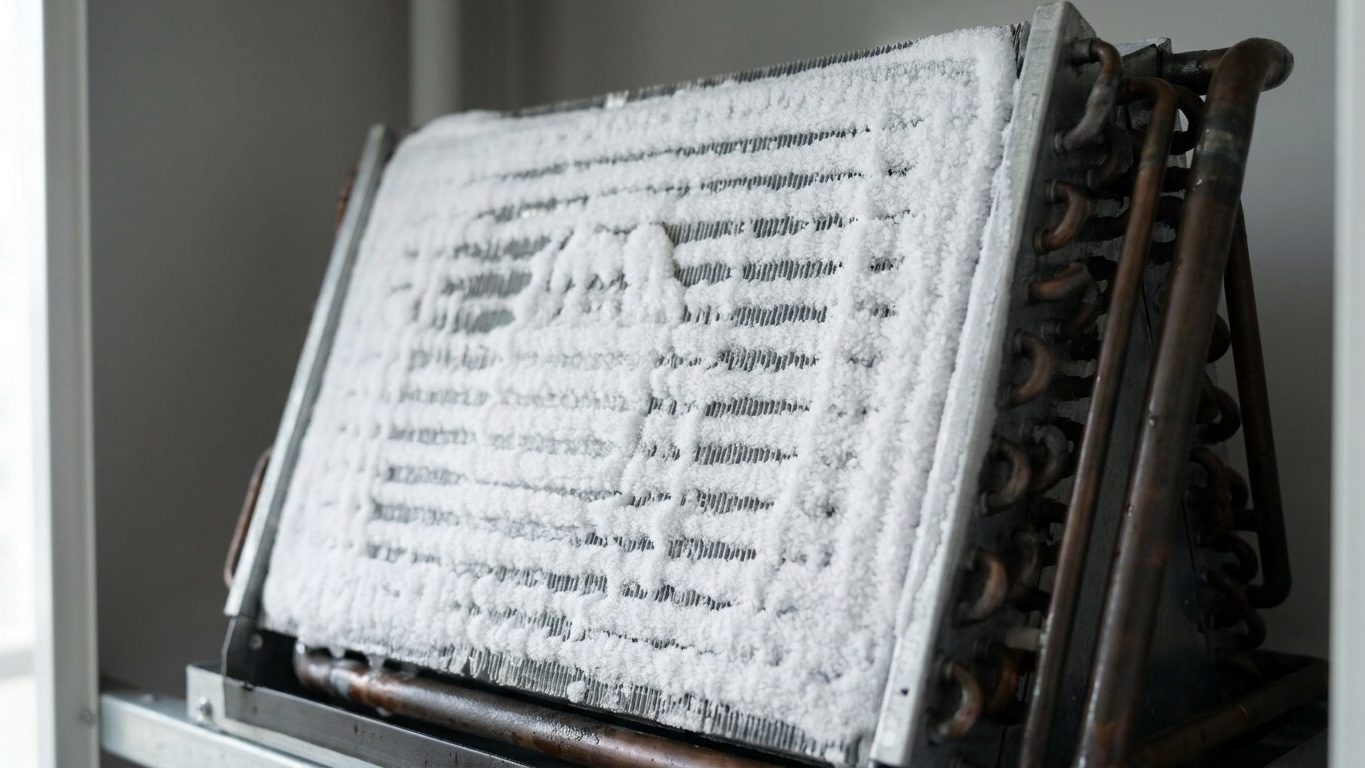

Your air conditioner freezes over because the Evaporator coil inside your indoor unit has dropped below 32°F, and instead of pulling moisture out of the air as liquid condensation, it’s turning that moisture directly into frost. The two usual culprits are weak airflow across the coil or a refrigerant charge that’s too low. Everything else is a variation on those two problems.
Why Your Air Conditioner Freezes Over
An air conditioner works by pushing warm indoor air across a coil filled with cold refrigerant. That coil needs a steady volume of air moving past it to stay above freezing. Refrigerant inside the coil typically runs somewhere in the 40s Fahrenheit, cold enough to pull heat and humidity out of the air but not cold enough to freeze anything, as long as enough warm air keeps flowing across it. Slow that airflow down, and the coil’s surface temperature drops. Once it dips below 32°F, moisture condensing on the coil doesn’t drip away as water anymore. It freezes in place, layer after layer, until the coil is wrapped in ice.
Airflow restriction is the more common trigger, and it’s often something small. A clogged filter is the classic example. The U.S. ENERGY STAR program notes that “airflow problems can reduce your system’s efficiency by up to 15 percent.” That’s a system that looks fine, runs, and cools the house on paper, but is already starving the coil of the air it needs. Push that restriction further, whether from a filthy filter, closed vents, a collapsed duct, or a blower motor that’s lost some of its punch, and you’re no longer just losing efficiency. You’re setting up the exact conditions for ice.
Low refrigerant works differently but lands in the same place. Refrigerant should circulate through the system as a sealed loop. If it’s leaking, whatever’s left inside the coil has to expand more to do the same job, and that expansion drops its temperature well below the normal 40s range. Now the coil is cold enough to freeze moisture even with completely normal airflow moving across it. This is the split that matters for diagnosis: airflow problems build ice gradually as a system runs, while a refrigerant leak can produce frost even on a unit that’s just started its cycle for the day.
Outdoor temperature plays a role too. Running a central air system when it’s cooler outside, say in the evening or during a mild spring day, doesn’t push it hard enough to keep proper airflow balance, and that alone can be enough to tip a marginal system into freezing. It’s rarely just one factor. Usually a system with a slightly dirty filter runs on a cool night, and it’s the combination that finally forms ice where a healthier setup would have shrugged it off.
How to tell, in your own house
You don’t need special tools for the first few checks. What you’re doing is narrowing down whether this is an airflow problem you can fix tonight or a refrigerant problem that needs a licensed technician. Work through these in order, because the cheapest fixes rule out the most common causes first.
- Turn the system off completely and let the ice melt. Running it while frozen just adds strain. Give it a few hours, or overnight if the ice buildup is heavy, with the fan off, not just the compressor.
- Pull the air filter and hold it up to a light. If you can’t see light through it, it’s restricting airflow enough to matter. Replace it. This single step resolves a surprising share of freeze-ups, because it directly addresses the efficiency loss ENERGY STAR points to.
- Walk the house and check every supply and return vent. Furniture pushed in front of a return, a vent closed off in an unused room, a rug covering a floor register, all of these cut the air volume reaching the coil.
- Look at the return air duct and the blower compartment for anything obviously collapsed, disconnected, or blocked with debris. You’re looking for something visibly wrong, not diagnosing duct sizing.
- Once the system is thawed, run it and listen to the indoor blower. A motor that sounds weak, labored, or noticeably quieter than usual may not be moving enough air even with a clean filter and open vents.
That’s where homeowner work ends. If the filter is clean, the vents are open, the ducts look intact, and the system still freezes within a few hours of running, the problem is very likely refrigerant level, and that’s not a DIY repair. Refrigerant is a regulated substance under federal law, and handling it, whether recovering it, adding it, or testing the charge with gauges connected to a sealed system, requires EPA certification. Beyond the legal issue, refrigerant systems are pressurized, and a low charge almost always means there’s a leak somewhere in the lines or coil that needs to be located and sealed before anything is added back. Guessing at that without proper equipment usually makes the leak worse or damages the compressor.
What it costs you to ignore it
A system that keeps freezing and gets switched back on before it’s fully thawed doesn’t just fail to cool the house. It runs its compressor against a partially frozen coil, forcing the motor to work harder to push refrigerant through a system that isn’t behaving the way it’s designed to. That extra strain is cumulative. Compressors are the most expensive component in a central air system, and they’re not built to run efficiently under repeated freeze-and-thaw cycles.
There’s also the water problem. Ice that melts has to go somewhere, and if it forms faster than the condensate drain can handle the runoff, water backs up past the drain pan and onto the floor, ceiling drywall below an attic unit, or the mechanical closet itself. That’s a slower, quieter kind of damage than a mechanical failure, but it’s often more expensive to repair once it’s soaked into flooring or framing.
Comfort erodes the whole time this is happening. A system fighting ice buildup is moving less air, so rooms farthest from the unit stop cooling evenly, humidity climbs indoors even as the thermostat claims the target temperature is met, and the unit runs longer to chase a setpoint it can’t actually reach. Every one of those symptoms points back to the same starting point: airflow or refrigerant, left unaddressed, until the system that was supposed to cool your house all summer spends its energy fighting itself instead.